
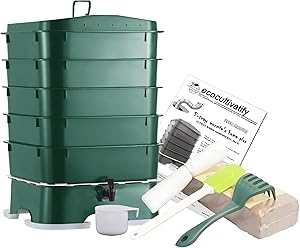
Worm farming sounds intimidating until you realize the worms do almost all the work. The real challenge is picking a bin that manages moisture properly, prevents escapes, and makes harvesting castings without sorting through thousands of worms bearable. Stack-style bins, flow-through designs, and simple single-tray systems all claim to be beginner-friendly, but they behave very differently once red wigglers are living inside them. We ran multiple worm bins for several months each to find out which ones are genuinely low-maintenance and which ones create more problems than they solve.
Quick Picks
Uncle Jim’s Worm Farm Composter (5-Tray)
- Stackable trays let worms self-migrate upward
- Spigot at base makes liquid fertilizer collection easy
- Expandable — add trays as population grows
Worm Factory 360 Worm Composting Bin
- Included thermometer and moisture gauge
- Wide base prevents tipping on uneven surfaces
- Comprehensive beginner guide included
Maze Worm Farm Composter
- Simple two-tray system is easy to start
- Legs elevate bin to fit a collection bucket beneath
- Affordable price point for first-time worm farmers
Why Trust Our Picks
We started each bin with an identical one-pound batch of red wigglers and identical bedding material, then fed them consistent weekly quantities of kitchen scraps over a four-month period. We tracked moisture levels, escape incidents, odor, and the ease of harvesting finished castings from each design. Our evaluation prioritized real beginner usability over theoretical capacity.
Individual Reviews
Uncle Jim’s Worm Farm Composter — Best Overall
The five-tray stacking design is the key to why this bin works so well for beginners: as lower trays fill with finished castings, worms naturally migrate upward toward fresh food in the upper trays, which means harvesting is as simple as removing the bottom tray — no hand-sorting required. The spigot at the base of the collection tray makes draining worm tea effortless and prevents the anaerobic pooling that causes most odor problems in worm bins. We had zero escape incidents over our full test period, which we credit to the tight-fitting tray lips and the mesh bottom that provides drainage without giving worms an exit route. The bin is expandable with additional trays as your worm population and composting volume grow.
- Pros: Self-harvesting stack system, spigot for worm tea, expandable, well-ventilated, escape-proof tray design
- Cons: Large footprint when fully stacked, relatively higher upfront cost
Worm Factory 360 — Runner-Up
The Worm Factory 360 earns its reputation as one of the most beginner-friendly systems on the market largely because of the extras it bundles in. The included thermometer and moisture guide take the guesswork out of two of the variables that kill worm bins — temperature and moisture balance — and the comprehensive getting-started booklet is genuinely useful rather than the usual pamphlet. The wider, lower profile base is noticeably more stable than taller stacking designs, which matters if you’re keeping the bin in a garage or on a deck where it could get bumped. Our worms were just as productive here as in the Uncle Jim’s bin, though the slightly different tray geometry made castings harvesting marginally more involved.
- Pros: Thermometer and moisture guide included, stable wide base, excellent beginner manual, expandable trays
- Cons: Similar price to best overall, slightly more complex harvest process
Maze Worm Farm Composter — Best Budget
The Maze bin strips vermicomposting down to its essential two-tray structure, and it does a solid job for anyone who wants to get started without a large initial investment. The legs that elevate the bin are a smart design touch — they create enough clearance to slide a standard bucket or tray beneath the spigot for worm tea collection without any improvised solutions. Moisture management requires slightly more attention than the more expensive stacking systems since there are fewer trays to buffer against wet or dry conditions. For apartment composters or people testing whether worm farming suits them before investing in a larger setup, it’s the right starting point.
- Pros: Very affordable, elevated legs for easy liquid collection, compact two-tray design, good starter kit
- Cons: Fewer trays means more frequent harvesting needed, less expandable than multi-tray systems
Urbalive Indoor Worm Farm — Also Great
If aesthetics matter and you want a worm bin that can sit in a living space without looking out of place, the Urbalive is in a category of its own. It’s designed in Europe and shows it — the rounded forms and neutral color options look like modern home decor rather than garden equipment. Functionally it uses the same flow-through tray principle as the other top picks, and moisture management was straightforward throughout our test. It costs more than functional competitors, but for apartment dwellers who need a bin in a visible location, the design premium is entirely justified.
- Pros: Genuinely attractive design, indoor-appropriate aesthetic, effective flow-through composting, good capacity
- Cons: Highest price of the group, less widely available, smaller community of users for troubleshooting help
Buyer’s Guide: Choosing a Worm Farm Bin
Tray design: Multi-tray stacking systems make harvesting far easier than single-bin designs because worms migrate upward naturally, leaving finished castings behind. If you can budget for a multi-tray system at the start, it will save significant hassle later compared to sorting worms from castings manually.
Moisture management: Too wet and your bin becomes anaerobic and smells; too dry and your worms stop eating and eventually die. Look for bins with drainage holes in tray bottoms, a collection reservoir below, and ventilation in the lid. A bin that handles moisture passively is far less work than one that requires constant monitoring.
Placement: Red wigglers thrive between 55°F and 77°F. Think carefully about where your bin will live year-round. Garages get too cold in winter in most climates; directly outdoors in full sun gets too hot in summer. A basement, pantry, or climate-controlled utility room is the ideal location for consistent year-round performance.
Frequently Asked Questions
Do worm bins smell bad?
A healthy worm bin should smell like fresh earth — not unpleasant at all. Odors develop when the bin is too wet, is being overfed, or contains foods worms shouldn’t have like meat, dairy, or citrus in large quantities. If your bin smells bad, add dry bedding material such as shredded newspaper and reduce feeding until the balance is restored.
How many worms do I need to start?
One pound of red wigglers (roughly 800–1,000 worms) is the standard starting amount for a small household. They will double in population approximately every 60–90 days given proper conditions, so you don’t need to start large — the worms will scale up to match your food waste output over time.
What should I not put in a worm bin?
Avoid meat, fish, dairy, oily foods, citrus in large amounts, onions, garlic, and anything heavily salted or spiced. These either attract pests, create odors, or have compounds that irritate worms. Stick to vegetable and fruit scraps, coffee grounds, tea bags, and cardboard or newspaper as bedding material for best results.
How do I use worm castings in my garden?
Worm castings are one of the most nutrient-dense soil amendments available. Mix them into potting soil at a ratio of about 20–30% castings, or work a few tablespoons into the planting hole for transplants. For established plants, top-dress with a thin layer around the root zone. You can also brew worm casting tea by steeping a cup of castings in a gallon of water for 24 hours and using it as a liquid fertilizer.
Final Verdict
The Uncle Jim’s Worm Farm 5-Tray Composter is the smartest investment for anyone serious about vermicomposting — the self-harvesting tray system and worm tea spigot remove the two biggest friction points for beginners. The Worm Factory 360 is the better choice if you want more guidance and monitoring tools included from the start, and the Maze Worm Farm is the right entry point for anyone not ready to commit to a larger setup.


