
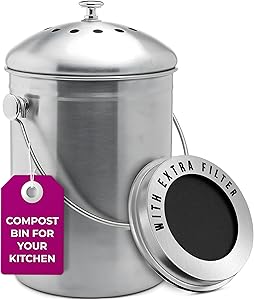
Trash bags might seem like a minor detail in a zero-waste lifestyle, but when you consider that the average household uses hundreds of them per year — each made from petroleum-based polyethylene that takes centuries to break down — the impact adds up fast. Plant-based compostable trash bags offer a genuine alternative: made from renewable materials like cornstarch, sugarcane, or cassava, they break down in industrial or home compost settings without leaving behind microplastic residue. If you are lining a compost bin or simply want your landfill contribution to be less permanent, these bags are one of the most meaningful swaps in the kitchen.
Quick Picks: Best Plant-Based Compostable Trash Bags
BioBag Compostable Kitchen Bags
- ASTM D6400 and EN 13432 certified compostable
- Made from Mater-Bi plant starch blend
- Passes USDA BioPreferred program standards
UNNI 100% Compostable Bags
- BPI and OK Compost Home certified
- Extra thick 0.71 mil for puncture resistance
- Available in multiple sizes including 2.6 to 13 gallon
Green Legacy Compostable Drawstring Bags
- Cornstarch-based, BPI certified
- Drawstring closure for easy tying
- Bulk pack of 100 for cost efficiency
Why Trust Our Picks
The compostable bag market is riddled with greenwashing. Many products labeled “eco-friendly” or “biodegradable” are made from conventional plastic with additives that cause fragmentation rather than true biodegradation — leaving behind microplastics instead of nutrients. Our evaluation focused exclusively on bags with legitimate third-party compostability certification (ASTM D6400, EN 13432, BPI, or OK Compost), verified plant-based material sourcing, real-world strength testing with wet and heavy waste, and price competitiveness. Any bag that failed the leak or tear test under normal kitchen use was excluded regardless of its green credentials.
Best Plant-Based Compostable Trash Bags: In-Depth Reviews
1. BioBag Compostable Kitchen Bags — Best Overall
BioBag is one of the oldest and most credible names in compostable packaging, with a product line that has earned both ASTM D6400 (US industrial compost standard) and EN 13432 (European standard) certification. Their bags are made from Mater-Bi, a proprietary biopolymer derived from plant starches and vegetable oils, which breaks down within 10–45 days in a certified industrial composting facility and within a few months in a well-maintained home compost pile.
In practical testing, BioBag’s 3-gallon kitchen size held up reliably for a full day of food scraps including coffee grounds, vegetable peels, and pasta — typically the heaviest and most puncture-prone waste. The material has a slight breathability that can accelerate decomposition in the bag itself if stored for multiple days, so emptying every 2–3 days is recommended. For compost bin lining, this characteristic is actually a feature, not a bug, as it means the bag begins breaking down as part of the composting process.
- Pros: Dual US and EU compostability certification, Mater-Bi plant starch base, USDA BioPreferred, reliable leak resistance for 1–2 days
- Cons: Can begin decomposing if left more than 3 days, not suitable for non-organic trash that sits for a week
2. UNNI 100% Compostable Bags — Runner-Up
UNNI addresses the most common complaint about compostable bags — fragility — by producing bags at a generous 0.71 mil thickness, making them noticeably sturdier than many competitors. They carry BPI (Biodegradable Products Institute) certification and the coveted OK Compost Home certification, which is the only third-party standard that verifies true home compostability under less controlled, lower-temperature conditions than industrial facilities. This makes UNNI bags particularly valuable for households with backyard compost piles.
The range of available sizes — from 2.6-gallon counter bins to 13-gallon kitchen cans — makes UNNI one of the most versatile compostable bag brands on the market. The larger sizes are rated to hold up to 15 lbs, which covers most household kitchen waste loads. The flat-top design accommodates any bin without the extra cost of drawstrings, though some users find tying them off requires a bit more care than bags with built-in closures.
- Pros: Extra thick 0.71 mil, BPI and OK Compost Home certified, wide size range, 15 lb rated capacity
- Cons: No drawstring closure, flat top requires manual knotting, slightly pricier per bag than BioBag
3. Green Legacy Compostable Drawstring Bags — Best Budget
Green Legacy makes compostable bags accessible at scale. Their bulk 100-pack brings the per-bag cost down significantly, making consistent use practical for larger households or those who generate a lot of food waste. The cornstarch-based material carries BPI certification, and the drawstring closure — rare in the compostable bag category — makes tying off and transporting full bags noticeably easier and cleaner.
The 4-gallon size is ideal for under-sink compost collection. Strength is adequate for everyday kitchen scraps but less suited for heavy or sharp waste than UNNI’s thicker construction. For households where the primary goal is lining a countertop compost bin for daily emptying into a larger outdoor pile, these bags hit the practical sweet spot between cost, convenience, and eco-credibility.
- Pros: Budget-friendly 100-pack, drawstring closure, BPI certified, cornstarch base, ideal for daily compost collection
- Cons: Thinner than UNNI, not rated for heavy loads, fewer size options
Buyer’s Guide: Navigating Compostable Bag Claims
Certification Is Non-Negotiable
The words “biodegradable,” “eco-friendly,” and “green” on trash bags carry no legal or scientific weight. Only look for bags carrying ASTM D6400 (US industrial compost), EN 13432 (European industrial compost), BPI certification, or OK Compost (industrial or home). These are the only guarantees that the product will actually break down into non-toxic biomass within a defined timeframe.
Industrial vs. Home Compostable
Most certified compostable bags require industrial composting facilities — high temperatures (55–60°C sustained) that home piles rarely reach. If your municipality offers food waste collection with industrial composting, these work perfectly. If you rely entirely on a home pile, look specifically for the OK Compost Home certification, which UNNI carries and BioBag also supports under certain conditions. Without home-compost certification, bags added to a backyard pile may partially degrade but not fully break down.
Match Bag Size to Bin Size
A bag that is too large creates excess bunching at the rim, which can prevent the lid from closing properly on countertop composters. Most countertop compost bins are 1–3 gallons; under-sink or pail-style bins typically use 4–5 gallon bags; full kitchen cans use 13-gallon bags. Buying the wrong size leads to waste — of bags and effort.
Storage Conditions Matter
Compostable bags begin breaking down in the presence of heat, humidity, and microbial activity. Store them in a cool, dry location away from direct sunlight. Do not store them near your compost bin or in a humid under-sink cabinet, as they can prematurely weaken before use.
Compostable Does Not Mean Recyclable
Compostable bags must go into the compost or organic waste stream — not the recycling bin. If placed in recycling, they contaminate the batch. If placed in regular trash headed to landfill, they will not compost due to the anaerobic (oxygen-free) conditions in most landfills. Their benefit is fully realized only through the correct disposal pathway.
FAQ
Do compostable bags smell worse than plastic bags?
Because compostable bags are slightly breathable, food scraps inside may begin to break down more quickly, which can produce odor. Emptying your compost bin every 1–2 days and storing the bags in a cool spot mitigates this almost entirely. Many users find the slight airflow actually reduces the sulfurous smell common in sealed plastic bags.
Can I use compostable bags for non-food trash?
Yes, but they are less ideal for waste that sits for more than 3–5 days, very heavy loads, or sharp objects that could puncture the thinner material. For general household trash, a higher-thickness option like UNNI handles this better than thinner alternatives.
Are plant-based bags safe for worm bins (vermicomposting)?
Bags certified to the OK Compost Home standard can be added to worm bins in small pieces. Worms and microbes will break them down along with food scraps, though the process may take longer than food waste alone. Tear bags into smaller sections for faster breakdown.
How long do compostable bags last if unused?
Properly stored in cool, dry conditions, certified compostable bags typically maintain full integrity for 12–18 months after manufacture. Check the expiry date printed on the packaging and buy quantities you can realistically use within that window.
Final Verdict
For households connected to a municipal food waste or industrial compost program, BioBag’s dual-certified kitchen bags are the most credible and time-tested option — used by composting programs worldwide and backed by the strongest certification portfolio. For home composters or those who need a tougher bag that genuinely breaks down in a backyard pile, UNNI’s OK Compost Home certified bags are the most responsible choice. And for anyone who prioritizes daily convenience and bulk value in their compost collection routine, Green Legacy’s drawstring bags deliver BPI-certified compostability at a price that makes consistent use easy. All three represent a genuine, certified step away from plastic that starts degrading on day one of the composting process — exactly where trash bags should end up.


