
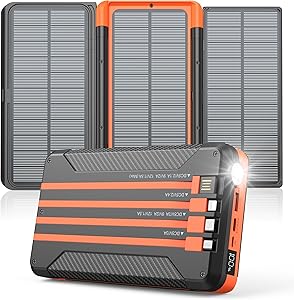
TL;DR: A solar phone charger harvests free energy from sunlight to keep your devices topped up off-grid — no wall outlet, no grid draw, no disposable batteries. For hikers, campers, or anyone cutting household energy consumption, it’s a straightforward zero-waste upgrade to your charging setup.
Best Solar Phone Charger: Portable, Eco-Friendly Power Without the Grid
Most of us charge our phones every day without thinking about where that electricity comes from. In the average home, phone charging draws from a grid still heavily dependent on fossil fuels — small per session, but consistent over a year. A solar phone charger breaks that dependency for mobile use cases. Whether you’re camping, traveling, or simply want to reduce your household energy draw, solar charging converts sunlight directly to usable power with no ongoing resource cost and no emissions at the point of use.
The technology has matured considerably. Portable solar panels now deliver 10W–28W output from foldable, lightweight designs that fit in a daypack. Monocrystalline silicon panels — the current efficiency standard — convert 20–24% of incident light to electricity, compared to 15–17% for older polycrystalline designs. That difference matters for cloudy days and partial shade, which are the real-world conditions most users encounter. Pair a quality panel with a power bank and you have a system that charges phones, earbuds, GPS devices, and small tablets entirely from ambient daylight.
Top Solar Phone Chargers
Don’t see what you need? Browse all portable solar chargers on Amazon — filter by wattage, weight, and panel type to match your specific use case.
Solar Phone Charger vs. Power Bank vs. Car Charger: Eco Impact Comparison
Standard power banks are convenient but must eventually be recharged from the grid. Car chargers draw from the alternator, which burns fuel. Solar cuts that chain entirely for outdoor use. The comparison below reflects typical real-world usage for someone who charges 1–2 devices per day on multi-day trips.
| Charger Type | Energy Source | Off-Grid Capable | Ongoing Cost | CO2 at Use | Best For |
|---|---|---|---|---|---|
| Solar Panel Charger | Sunlight | Yes — indefinitely | None | Zero | Camping, hiking, travel |
| Solar Panel + Power Bank | Sunlight → stored | Yes — with reserve | None | Zero | Multi-day off-grid |
| Standard Power Bank | Grid electricity | Limited (until depleted) | Grid rate per kWh | Indirect | Urban backup |
| Car Charger | Engine/alternator | Yes (with vehicle) | Fuel burn per charge | Direct (fuel) | Road trips |
| Wall Adapter | Grid electricity | No | Grid rate per kWh | Indirect | Home use |
What to Look for in a Portable Solar Charger
Panel wattage determines real-world charge speed. A 10W panel in full sun generates roughly 10W — enough to trickle-charge one phone slowly. A 21W–28W panel can charge a phone at near-wall-adapter speed under ideal conditions. For most hikers and campers, 15W–21W hits the sweet spot between portability and meaningful output.
Panel efficiency class matters more than wattage claims. Monocrystalline panels maintain better output in partial shade and diffuse light (overcast skies, tree cover) than polycrystalline. If you’re camping in forested areas or shoulder seasons, mono panels justify the small premium.
USB-A vs. USB-C output affects compatibility. Older solar chargers offer only USB-A. Newer panels include USB-C with Power Delivery (PD) — important for charging modern phones at their maximum input rate. If you carry a MacBook or iPad alongside your phone, USB-C PD output is worth prioritizing.
Weight and packed size determine whether you actually bring it. The best solar charger is the one in your pack, not the one left at home because it was too heavy. Foldable designs in the 0.5–1 lb range attach to the outside of a daypack and charge passively while you hike. Heavier panels (1.5 lb+) are better suited to base camps or vehicle travel.
Integrated power bank vs. panel only. Some solar chargers integrate a battery — charge the bank during the day, use it at night. Others are panel-only and require a separate power bank. The integrated option is simpler; the modular option lets you upgrade components independently and often delivers better overall performance per dollar.
Pairing Your Solar Charger With Other Zero-Waste Gear
A solar charger fits naturally into a broader low-waste outdoor kit. If you’re already using reusable gear to cut single-use waste on trips, power generation is the next logical piece. A few complementary swaps worth considering:
- Reusable containers and wraps — eliminate single-use packaging on trail food. See our guide to refillable bottles and containers for the home-to-trail overlap.
- Bamboo or reusable cutlery — no plastic utensils in the field. Our bamboo travel cutlery guide covers the best lightweight sets.
- Compostable waste disposal — if you’re already separating compostables at home, compostable bags extend that system to the field.
Solar Phone Charger FAQ
Can a solar phone charger work on a cloudy day?
Yes, with reduced output. Monocrystalline panels generate 10–25% of their rated wattage under heavy overcast — enough for a slow charge but not full speed. Thin cloud cover reduces output by 20–30% rather than 75–90%. For trips where overcast is expected, pack a separate power bank charged before departure as a buffer.
How long does it take to charge a phone with solar?
A fully depleted 4,000mAh phone battery (modern flagship size) needs roughly 15–20Wh to charge. A 20W panel in direct sun delivers that in 60–90 minutes under ideal conditions. Real-world conditions — angle, partial shade, temperature — typically add 30–60% to that estimate. Most users charge phones incrementally throughout the day rather than in a single session.
Is it worth buying a solar charger just for home use?
Marginally. Portable solar chargers are optimized for portability over efficiency — fixed rooftop solar is dramatically more cost-effective for home energy generation. If your goal is reducing home electricity consumption, a rooftop or balcony solar installation delivers far better return. Portable chargers make sense for anyone spending meaningful time outdoors or in situations where grid access is unreliable.
What’s the lifespan of a portable solar panel?
Quality monocrystalline portable panels typically maintain 80%+ of original efficiency for 5–7 years with normal outdoor use. Degradation is gradual — the panel doesn’t stop working, it slowly produces slightly less power per hour of sun. The main failure mode is physical damage (tears, connector failure) rather than cell degradation in well-made panels.
Can I charge a laptop with a portable solar panel?
Small ultrabooks can be trickle-charged via USB-C PD from a high-wattage solar panel (25W+). Gaming laptops and most 15″+ laptops require more power than portable solar panels provide. For laptop charging via solar, a high-capacity solar generator (100W+ panel with large battery) is a more practical solution than a portable panel designed for phones.
More Zero-Waste Swaps
Already swapping to cleaner energy on the go? These picks round out a low-waste outdoor and home setup:


