
TL;DR: Compostable trash bags break down in industrial or home compost systems within 90–180 days, leaving no plastic residue. They’re the correct liner for food waste bins headed to compost — and a meaningful swap from conventional plastic bags for any household reducing its landfill footprint.
Best Biodegradable Trash Bags: Compostable Liners That Actually Break Down
Standard plastic trash bags are designed to contain waste, not break down. Most are made from low-density polyethylene (LDPE) — a durable, flexible plastic that persists for hundreds of years in landfill conditions and fragments into microplastics rather than decomposing. Biodegradable and compostable trash bags replace that persistent polymer with plant-based materials — typically cornstarch, PBAT (a biodegradable polymer), or PLA (polylactic acid) — that break down in composting conditions within a defined timeframe under certified testing standards.
The distinction between “biodegradable” and “compostable” matters significantly. Biodegradable is an unregulated claim in most markets — it means only that a product breaks down eventually, which technically includes conventional plastic given enough centuries. Compostable is a regulated term tied to specific testing standards: ASTM D6400 in the US and EN 13432 in Europe define compostable as breaking down into water, CO2, and biomass within 180 days in industrial composting conditions, with no toxic residue. For food waste bins and zero-waste households, look for certified compostable — not just biodegradable.
- Top Compostable Trash Bags
- Compostable vs. Biodegradable vs. Recycled-Content Bags: What the Labels Actually Mean
- Industrial vs. Home Compostable: Which Do You Need?
- Practical Considerations: Strength, Storage, and Use
- Fitting Compostable Bags Into a Zero-Waste Kitchen System
- More Zero-Waste Swaps for the Kitchen
- FAQ: Biodegradable and Compostable Trash Bags
Top Compostable Trash Bags
Compostable vs. Biodegradable vs. Recycled-Content Bags: What the Labels Actually Mean
The trash bag aisle has accumulated a proliferation of green-sounding terms that don’t all carry equal weight. Understanding what each claim means — and what certification backs it — is the difference between making a genuine environmental improvement and paying a premium for greenwashing. Recycled-content bags are a legitimate option for general waste but don’t break down in composting — they still end up in landfill, just with a lower production footprint. Compostable bags are the right choice specifically for food waste and organic material destined for compost.
| Bag Type | Certification Standard | Breaks Down in Compost | Suitable for Food Waste | End-of-Life |
|---|---|---|---|---|
| Certified Compostable | ASTM D6400 / EN 13432 | Yes (90–180 days) | Yes | Industrial or home compost |
| “Biodegradable” (uncertified) | None | Uncertain / slow | Not recommended | Likely landfill |
| Recycled-Content Plastic | Varies | No | No | Landfill |
| Standard LDPE | None needed | No | No | Landfill (300+ years) |
| Home Compostable | OK Compost HOME / AS 5810 | Yes (180 days at home) | Yes | Backyard compost |
Industrial vs. Home Compostable: Which Do You Need?
Most certified compostable bags on the market are certified for industrial composting only — this means they require the sustained high temperatures (55–65°C) and specific microbial conditions of a commercial compost facility to break down within the certified timeframe. In a backyard compost heap that doesn’t reach those temperatures, an industrial-only compostable bag may take significantly longer or not fully break down at all.
Home compostable certification (OK Compost HOME from TÜV Austria, or AS 5810 in Australia) is a stricter standard — these bags are tested to break down in ambient backyard conditions at lower temperatures. If you compost at home, look specifically for home compostable certification. If your food scraps go to a municipal organics program, industrial compostable certification is sufficient and typically more widely available.
Practical Considerations: Strength, Storage, and Use
Compostable bags have different physical properties than conventional plastic. They’re typically less puncture-resistant and more sensitive to moisture — wet food scraps against the bag surface can begin breaking down the material before you’re ready to empty it. Practical solutions: use a dry liner layer of newspaper or cardboard in the bottom of your food waste bin, empty the bin every 2–3 days rather than letting bags sit full, and store unused bags in a cool dry place away from humidity.
Thickness is listed in microns on quality products. For kitchen food waste, 15–18 microns is the workable range — thin enough to break down efficiently, thick enough to handle several days of typical food scraps without tearing. Bags under 12 microns are prone to puncture from bone fragments or hard vegetable waste. For general household waste (not going to compost), a 20–25 micron compostable bag handles heavier loads.
Check sizing carefully. Compostable bag sizes don’t always follow the same volume designations as conventional bags. A “small” compostable bag is sometimes sized for a 2–3 gallon countertop bin, not the 4-gallon kitchen bin it’s marketed for. Measure your bin diameter and depth before ordering, or check the bag’s listed gallon capacity rather than the size designation.
Fitting Compostable Bags Into a Zero-Waste Kitchen System
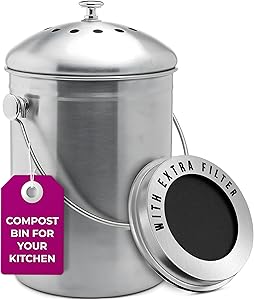
Compostable bags work best as part of a complete food waste system. Line your countertop compost bin with a certified compostable bag, collect scraps for 2–3 days, then transfer the whole bag to your outdoor compost bin or municipal organics pickup. The bag goes in with the scraps — no need to empty and clean a dirty bin liner. This reduces the friction of composting significantly, which is the main reason people abandon the habit.
Connect this to the broader kitchen loop: used coffee grounds from reusable coffee filters go straight into the compost bag, finished compost can be brewed into liquid fertilizer with a compost tea brewer, and kitchen surfaces get wiped down with organic cotton dish towels instead of paper. Each swap reinforces the others.
More Zero-Waste Swaps for the Kitchen
Complete your zero-waste kitchen system or browse compostable trash bags on Amazon:
- Compost tea brewer — turn your collected scraps into liquid fertilizer
- Organic cotton dish towels — replace paper towels for everyday cleanup
- Reusable coffee filters — grounds go straight into the compost bin
FAQ: Biodegradable and Compostable Trash Bags
Can compostable trash bags go in curbside recycling?
No. Compostable bags contaminate plastic recycling streams — they look similar to LDPE bags but are chemically incompatible. They should go into your compost bin or organics pickup, or into general waste if neither is available. Never put compostable bags in plastic film recycling drop-offs at grocery stores — the contamination can render an entire bale of recyclable plastic unusable.
Will compostable bags break down in a landfill?
No, or only very slowly. Landfills are anaerobic environments — they lack the oxygen and microbial activity that compostable materials require to break down. A compostable bag in a sealed landfill cell behaves similarly to conventional plastic over the short term. The certification standards apply only to composting conditions. Compostable bags are not a solution for landfill waste — they’re specifically designed for organic waste that gets composted.
How do I tell if a compostable bag is genuinely certified?
Look for the Seedling logo (BPI certification, ASTM D6400) or the TÜV Austria OK Compost logo on the packaging. These are third-party certifications that require actual lab testing — not self-declared marketing claims. BPI (Biodegradable Products Institute) certification is the most recognized standard in North America. EN 13432 certification is the European equivalent. If the packaging says “biodegradable” or “eco-friendly” without a certification mark, treat the claim with skepticism.
Are compostable bags strong enough for wet kitchen waste?
Quality compostable bags at 15+ microns handle typical wet food scraps for 2–3 days without failure. Extended contact with standing liquid (soup, wet coffee grounds pooling in the bottom) will degrade the bag faster. The practical solution is to drain liquids before bagging, add an absorbent layer at the bottom, and empty every 2–3 days. Bags designed specifically for food waste (as opposed to general compostable bags) are formulated with slightly higher moisture resistance.
What’s the carbon footprint of compostable bags vs. conventional plastic?
It depends heavily on end-of-life. When properly composted, compostable bags have a lower net carbon impact — the biogenic carbon in plant-based materials cycles back through the system rather than being extracted from fossil fuel reserves. When they end up in landfill (the outcome for a large percentage of “compostable” products in practice), the benefit is largely negated. The environmental case for compostable bags depends on having an accessible composting pathway — without that, the production footprint difference over conventional plastic is smaller than marketing suggests.


