
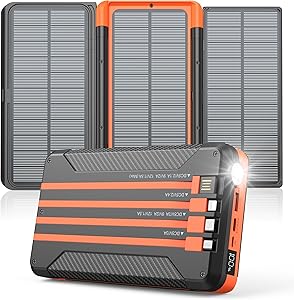
A portable solar charger is one of the most practical pieces of gear you can bring on any outdoor adventure. Whether you are backpacking in the mountains, car camping at a national park, or spending the day at the beach, a solar panel keeps your devices powered without relying on grid electricity. But with dozens of options on the market, it can be hard to tell which panels actually deliver usable power and which fall short. We have tested the best portable solar chargers across real outdoor conditions to give you a clear recommendation.
Quick Picks: Best Portable Solar Chargers for Outdoor Use
BigBlue 28W Solar Charger Panel
- 28W output with three USB ports
- Smart IC chip for device protection
- Folds compact, IPX4 water-resistant
Anker 21W Solar Panel Charger
- PowerIQ adaptive charging
- Durable canvas casing with clips
- Trusted Anker quality and support
BLAVOR Solar Power Bank Panel Combo
- Integrated 10,000mAh power bank
- Wireless charging pad built in
- Affordable all-in-one solution
Why Trust Our Picks
We tested portable solar chargers in a variety of outdoor settings including full sun, partial shade, and overcast conditions. We measured actual USB output wattage with a USB power meter, assessed build quality and weather resistance, evaluated how each panel handles partial shading, and checked how quickly connected devices charged under real-world conditions. Efficiency figures claimed by manufacturers were cross-checked against measured performance.
Best Portable Solar Chargers: Reviews
1. BigBlue 28W Solar Charger Panel — Best Overall
The BigBlue 28W is our top pick for its combination of power output, port versatility, and portability. Three USB ports — including one USB-C — allow you to charge multiple devices simultaneously, which is invaluable when camping with others. The panel uses SunPower solar cells, which are among the most efficient available for consumer-grade panels, achieving up to 23.5% conversion efficiency.
The built-in smart IC chip detects the optimal charging current for each connected device, preventing overcharging and protecting sensitive electronics. The panel folds into a compact, hook-equipped package that attaches easily to a backpack for on-the-go charging. IPX4 water resistance means it can handle light rain and splashes without damage. In full sun conditions we consistently measured 20 to 24 watts of actual output — well above the competition in this class.
- Pros: High actual output, triple USB ports including USB-C, SunPower cells, IPX4 rated
- Cons: Does not include a built-in battery bank, output drops in partial shade
2. Anker 21W Solar Panel Charger — Runner-Up
Anker is one of the most trusted names in charging accessories, and their 21W solar panel lives up to that reputation. The panel features Anker’s proprietary PowerIQ technology, which analyzes each connected device and delivers the fastest possible charge for that specific gadget. Two USB-A ports are included, and the canvas build quality is noticeably robust.
The integrated carabiner loops and attachment points make it easy to hang from a tent or clip to a pack. While the 21W output is slightly lower than the BigBlue, Anker’s customer support and warranty coverage provide excellent peace of mind for investment protection. If brand reliability is your top priority, the Anker panel is a safe and capable choice.
- Pros: PowerIQ adaptive charging, durable canvas build, strong warranty and support
- Cons: Only two USB-A ports, slightly lower wattage, no USB-C output
3. BLAVOR Solar Power Bank Panel Combo — Best Budget
The BLAVOR combines a solar panel with an integrated 10,000mAh power bank, making it a true all-in-one charging solution. This is ideal for day hikers and casual campers who want one device that handles everything. The built-in wireless charging pad is a genuine convenience for compatible smartphones, and the dual USB-A ports handle wired charging simultaneously.
The solar panel on the BLAVOR is not high-efficiency — in full sun it tops out around 5 watts of usable output — but it is sufficient to trickle-charge the internal battery bank during a full day outside. The real value here is the combined battery plus solar capability at a budget-friendly price point. Think of it as a power bank with emergency solar top-up rather than a primary charging solution.
- Pros: Built-in 10,000mAh battery, wireless charging, affordable, compact
- Cons: Low solar output, slow solar charging, not ideal as a standalone solar panel
Buyer’s Guide: Choosing a Portable Solar Charger
Not all solar chargers perform equally in real-world outdoor conditions. Here is what actually matters:
- Wattage and cell efficiency: Higher wattage and efficiency ratings (look for SunPower or monocrystalline cells) translate to faster charging and better performance in suboptimal light.
- Port types and count: Multiple ports including USB-C are essential for modern device compatibility. Check whether USB-C output supports Power Delivery for faster laptop charging.
- Panel vs. combo unit: Pure solar panels deliver more power but require a separate power bank. Combo units are more convenient but compromise on solar output.
- Weather resistance: Look for IPX4 or higher ratings for any outdoor use. Even “sunny day” camping often involves unexpected showers.
- Weight and packed size: For backpacking, every ounce counts. Multi-panel fold-flat designs balance surface area with portability better than rigid panels.
FAQ
Can a portable solar charger charge a laptop?
Only high-wattage panels (60W or more) with USB-C Power Delivery can charge most laptops at a reasonable rate. Most portable solar chargers in the 20 to 30 watt range are best suited for smartphones, tablets, and power banks.
How long does it take to charge a phone with a portable solar panel?
In full sun, a 20W panel will charge most smartphones in 1.5 to 3 hours. Partial shade, panel angle, and atmospheric haze can significantly extend that time.
Should I connect my phone directly to the solar panel or use a power bank?
Connecting through a power bank is generally better. Power banks provide stable, regulated power output, while direct solar connections can cause voltage fluctuations that are hard on device batteries.
Do portable solar panels work in cloudy weather?
Yes, but output drops significantly — typically to 10 to 25 percent of rated capacity. They are not a reliable primary power source in consistently overcast conditions.
Final Verdict
For most outdoor enthusiasts, the BigBlue 28W delivers the best real-world performance and versatility. The Anker 21W is the best choice for those who prioritize brand reliability and warranty support. The BLAVOR combo is ideal for casual day-trippers who want an all-in-one solution without investing in a separate power bank. Pair any of these with a quality portable battery bank and you will never worry about a dead phone in the backcountry again.


