
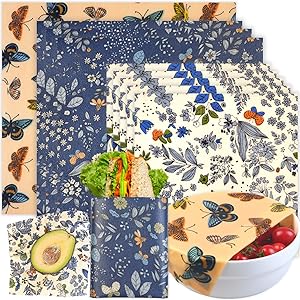
TL;DR: Bee’s Wrap is the category-defining beeswax food wrap — genuinely moldable, washer-friendly, and compostable after a year of use. It outperforms generic beeswax wraps on longevity and adhesion. Best pick: ASIN B07JHY9WBQ.
Bee’s Wrap Review vs. Alternatives in 2026
Plastic cling wrap is one of the most ubiquitous single-use plastics in the kitchen — a roll that produces waste every time you cover a bowl, wrap a half-cut avocado, or seal a block of cheese. The plastic is not recyclable through standard curbside programs and ends up in landfill, every time. Beeswax food wraps are the direct replacement: fabric infused with a beeswax, tree resin, and jojoba oil blend that becomes pliable with the warmth of your hands, molds around food and containers, and creates a breathable, adherent seal that keeps food fresh without any plastic. Bee’s Wrap is the brand that established this category, and over a decade later it remains the benchmark against which alternatives are measured.
This review covers how Bee’s Wrap performs in real kitchen conditions, where it excels and where it falls short, and how it compares to the growing field of alternatives — from competing beeswax brands to silicone stretch covers and reusable bags. If you’ve already added reusable produce bags and switched to glass food storage containers, beeswax wrap closes the last single-use plastic gap in most kitchen workflows.
Top Pick: Bee’s Wrap Assorted 3-Pack
Want to compare options? Browse beeswax wraps on Amazon — filter by size, pack configuration, and certified organic vs. standard beeswax sourcing.
Bee’s Wrap vs. Alternatives: Head-to-Head
| Feature | Bee’s Wrap | Generic Beeswax Wrap | Silicone Stretch Covers | Stasher Bags |
|---|---|---|---|---|
| Material | Organic cotton + beeswax, tree resin, jojoba oil | Cotton + beeswax (variable sourcing) | Food-grade silicone | Platinum silicone |
| Adhesion Method | Hand warmth — body heat activates | Same | Stretch-seal over rim | Zip-close seal |
| Usable Life | 12 months with regular use | 3–6 months (thinner coating) | Years — silicone is highly durable | 3+ years |
| End of Life | Home compostable | Variable — check synthetic additives | Not compostable — landfill eventually | Not compostable |
| Temperature Range | Cold only — no microwave, no hot food | Same | Freezer to oven (some models) | Freezer to sous vide safe |
| Best Use Case | Cheese, produce, bread, bowl covers | Same | Bowls, cut fruit, round containers | Snacks, sandwiches, liquids |
| Price Point | $18–$22 for 3-pack | $8–$14 for 3–6 pack | $12–$25 for set of 6 | $10–$15 per bag |
| Vegan Option | No — beeswax is animal-derived | No | Yes | Yes |
How Bee’s Wrap Performs in Real Kitchen Use
The activation feel is the differentiator. What sets Bee’s Wrap apart from cheaper beeswax wraps is the quality of its beeswax-resin-oil formula. The tree resin component (derived from tree sap) is what provides tackiness — the same principle behind pine resin’s natural stickiness. Lower-quality beeswax wraps use less or lower-grade resin, which results in a wrap that softens but doesn’t adhere confidently to surfaces. Bee’s Wrap’s blend creates a genuine seal around a bowl rim or an irregular surface (like a halved cantaloupe) that holds without manual pressure. The jojoba oil component maintains the wrap’s flexibility across repeated use cycles; wraps without it tend to become brittle after 3–4 months.
Best uses in practice. Beeswax wrap excels at: wrapping cheese (breathable wrap prevents the anaerobic environment that accelerates spoilage while keeping moisture in), covering bowls of leftovers in the fridge, wrapping half-cut produce like avocados and cucumbers, and packaging sandwiches and snacks. The medium-size wrap (11 x 11 inches) handles most bowl and produce applications; the large (13 x 13 inches) covers mixing bowls and watermelon halves; the small (7 x 8 inches) is sized for single pieces of fruit and cheese wedges. The assorted 3-pack in all three sizes is the most practical entry configuration for a household doing a full plastic-wrap replacement.
Where it falls short. Beeswax wrap cannot contact raw meat — the porous fabric would absorb bacteria and cannot be sterilized effectively. It cannot be used in the microwave or with hot foods (heat melts the wax). It cannot seal liquids in any meaningful way — it’s a cover and wrap, not a bag or container. For these use cases, silicone bags, glass containers, or stainless steel options are the appropriate complementary tools. Pairing reusable silicone bags with beeswax wrap gives a household plastic-free coverage across the full range of food storage needs.
Care and Maximizing Lifespan
Bee’s Wrap has a simple care protocol: rinse with cool water and mild dish soap after use, then air dry flat before storing. The critical rule is temperature — hot water softens and redistributes the wax coating, degrading the wrap’s adhesion over time. Cool or cold water only. Never place in the dishwasher, microwave, or on warm surfaces. Store folded loosely at room temperature — the wax hardens at refrigerator temperatures and becomes less pliable if stored cold.
The expected lifespan Bee’s Wrap advertises — approximately one year with daily use — is realistic based on user reporting. Signs that a wrap has reached end of life: reduced tackiness that can’t be restored by warming, significant cracking or delamination of the wax layer, thinning of the fabric in high-flex areas. At end of life, cut the wrap into small pieces and compost — the organic cotton, beeswax, tree resin, and jojoba oil all break down in a home compost pile. This lifecycle connection makes Bee’s Wrap a natural pairing with a countertop compost bin as part of a zero-waste kitchen setup.
Is Bee’s Wrap Worth the Premium Over Generic Beeswax Wraps?
Generic beeswax wraps are available at roughly half the price per unit. For a household testing the concept before committing, a cheaper generic is a reasonable trial option. However, the performance gap is meaningful enough that most users who switch from generic to Bee’s Wrap don’t go back: the adhesion is noticeably better, the lifespan is approximately twice as long (reducing the per-use cost), and the organic certification provides confidence about what’s contacting your food. At $6–$7 per wrap in the assorted 3-pack, Bee’s Wrap is not a luxury product — it’s priced competitively with a 3–4 month supply of the plastic wrap it replaces for most households.
For vegan households, Bee’s Wrap is not an option — the beeswax is inherently animal-derived. The brand does not currently offer a vegan-certified beeswax-free alternative. Plant-based wax wraps (using candelilla or soy wax) exist but have generally weaker adhesion profiles in testing. Silicone stretch covers are the most practical vegan alternative for bowl covering; silicone bags for wrapping. The trade-off is end-of-life compostability — silicone does not break down in home composting systems, which matters for households optimizing their full zero-waste loop.
Frequently Asked Questions
How do I know when my Bee’s Wrap is activated correctly?
When the wrap is warmed by your hands (10–15 seconds of cupping and rubbing), it transitions from a stiff, waxy sheet to a pliable, slightly tacky material that conforms to surfaces under gentle pressure. You’ll feel the wax soften — it should feel somewhat like a warm, slightly greasy fabric rather than a rigid sheet. If it’s not responding, your hands may be cold; run warm water over your hands first, dry them, then work the wrap. In very cold kitchens (under 60°F), the wax activates more slowly.
Can Bee’s Wrap go in the refrigerator and freezer?
Refrigerator — yes, and this is the most common use case. The cool temperature actually firms the wax and holds the seal more securely once you’ve molded it. Freezer — no. Freezer temperatures make the wrap brittle and can crack the wax coating; the material is not designed for freeze-thaw cycling. For freezer storage, use silicone bags or rigid glass containers with sealing lids.
Is it safe to use Bee’s Wrap on all types of food?
Safe for all cooked foods, produce, cheese, bread, and snacks that won’t contact the wrap’s wax with raw meat juices or high-acid liquids. Avoid raw meat (bacteria absorption risk), cut citrus held for more than a few hours (acidity can degrade the wax coating over repeated contact), and any food that requires microwave reheating while wrapped. For everything else — daily kitchen wrapping needs — it is fully food-safe. Bee’s Wrap’s formulation uses GOTS-certified organic cotton and food-grade wax components.
How much plastic wrap does switching to Bee’s Wrap actually save?
A household that uses one roll of plastic wrap per month generates approximately 12 rolls of non-recyclable plastic per year. One Bee’s Wrap 3-pack used consistently for 12 months replaces the entire annual plastic wrap consumption for most households. At an average roll cost of $4–$6, the break-even with a $20 Bee’s Wrap set is 3–5 months; every month after that is net savings alongside zero plastic generation. Over three years (replacing one set per year), the household eliminates 36 rolls of single-use plastic wrap — a meaningful and visible waste reduction.
What’s the difference between Bee’s Wrap Original and Bee’s Wrap Stretch?
Bee’s Wrap Stretch uses a jersey-knit cotton fabric instead of the standard woven muslin, giving it more stretch and elasticity — better for covering uneven or round surfaces like bowls of varying diameters. The original woven version is slightly more structured, better for flat wrapping applications like sandwiches and cheese. The wax formulation is the same across both lines. If you primarily cover bowls, Stretch is the more versatile option; if you primarily wrap items flat, the original performs better.


