
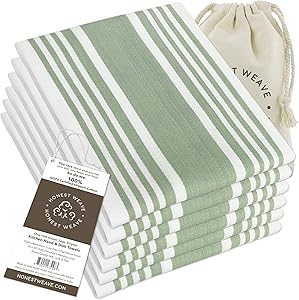
TL;DR: Organic cotton dish towels absorb better than conventional cotton, skip the pesticide-heavy growing process, and last years longer than paper towel rolls they replace. One good set handles 90% of the tasks you currently reach for paper towels to do.
Best Organic Cotton Dish Towels: Replace Paper Towels for Good
The average American household uses about one roll of paper towels per week — roughly 50 rolls a year, most of which are made from virgin tree fiber. Organic cotton dish towels replace that stream with a reusable alternative that performs better for most kitchen tasks, costs less over time, and sidesteps both the deforestation and pesticide-intensive cotton farming that conventional options involve. Organic cotton specifically avoids the synthetic pesticides and fertilizers used in standard cotton cultivation, which accounts for roughly 16% of global insecticide use despite occupying less than 3% of agricultural land.
The performance case is straightforward. Woven cotton — especially waffle-weave or plain-weave constructions — absorbs more liquid per square inch than paper towels, dries dishes without streaking, and handles hot pans without disintegrating. The tasks where paper towels genuinely outperform cloth are limited: absorbing raw meat juices (a hygiene concern) and wiping up hazardous spills you’d rather discard. For everything else — drying hands, wiping counters, drying produce, handling hot cookware — cloth is the functionally superior option.
Top Organic Cotton Dish Towels
Organic Cotton vs. Conventional Cotton vs. Linen vs. Bamboo Towels
The dish towel market has expanded significantly in the sustainable direction. Organic cotton, conventional cotton, linen, and bamboo-blend towels all claim eco credentials with varying degrees of accuracy. The key differences come down to agricultural impact, fiber performance, and longevity. Linen is the most durable and quickest-drying of the natural options but has a steeper initial price and stiffer hand feel. Bamboo blends are soft but often mixed with rayon processing chemicals that undercut the eco story. Organic cotton is the most accessible balance of performance, price, and verified sustainability.
| Material | Absorbency | Dry Speed | Durability | Eco Credentials | Price Range |
|---|---|---|---|---|---|
| Organic Cotton | High | Medium | 200–300 washes | GOTS certified available | $$ |
| Conventional Cotton | High | Medium | 150–250 washes | Pesticide-intensive crop | $ |
| Linen | Medium-High | Fast | 300–500 washes | Low-input crop, biodegradable | $$$ |
| Bamboo Blend | Very High | Fast | 100–200 washes | Mixed — chemical processing | $$ |
What to Look for When Buying Organic Dish Towels
GOTS certification (Global Organic Textile Standard) is the gold standard for organic cotton textiles. It covers the full supply chain — from fiber to finished product — including dye processes and worker conditions. OEKO-TEX Standard 100 is a useful secondary certification that confirms the finished product is free of harmful substances, even if it doesn’t certify organic fiber sourcing. Either certification on the label means the product has been third-party verified rather than self-reported as “natural.”
Weave structure determines function. Waffle-weave towels have the highest effective surface area and absorb the most liquid — ideal for dish drying and hand drying. Plain-weave or flat-weave towels are smoother and better for polishing glassware or wiping down surfaces without leaving lint. Having a mix of both types covers the full range of kitchen tasks without compromise.
Weight is listed in grams per square meter (GSM) on quality products. A 150–180 GSM towel is a standard all-purpose weight — substantial enough for dish drying but quick enough to dry between uses. Above 200 GSM produces a thicker towel that absorbs more but takes longer to dry and can mildew in humid kitchens if not managed well. Below 140 GSM is typically decorative weight — fine for countertop use but inadequate as a paper towel replacement.
Pre-washing is important before first use. New cotton towels — organic or conventional — have a sizing finish that reduces initial absorbency. Wash at least once before use; absorbency peaks after three to five washes as the sizing fully clears. This is not a product defect, just an inherent property of sized cotton textiles.
Making the Paper Towel Switch Actually Stick
Most people who try to switch to cloth towels fail because they underestimate how many they need. A realistic number for a household doing regular cooking is 8–12 towels in rotation — enough to have clean dry towels available without doing laundry every two days. Keep a small basket or hook near the sink for used towels and add them to regular laundry loads. The friction point is usually not the towels themselves but the rotation system.
Reserve a small stock of paper towels for the specific cases where cloth is genuinely inappropriate — raw meat, pet accidents, chemical spills. Keeping a single roll under the sink rather than on the counter changes the default behavior from paper-first to cloth-first without requiring any willpower. Most households that make this switch find paper towel consumption drops by 80–90% within a month.
Pairing With Other Zero-Waste Kitchen Habits
Dish towels pair naturally with other paper-reduction swaps. A compost tea brewer handles kitchen food scraps more efficiently when you have cloth towels for wiping produce before composting. Silicone baking cups and reusable covers reduce the surfaces that need cleanup. For the waste stream that remains, compostable trash bags close the loop without introducing new plastic.
More Zero-Waste Kitchen Swaps
Explore more sustainable kitchen upgrades or browse organic cotton dish towels on Amazon:
- Silicone cupcake liners — reusable baking cups that cut single-use waste
- Reusable coffee filters — another daily paper habit worth breaking
- Compostable trash bags — for waste that cloth can’t handle
FAQ: Organic Cotton Dish Towels
How often should organic cotton dish towels be washed?
Every 2–3 days for towels used for hand drying and general wiping. Towels used to dry raw produce or handle meat should be washed after each use. Kitchen towels accumulate bacteria faster than bathroom towels because they contact food surfaces repeatedly — the rotation schedule matters more than the organic fiber in terms of kitchen hygiene.
Will organic cotton dish towels shrink in the wash?
Pre-shrunk organic cotton towels lose about 3–5% of their dimensions in the first few washes if they weren’t pre-washed at the factory. After that initial settling, shrinkage is negligible with normal washing at 30–40°C. Washing at high heat (60°C+) accelerates fiber breakdown and reduces towel lifespan — stick to warm or cold washes and line dry or tumble low when possible.
What’s the difference between GOTS and OEKO-TEX certification?
GOTS (Global Organic Textile Standard) certifies the entire production chain — organic fiber sourcing, dyeing, processing, and labor conditions. OEKO-TEX Standard 100 tests only the finished product for harmful substance residues — it doesn’t verify organic fiber sourcing or production practices. For environmental impact, GOTS is the more meaningful certification. For product safety assurance, either certification provides useful verification.
How many dish towels do I actually need to replace paper towels?
8–12 for a household of 2–4 people doing regular cooking. This covers a 3–4 day rotation before laundry, which aligns with most households’ washing cadence. Fewer than 6 creates friction — you’ll run out before laundry day and default back to paper towels. More than 15 is unnecessary storage for most kitchens.
Are organic cotton towels better for drying glassware than conventional cotton?
The organic certification doesn’t directly affect lint or streak performance — those are determined by weave structure and fiber finish. Flat-weave organic cotton towels perform comparably to conventional flat-weave for glassware. What organic cotton avoids is residual bleaching chemicals and synthetic sizing, which can leave trace residue on glassware through multiple washes. For streak-free results, a flat-weave towel washed without fabric softener (which coats fibers and reduces absorbency) is the key variable regardless of organic status.


