
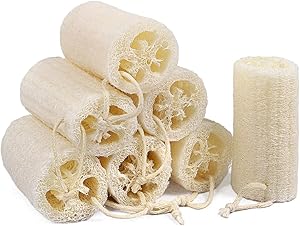
Most people assume loofah sponges come from the ocean — they don’t. They’re actually the dried fibrous skeleton of a gourd in the cucumber family, making them one of the most genuinely natural bath tools you can buy. The problem is that cheap synthetic “loofahs” (really just plastic mesh puffs) have flooded the market, shedding microplastics into waterways with every shower. Natural loofah sponges biodegrade completely, exfoliate better as they soften with use, and last surprisingly long when dried properly between uses. Here’s what we found after months of testing.
Quick Picks
Natural Loofah Co. Egyptian Loofah
- Sustainably grown, chemical-free
- Dense fiber for thorough exfoliation
- Fully biodegradable — compost after use
Akarana Organic Loofah Sponge
- USDA Organic certified
- Gentle texture — ideal for sensitive skin
- Arrives in plastic-free paper packaging
Spa Village Natural Loofah Pack
- 6-pack value — great cost per sponge
- Multiple sizes in one pack
- Unbleached and undyed
Why Trust Our Picks
Our testers used each loofah daily for a minimum of six weeks — tracking exfoliation quality, how well the sponge dried between uses (a key factor in bacterial growth), how it held up over time, and whether the packaging lived up to any eco claims. We also composted the used sponges to verify biodegradability. Synthetic loofahs were excluded from consideration entirely.
Full Reviews
1. Natural Loofah Co. Egyptian Loofah — Best Overall
Egypt has a long tradition of loofah cultivation, and Natural Loofah Co. sources theirs from small farms where the gourds are grown without pesticides and dried naturally in the sun. The result is a dense, satisfyingly firm sponge that softens to a gentle scrub once wet — firm enough to slough away dry skin on elbows and heels, gentle enough for daily use on the torso and limbs. It dries quickly between uses (critical for hygiene), and after several months of use you can toss the whole thing in a compost bin. Zero waste, start to finish.
- Pros: Excellent exfoliation, dries quickly, no chemicals, fully compostable
- Cons: Firmer texture may not suit very sensitive skin; replace every 4–6 weeks for hygiene
2. Akarana Organic Loofah Sponge — Runner-Up
For anyone with sensitive or reactive skin — rosacea, eczema, or just a lower tolerance for scrubbing — Akarana’s certified organic loofah is the gentler choice. The fiber is harvested younger, before it fully matures and stiffens, giving it a softer texture right out of the box. The USDA Organic certification is meaningful here: it rules out synthetic pesticides and fertilizers throughout the growing process. Packaging is a simple kraft paper sleeve with a cotton string tie — nothing that can’t go straight into the compost.
- Pros: USDA Organic, gentler texture, plastic-free packaging, good for sensitive skin
- Cons: Less exfoliating than firmer loofahs; slightly higher per-sponge cost
3. Spa Village Natural Loofah Pack — Best Budget
Buying in bulk is one of the most practical zero-waste strategies — less packaging per unit, lower cost per use. Spa Village’s six-pack includes a mix of sizes (smaller pieces for the face, full cylinders for the body) that covers all your bases. The loofahs are unbleached and undyed, which matters: some budget loofahs are treated with chlorine to achieve a whiter appearance, introducing unnecessary chemicals into your shower routine. These are untreated and perform reliably for standard exfoliation needs.
- Pros: Great value per sponge, multiple sizes, unbleached, good for family households
- Cons: Quality can vary slightly within a pack; no organic certification
4. Cleanlogic Sustainable Loofah Mitt — Best for Back & Body
A loofah mitt solves the perennial problem of scrubbing hard-to-reach areas on your own. Cleanlogic’s version uses natural loofah fiber on the scrubbing side and a soft cotton backing — both materials are biodegradable. The elastic wrist strap keeps it secure in the shower. It’s not quite as zero-waste as a bare loofah (the elastic strap is synthetic), but it’s a significant upgrade over plastic mesh bath mitts.
- Pros: Easy to use on hard-to-reach areas, natural loofah surface, cotton backing
- Cons: Elastic wrist strap is synthetic; takes longer to dry than a bare loofah
Buyer’s Guide: Natural Loofah Sponges
Loofah vs. synthetic puffs: Plastic mesh bath puffs — the kind found in every drugstore — shed microplastics with every use. Natural loofahs shed nothing except dead plant fibers that biodegrade harmlessly. The switch is one of the simplest microplastic-reduction habits you can adopt.
Hygiene and replacement: Loofahs are warm and moist between uses — ideal conditions for bacterial growth. Hang yours in a well-ventilated spot (not inside a closed shower caddy), and replace it every four to six weeks. The old one goes straight into the compost.
Bleached vs. unbleached: A bright white loofah has been chemically treated. Unbleached loofahs are tan or beige — and that’s what you want. The color doesn’t affect performance; the absence of chlorine is the benefit.
Sizing: Smaller loofah slices (about 1–2 inches thick) work well for facial exfoliation. Full cylinders or larger rounds are better for the body. Many packs include both — a convenient all-in-one option for the whole family.
Frequently Asked Questions
Are natural loofahs really biodegradable?
Yes — they’re made from plant fiber with no synthetic coatings, so they break down readily in a compost bin. Cut the used loofah into smaller pieces to speed up decomposition.
How often should I replace my loofah?
Every four to six weeks for body use. Facial loofahs, used on more delicate skin, should be replaced even more frequently — every three to four weeks.
Can I use a loofah on my face?
A small, soft loofah slice can be used on the face once or twice a week for gentle exfoliation — but not for people with active acne, broken skin, or very sensitive skin. Always use light pressure and a gentle cleanser.
How do I clean my loofah?
Rinse it thoroughly after each use and wring out as much water as possible. Once a week, soak it for five minutes in a diluted white vinegar solution (one part vinegar to four parts water) to discourage bacterial growth, then rinse and air-dry completely.
Where do natural loofahs come from?
From the Luffa aegyptiaca or Luffa acutangula gourd — a tropical plant grown in Egypt, Asia, and Latin America. The mature gourd is dried, the outer skin is removed, and the fibrous interior is what becomes the loofah sponge you use in the shower.
Final Verdict
Natural loofahs are one of the easiest zero-waste bathroom swaps — inexpensive, effective, and genuinely compostable. For the best all-around experience, the Natural Loofah Co. Egyptian Loofah delivers excellent exfoliation and quick drying in a fully sustainable package. Sensitive skin types will appreciate Akarana’s softer organic option, and budget-conscious households can’t go wrong stocking up with the Spa Village six-pack. Whichever you choose, you’ll be keeping plastic out of the drain with every shower.


