
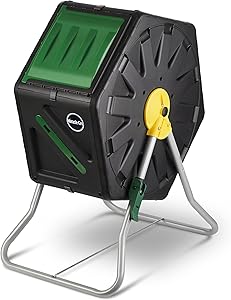
Turning kitchen scraps and yard waste into rich garden compost no longer requires a large backyard or complicated setup. A small outdoor compost tumbler is the modern solution for urban gardeners, small-space homeowners, and eco-conscious households who want to close the loop on organic waste without the mess, smell, or pest problems of open pile composting. Tumbler designs speed up the composting process dramatically — properly managed tumblers can produce finished compost in as little as 2–4 weeks compared to 3–6 months for traditional piles. In this review we evaluate the best compact compost tumblers available on Amazon, with a focus on ease of use, build quality, and real-world composting performance.
Quick Picks: Best Small Outdoor Compost Tumblers
FCMP Outdoor Dual-Chamber Tumbler (37 Gal)
- Dual chambers for continuous composting
- BPA-free recycled plastic construction
- Large aeration holes accelerate breakdown
Miracle-Gro Small Composter (18.5 Gal)
- Ultra-compact for small patios and balconies
- Sliding door for easy loading and unloading
- Deep-ridged drum mixes compost with each turn
Envirocycle Mini Composter (19 Gal)
- Ground-level rolling design — no frame needed
- Collects compost tea in integrated base tray
- Made from BPA and BHT-free materials
Why Trust Our Picks
Our review process involved running each tumbler through a full composting cycle with a standardized mix of kitchen scraps (vegetable peels, coffee grounds, eggshells) and carbon materials (cardboard, dried leaves). We tracked time to finished compost, ease of tumbling and loading, moisture retention, pest resistance, and durability of the drum and frame after months of outdoor exposure. We also reviewed hundreds of verified Amazon customer reports to identify long-term reliability patterns beyond our own testing window.
Best Small Compost Tumblers: In-Depth Reviews
1. FCMP Outdoor Dual-Chamber Tumbler — Best Overall
The FCMP Outdoor tumbler is the best-selling compost tumbler on Amazon for good reason — it solves the single biggest limitation of single-chamber tumblers: the inability to add fresh scraps while older material finishes composting. With two independent 18.5-gallon chambers on a single frame, you can actively compost in one side while the other side finishes curing. This continuous composting cycle means you’re never waiting months between batches.
The drum is made from BPA-free recycled plastic with large aeration holes on every panel that allow excellent airflow — critical for aerobic decomposition. The elevated frame keeps the drum off the ground (blocking pests and improving drainage) and positions the loading door at a comfortable working height. In our testing, we achieved finished compost in 3–4 weeks with daily or every-other-day tumbling. Assembly takes about 30–45 minutes with the included hardware.
- Pros: Dual chamber for continuous composting, BPA-free recycled plastic, large aeration holes, elevated frame for pest resistance, 37-gallon total capacity
- Cons: Assembly can be fiddly for one person, frame legs can shift on uneven ground, door latch reported to loosen over time by some users
2. Miracle-Gro Small Composter — Runner-Up
For gardeners with limited outdoor space — a small patio, balcony, or side yard — the Miracle-Gro 18.5-gallon composter hits the ideal size sweet spot. It’s compact enough to tuck into a corner without dominating your outdoor space, yet large enough to process a family of two to three people’s kitchen scraps effectively. The drum sits on a galvanized steel frame that has proven exceptionally rust-resistant in our outdoor testing.
What sets this model apart is the deep-ridged interior drum design. The internal ridges act like paddles, breaking up clumps and mixing material with each rotation far more effectively than a smooth-walled drum. The sliding door mechanism is one of the easiest loading systems we tested — no awkward latches or door panels that fall off mid-loading. Finished compost time in our tests was 4–5 weeks with regular turning.
- Pros: Compact footprint, internal ridges for better mixing, galvanized steel frame, easy sliding door, reliable pest exclusion
- Cons: Single chamber limits continuous composting, smaller 18.5-gallon capacity may not suit larger households
3. Envirocycle Mini Composter — Best Budget
The Envirocycle Mini is unlike any other compost tumbler in this review: it rolls on the ground rather than spinning on a frame. This ground-level rolling design makes it extremely stable, easy to move around the yard, and — most uniquely — equipped with an integrated base tray that collects compost tea as liquid drains from the drum during decomposition. Compost tea is a nutrient-rich liquid fertilizer that gardeners prize for feeding plants, and most tumblers simply let it drain and waste away.
Made entirely from BPA-free and BHT-free food-grade materials, it’s one of the safest tumblers for households concerned about plasticizer leaching into compost that will be used in vegetable gardens. At 19 gallons it handles a family’s scraps well. The trade-off is the extra step of bending to ground level for loading, which some users find less comfortable than an elevated-frame design.
- Pros: Unique compost tea collection, BPA/BHT-free food-grade plastic, no assembly required, portable rolling design, lower price point
- Cons: Ground-level loading requires bending, rolling on grass can be less smooth than spinning on a frame, single chamber design
Buyer’s Guide: Choosing a Small Compost Tumbler
Capacity: How Big Do You Need?
For a household of 1–2 people composting kitchen scraps only, a 15–20 gallon tumbler is adequate. For a family of 3–4 or anyone composting yard waste in addition to kitchen scraps, look for 30–50 gallon capacity. Keep in mind that tumblers should be filled no more than two-thirds full to allow material to tumble freely — an overfilled tumbler won’t mix properly and will slow decomposition dramatically.
Single vs. Dual Chamber
Single-chamber tumblers are simpler and less expensive, but require you to stop adding material while the batch finishes — typically 4–8 weeks. During that time, you’ll need a temporary holding area for fresh scraps. Dual-chamber tumblers solve this by allowing you to fill one side while the other finishes, enabling genuinely continuous composting. For anyone composting year-round, dual chamber is worth the extra investment.
Aeration and Turning Frequency
Aerobic decomposition — the kind that’s fast and odor-free — requires regular oxygen introduction. Tumblers make this easy: a few spins every day or every other day introduces fresh air throughout the pile. Look for tumblers with multiple aeration vents or holes across the drum surface, not just end-cap vents. The more surface area open to airflow, the faster and more evenly the material breaks down.
Frame Material and Ground Stability
Painted steel frames are common and work well but can rust at paint chips over 2–3 seasons. Galvanized or powder-coated steel frames last significantly longer. Look for wide-stance leg designs with ground stakes or feet that prevent tipping on soft soil. A wobbly tumbler is both frustrating to use and potentially dangerous if it tips while loaded.
FAQ: Small Outdoor Compost Tumblers
How often should I turn a compost tumbler?
For fastest results, turn the tumbler every 1–2 days. This introduces oxygen and redistributes moisture throughout the material. If you turn less frequently — every 3–5 days — decomposition still occurs but will take longer. Even once a week is far better than a static pile and will produce finished compost in 6–8 weeks rather than the 3–6 months of an untended heap.
What can I put in a small compost tumbler?
Green (nitrogen-rich) materials: fruit and vegetable scraps, coffee grounds, fresh grass clippings, plant trimmings. Brown (carbon-rich) materials: cardboard, paper, dried leaves, straw, wood chips. The ideal ratio is roughly 3 parts brown to 1 part green by volume. Avoid meat, dairy, oily foods, and pet waste — these cause odors and attract pests even in enclosed tumblers.
Why is my compost tumbler not heating up?
A compost pile that doesn’t heat up is usually too dry, too small, or lacking nitrogen. Add water until the material feels like a wrung-out sponge, add fresh green materials to boost nitrogen, and ensure the batch is large enough (at least one-third full) to generate and retain heat. A well-balanced, properly moist tumbler should reach 130–160°F (55–71°C) in the center within days of a good mix.
Can I use a compost tumbler in winter?
Yes, though composting slows significantly below 10°C (50°F) and nearly stops below freezing. In mild winter climates, active composting continues year-round. In cold climates, the tumbler will essentially pause in deep winter but resume when temperatures rise. You can continue adding material through winter — it will process in spring. Placing the tumbler in a sunny, sheltered location maximizes winter activity.
Final Verdict
A small outdoor compost tumbler is one of the most impactful investments you can make for both your garden and your environmental footprint. The FCMP Outdoor Dual-Chamber Tumbler is our top pick for its continuous composting capability and proven performance — it’s the gold standard of home tumblers for good reason. The Miracle-Gro Small Composter is the ideal choice for space-constrained gardeners who want a tidy, effective unit without the dual-chamber complexity. And the Envirocycle Mini offers the unique bonus of compost tea collection at a budget price, making it perfect for vegetable gardeners who want every drop of nutrient value from their organic waste. Whichever you choose, you’ll be diverting food waste from landfill and building soil health at the same time.


