
Yes, as long as your cordless drill has adequate torque — at least 350–400 in-lbs for clay soils. In soft, well-amended garden soil, even a lightweight cordless model will handle a bulb auger without trouble.
Does an auger work in rocky soil?
Augers handle embedded small stones and roots surprisingly well, but hitting a large rock can bend a lightweight bit instantly. If your soil is very rocky, use a heavy-gauge auger and work slowly, changing direction gently if you feel resistance rather than forcing through.
How do I clean soil off the auger after use?
Spin it at low speed into a bucket or against the ground to fling off loose soil, then wipe with a damp rag. Dry thoroughly before storage to prevent rust on uncoated steel — a light coat of WD-40 or mineral oil on the bit at season’s end extends its life significantly.
- Final Verdict
- Final Verdict
- Buyer’s Guide: Choosing a Bulb Auger
- Frequently Asked Questions
- Final Verdict
- Buyer’s Guide: Choosing a Bulb Auger
- Frequently Asked Questions
- Final Verdict
- Buyer’s Guide: Choosing a Bulb Auger
- Frequently Asked Questions
- Final Verdict
- Final Verdict
- Buyer’s Guide: Choosing a Bulb Auger
- Frequently Asked Questions
- Final Verdict
- Final Verdict
- Buyer’s Guide: Choosing a Bulb Auger
- Frequently Asked Questions
- Final Verdict
- Final Verdict
- Buyer’s Guide: Choosing a Bulb Auger
- Frequently Asked Questions
- Final Verdict
- Buyer’s Guide: Choosing a Bulb Auger
- Frequently Asked Questions
- Final Verdict
- Buyer’s Guide: Choosing a Bulb Auger
- Frequently Asked Questions
- Final Verdict
- Buyer’s Guide: Choosing a Bulb Auger
- Frequently Asked Questions
- Final Verdict
- Buyer’s Guide: Choosing a Bulb Auger
- Frequently Asked Questions
- Final Verdict
- Final Verdict
- Buyer’s Guide: Choosing a Bulb Auger
- Frequently Asked Questions
- Final Verdict
- Buyer’s Guide: Choosing a Bulb Auger
- Frequently Asked Questions
- Final Verdict
- Final Verdict
- Buyer’s Guide: Choosing a Bulb Auger
- Frequently Asked Questions
- Final Verdict
- Buyer’s Guide: Choosing a Bulb Auger
- Frequently Asked Questions
- Final Verdict
- Final Verdict
- Buyer’s Guide: Choosing a Bulb Auger
- Frequently Asked Questions
- Final Verdict
- Buyer’s Guide: Choosing a Bulb Auger
- Frequently Asked Questions
- Final Verdict
- Buyer’s Guide: Choosing a Bulb Auger
- Frequently Asked Questions
- Final Verdict
- Buyer’s Guide: Choosing a Bulb Auger
- Frequently Asked Questions
- Final Verdict
- Buyer’s Guide: Choosing a Bulb Auger
- Frequently Asked Questions
- Final Verdict
- Final Verdict
- Buyer’s Guide: Choosing a Bulb Auger
- Frequently Asked Questions
- Final Verdict
- Buyer’s Guide: Choosing a Bulb Auger
- Frequently Asked Questions
- Final Verdict
- Buyer’s Guide: Choosing a Bulb Auger
- Frequently Asked Questions
- Final Verdict
- Final Verdict
- Buyer’s Guide: Choosing a Bulb Auger
- Frequently Asked Questions
- Final Verdict
- Buyer’s Guide: Choosing a Bulb Auger
- Frequently Asked Questions
- Final Verdict
- Buyer’s Guide: Choosing a Bulb Auger
- Frequently Asked Questions
- Final Verdict
- Final Verdict
- Buyer’s Guide: Choosing a Bulb Auger
- Frequently Asked Questions
- Final Verdict
- Buyer’s Guide: Choosing a Bulb Auger
- Frequently Asked Questions
- Final Verdict
- Buyer’s Guide: Choosing a Bulb Auger
- Frequently Asked Questions
- Final Verdict
- Final Verdict
- Final Verdict
- Buyer’s Guide: Choosing a Bulb Auger
- Frequently Asked Questions
- Final Verdict
- Buyer’s Guide: Choosing a Bulb Auger
- Frequently Asked Questions
- Final Verdict
- Buyer’s Guide: Choosing a Bulb Auger
- Frequently Asked Questions
- Final Verdict
- Final Verdict
- Final Verdict
- Buyer’s Guide: Choosing a Bulb Auger
- Frequently Asked Questions
- Final Verdict
- Buyer’s Guide: Choosing a Bulb Auger
- Frequently Asked Questions
- Final Verdict
- Buyer’s Guide: Choosing a Bulb Auger
- Frequently Asked Questions
- Final Verdict
- Final Verdict
- Final Verdict
- Final Verdict
- Buyer’s Guide: Choosing a Bulb Auger
- Frequently Asked Questions
- Final Verdict
- Buyer’s Guide: Choosing a Bulb Auger
- Frequently Asked Questions
- Final Verdict
- Buyer’s Guide: Choosing a Bulb Auger
- Frequently Asked Questions
- Final Verdict
- Quick Picks
- Why Trust Our Picks
- Individual Reviews
- Final Verdict
- Final Verdict
- Final Verdict
- Final Verdict
- Buyer’s Guide: Choosing a Bulb Auger
- Frequently Asked Questions
- Final Verdict
- Buyer’s Guide: Choosing a Bulb Auger
- Frequently Asked Questions
- Final Verdict
- Buyer’s Guide: Choosing a Bulb Auger
- Frequently Asked Questions
- Final Verdict
Final Verdict
For gardeners planting in real-world soil conditions — clay, compaction, occasional rocks — the Yard Butler BD-6 is the clear choice. Its steel gauge and diameter are calibrated for the task in a way cheaper options simply aren’t. Gardeners who need to plant at greater depths should look at the AMES Power Planter, whose 7-inch length and hex shank make deep planting fast and reliable.
Tulip bulbs are typically 1.5–2 inches in diameter and should be planted 6 inches deep. A 3-inch diameter auger gives you comfortable clearance to place the bulb and allows loose soil to fill in around the sides for good root contact.
Can I use a bulb auger with a cordless drill?
Yes, as long as your cordless drill has adequate torque — at least 350–400 in-lbs for clay soils. In soft, well-amended garden soil, even a lightweight cordless model will handle a bulb auger without trouble.
Does an auger work in rocky soil?
Augers handle embedded small stones and roots surprisingly well, but hitting a large rock can bend a lightweight bit instantly. If your soil is very rocky, use a heavy-gauge auger and work slowly, changing direction gently if you feel resistance rather than forcing through.
How do I clean soil off the auger after use?
Spin it at low speed into a bucket or against the ground to fling off loose soil, then wipe with a damp rag. Dry thoroughly before storage to prevent rust on uncoated steel — a light coat of WD-40 or mineral oil on the bit at season’s end extends its life significantly.
Final Verdict
For gardeners planting in real-world soil conditions — clay, compaction, occasional rocks — the Yard Butler BD-6 is the clear choice. Its steel gauge and diameter are calibrated for the task in a way cheaper options simply aren’t. Gardeners who need to plant at greater depths should look at the AMES Power Planter, whose 7-inch length and hex shank make deep planting fast and reliable.
If you’re serious about bulb planting and want to cover every scenario with one purchase, the Landzie 3-piece set is worth considering. You get a narrow bit for small bulbs, a medium bit for standard sizes, and a wider bit for large species tulips and crown imperials — all in one package. The steel quality is consistent across all three, and the storage bag keeps them organized between uses. The set costs more than buying a single auger, but less than purchasing three separate quality bits individually, making it the smart buy for committed bulb gardeners.
- Pros: Three sizes cover all planting scenarios, consistent steel quality across set, good value vs. individual purchases
- Cons: Higher upfront cost than a single bit, the largest bit requires a high-torque drill to perform well in clay
Buyer’s Guide: Choosing a Bulb Auger
Match diameter to your most-planted bulb size: Tulips and daffodils need a 3-inch diameter hole at minimum. Smaller bulbs like crocus, grape hyacinth, and snowdrops work best with a 1.5–2 inch bit. Buying the right diameter saves time — an oversized hole leaves roots without proper soil contact.
Your drill’s torque matters: In clay or compacted soil, a low-torque cordless drill will stall or overheat. A drill with at least 400 in-lbs of torque handles clay reliably. If your drill struggles, reduce speed and let the auger do the work rather than forcing it.
Shank type affects chuck security: Round-shank augers can rotate in the chuck when they hit resistance — annoying and potentially damaging to the chuck. Hex-shank models lock in place mechanically and are worth the upgrade if you do heavy-volume planting.
Frequently Asked Questions
What size auger do I need for tulip bulbs?
Tulip bulbs are typically 1.5–2 inches in diameter and should be planted 6 inches deep. A 3-inch diameter auger gives you comfortable clearance to place the bulb and allows loose soil to fill in around the sides for good root contact.
Can I use a bulb auger with a cordless drill?
Yes, as long as your cordless drill has adequate torque — at least 350–400 in-lbs for clay soils. In soft, well-amended garden soil, even a lightweight cordless model will handle a bulb auger without trouble.
Does an auger work in rocky soil?
Augers handle embedded small stones and roots surprisingly well, but hitting a large rock can bend a lightweight bit instantly. If your soil is very rocky, use a heavy-gauge auger and work slowly, changing direction gently if you feel resistance rather than forcing through.
How do I clean soil off the auger after use?
Spin it at low speed into a bucket or against the ground to fling off loose soil, then wipe with a damp rag. Dry thoroughly before storage to prevent rust on uncoated steel — a light coat of WD-40 or mineral oil on the bit at season’s end extends its life significantly.
Final Verdict
For gardeners planting in real-world soil conditions — clay, compaction, occasional rocks — the Yard Butler BD-6 is the clear choice. Its steel gauge and diameter are calibrated for the task in a way cheaper options simply aren’t. Gardeners who need to plant at greater depths should look at the AMES Power Planter, whose 7-inch length and hex shank make deep planting fast and reliable.
Not every planting task calls for a 3-inch hole — and for smaller bulbs, annuals, and vegetable transplants, the VIVOSUN 1.6-inch auger is a genuinely useful tool at an entry-level price. It fits all standard drills and cordless models, which makes it accessible to any gardener who already owns a drill. Performance in loose garden soil is very good; in clay it works but requires more patient, lower-torque operation to avoid flexing the bit. The real appeal is that at this price point, you can keep one at the garden shed and one in the potting area without a second thought.
- Pros: Right size for small bulbs and annuals, very affordable, works with any standard drill
- Cons: Lighter steel flexes in clay, too narrow for large bulbs like tulips and daffodils
Landzie Bulb Planter Auger Set (3-Piece) — Also Great
If you’re serious about bulb planting and want to cover every scenario with one purchase, the Landzie 3-piece set is worth considering. You get a narrow bit for small bulbs, a medium bit for standard sizes, and a wider bit for large species tulips and crown imperials — all in one package. The steel quality is consistent across all three, and the storage bag keeps them organized between uses. The set costs more than buying a single auger, but less than purchasing three separate quality bits individually, making it the smart buy for committed bulb gardeners.
- Pros: Three sizes cover all planting scenarios, consistent steel quality across set, good value vs. individual purchases
- Cons: Higher upfront cost than a single bit, the largest bit requires a high-torque drill to perform well in clay
Buyer’s Guide: Choosing a Bulb Auger
Match diameter to your most-planted bulb size: Tulips and daffodils need a 3-inch diameter hole at minimum. Smaller bulbs like crocus, grape hyacinth, and snowdrops work best with a 1.5–2 inch bit. Buying the right diameter saves time — an oversized hole leaves roots without proper soil contact.
Your drill’s torque matters: In clay or compacted soil, a low-torque cordless drill will stall or overheat. A drill with at least 400 in-lbs of torque handles clay reliably. If your drill struggles, reduce speed and let the auger do the work rather than forcing it.
Shank type affects chuck security: Round-shank augers can rotate in the chuck when they hit resistance — annoying and potentially damaging to the chuck. Hex-shank models lock in place mechanically and are worth the upgrade if you do heavy-volume planting.
Frequently Asked Questions
What size auger do I need for tulip bulbs?
Tulip bulbs are typically 1.5–2 inches in diameter and should be planted 6 inches deep. A 3-inch diameter auger gives you comfortable clearance to place the bulb and allows loose soil to fill in around the sides for good root contact.
Can I use a bulb auger with a cordless drill?
Yes, as long as your cordless drill has adequate torque — at least 350–400 in-lbs for clay soils. In soft, well-amended garden soil, even a lightweight cordless model will handle a bulb auger without trouble.
Does an auger work in rocky soil?
Augers handle embedded small stones and roots surprisingly well, but hitting a large rock can bend a lightweight bit instantly. If your soil is very rocky, use a heavy-gauge auger and work slowly, changing direction gently if you feel resistance rather than forcing through.
How do I clean soil off the auger after use?
Spin it at low speed into a bucket or against the ground to fling off loose soil, then wipe with a damp rag. Dry thoroughly before storage to prevent rust on uncoated steel — a light coat of WD-40 or mineral oil on the bit at season’s end extends its life significantly.
Final Verdict
For gardeners planting in real-world soil conditions — clay, compaction, occasional rocks — the Yard Butler BD-6 is the clear choice. Its steel gauge and diameter are calibrated for the task in a way cheaper options simply aren’t. Gardeners who need to plant at greater depths should look at the AMES Power Planter, whose 7-inch length and hex shank make deep planting fast and reliable.
Where the Yard Butler excels at standard depths, the AMES Power Planter is purpose-built for deep planting. Its 7-inch working length reaches the 6-inch depth required for tulips and the 8-inch depth preferred for large alliums without tilting or repositioning. The hex shank is a genuine quality-of-life upgrade — round shanks can rotate in the chuck during hard use, requiring you to stop and retighten; the hex shank eliminates that entirely. Soil ejection is clean and efficient, which matters when you’re doing hundreds of holes in quick succession.
- Pros: Long reach for deep planting, hex shank prevents chuck slipping, efficient soil ejection
- Cons: Slightly narrower diameter limits use with the largest bulbs, overkill for shallow-planting species
VIVOSUN 1.6-Inch Planting Auger — Best Budget
Not every planting task calls for a 3-inch hole — and for smaller bulbs, annuals, and vegetable transplants, the VIVOSUN 1.6-inch auger is a genuinely useful tool at an entry-level price. It fits all standard drills and cordless models, which makes it accessible to any gardener who already owns a drill. Performance in loose garden soil is very good; in clay it works but requires more patient, lower-torque operation to avoid flexing the bit. The real appeal is that at this price point, you can keep one at the garden shed and one in the potting area without a second thought.
- Pros: Right size for small bulbs and annuals, very affordable, works with any standard drill
- Cons: Lighter steel flexes in clay, too narrow for large bulbs like tulips and daffodils
Landzie Bulb Planter Auger Set (3-Piece) — Also Great
If you’re serious about bulb planting and want to cover every scenario with one purchase, the Landzie 3-piece set is worth considering. You get a narrow bit for small bulbs, a medium bit for standard sizes, and a wider bit for large species tulips and crown imperials — all in one package. The steel quality is consistent across all three, and the storage bag keeps them organized between uses. The set costs more than buying a single auger, but less than purchasing three separate quality bits individually, making it the smart buy for committed bulb gardeners.
- Pros: Three sizes cover all planting scenarios, consistent steel quality across set, good value vs. individual purchases
- Cons: Higher upfront cost than a single bit, the largest bit requires a high-torque drill to perform well in clay
Buyer’s Guide: Choosing a Bulb Auger
Match diameter to your most-planted bulb size: Tulips and daffodils need a 3-inch diameter hole at minimum. Smaller bulbs like crocus, grape hyacinth, and snowdrops work best with a 1.5–2 inch bit. Buying the right diameter saves time — an oversized hole leaves roots without proper soil contact.
Your drill’s torque matters: In clay or compacted soil, a low-torque cordless drill will stall or overheat. A drill with at least 400 in-lbs of torque handles clay reliably. If your drill struggles, reduce speed and let the auger do the work rather than forcing it.
Shank type affects chuck security: Round-shank augers can rotate in the chuck when they hit resistance — annoying and potentially damaging to the chuck. Hex-shank models lock in place mechanically and are worth the upgrade if you do heavy-volume planting.
Frequently Asked Questions
What size auger do I need for tulip bulbs?
Tulip bulbs are typically 1.5–2 inches in diameter and should be planted 6 inches deep. A 3-inch diameter auger gives you comfortable clearance to place the bulb and allows loose soil to fill in around the sides for good root contact.
Can I use a bulb auger with a cordless drill?
Yes, as long as your cordless drill has adequate torque — at least 350–400 in-lbs for clay soils. In soft, well-amended garden soil, even a lightweight cordless model will handle a bulb auger without trouble.
Does an auger work in rocky soil?
Augers handle embedded small stones and roots surprisingly well, but hitting a large rock can bend a lightweight bit instantly. If your soil is very rocky, use a heavy-gauge auger and work slowly, changing direction gently if you feel resistance rather than forcing through.
How do I clean soil off the auger after use?
Spin it at low speed into a bucket or against the ground to fling off loose soil, then wipe with a damp rag. Dry thoroughly before storage to prevent rust on uncoated steel — a light coat of WD-40 or mineral oil on the bit at season’s end extends its life significantly.
Final Verdict
For gardeners planting in real-world soil conditions — clay, compaction, occasional rocks — the Yard Butler BD-6 is the clear choice. Its steel gauge and diameter are calibrated for the task in a way cheaper options simply aren’t. Gardeners who need to plant at greater depths should look at the AMES Power Planter, whose 7-inch length and hex shank make deep planting fast and reliable.
Augers handle embedded small stones and roots surprisingly well, but hitting a large rock can bend a lightweight bit instantly. If your soil is very rocky, use a heavy-gauge auger and work slowly, changing direction gently if you feel resistance rather than forcing through.
How do I clean soil off the auger after use?
Spin it at low speed into a bucket or against the ground to fling off loose soil, then wipe with a damp rag. Dry thoroughly before storage to prevent rust on uncoated steel — a light coat of WD-40 or mineral oil on the bit at season’s end extends its life significantly.
Final Verdict
For gardeners planting in real-world soil conditions — clay, compaction, occasional rocks — the Yard Butler BD-6 is the clear choice. Its steel gauge and diameter are calibrated for the task in a way cheaper options simply aren’t. Gardeners who need to plant at greater depths should look at the AMES Power Planter, whose 7-inch length and hex shank make deep planting fast and reliable.
Where the Yard Butler excels at standard depths, the AMES Power Planter is purpose-built for deep planting. Its 7-inch working length reaches the 6-inch depth required for tulips and the 8-inch depth preferred for large alliums without tilting or repositioning. The hex shank is a genuine quality-of-life upgrade — round shanks can rotate in the chuck during hard use, requiring you to stop and retighten; the hex shank eliminates that entirely. Soil ejection is clean and efficient, which matters when you’re doing hundreds of holes in quick succession.
- Pros: Long reach for deep planting, hex shank prevents chuck slipping, efficient soil ejection
- Cons: Slightly narrower diameter limits use with the largest bulbs, overkill for shallow-planting species
VIVOSUN 1.6-Inch Planting Auger — Best Budget
Not every planting task calls for a 3-inch hole — and for smaller bulbs, annuals, and vegetable transplants, the VIVOSUN 1.6-inch auger is a genuinely useful tool at an entry-level price. It fits all standard drills and cordless models, which makes it accessible to any gardener who already owns a drill. Performance in loose garden soil is very good; in clay it works but requires more patient, lower-torque operation to avoid flexing the bit. The real appeal is that at this price point, you can keep one at the garden shed and one in the potting area without a second thought.
- Pros: Right size for small bulbs and annuals, very affordable, works with any standard drill
- Cons: Lighter steel flexes in clay, too narrow for large bulbs like tulips and daffodils
Landzie Bulb Planter Auger Set (3-Piece) — Also Great
If you’re serious about bulb planting and want to cover every scenario with one purchase, the Landzie 3-piece set is worth considering. You get a narrow bit for small bulbs, a medium bit for standard sizes, and a wider bit for large species tulips and crown imperials — all in one package. The steel quality is consistent across all three, and the storage bag keeps them organized between uses. The set costs more than buying a single auger, but less than purchasing three separate quality bits individually, making it the smart buy for committed bulb gardeners.
- Pros: Three sizes cover all planting scenarios, consistent steel quality across set, good value vs. individual purchases
- Cons: Higher upfront cost than a single bit, the largest bit requires a high-torque drill to perform well in clay
Buyer’s Guide: Choosing a Bulb Auger
Match diameter to your most-planted bulb size: Tulips and daffodils need a 3-inch diameter hole at minimum. Smaller bulbs like crocus, grape hyacinth, and snowdrops work best with a 1.5–2 inch bit. Buying the right diameter saves time — an oversized hole leaves roots without proper soil contact.
Your drill’s torque matters: In clay or compacted soil, a low-torque cordless drill will stall or overheat. A drill with at least 400 in-lbs of torque handles clay reliably. If your drill struggles, reduce speed and let the auger do the work rather than forcing it.
Shank type affects chuck security: Round-shank augers can rotate in the chuck when they hit resistance — annoying and potentially damaging to the chuck. Hex-shank models lock in place mechanically and are worth the upgrade if you do heavy-volume planting.
Frequently Asked Questions
What size auger do I need for tulip bulbs?
Tulip bulbs are typically 1.5–2 inches in diameter and should be planted 6 inches deep. A 3-inch diameter auger gives you comfortable clearance to place the bulb and allows loose soil to fill in around the sides for good root contact.
Can I use a bulb auger with a cordless drill?
Yes, as long as your cordless drill has adequate torque — at least 350–400 in-lbs for clay soils. In soft, well-amended garden soil, even a lightweight cordless model will handle a bulb auger without trouble.
Does an auger work in rocky soil?
Augers handle embedded small stones and roots surprisingly well, but hitting a large rock can bend a lightweight bit instantly. If your soil is very rocky, use a heavy-gauge auger and work slowly, changing direction gently if you feel resistance rather than forcing through.
How do I clean soil off the auger after use?
Spin it at low speed into a bucket or against the ground to fling off loose soil, then wipe with a damp rag. Dry thoroughly before storage to prevent rust on uncoated steel — a light coat of WD-40 or mineral oil on the bit at season’s end extends its life significantly.
Final Verdict
For gardeners planting in real-world soil conditions — clay, compaction, occasional rocks — the Yard Butler BD-6 is the clear choice. Its steel gauge and diameter are calibrated for the task in a way cheaper options simply aren’t. Gardeners who need to plant at greater depths should look at the AMES Power Planter, whose 7-inch length and hex shank make deep planting fast and reliable.
Yes, as long as your cordless drill has adequate torque — at least 350–400 in-lbs for clay soils. In soft, well-amended garden soil, even a lightweight cordless model will handle a bulb auger without trouble.
Does an auger work in rocky soil?
Augers handle embedded small stones and roots surprisingly well, but hitting a large rock can bend a lightweight bit instantly. If your soil is very rocky, use a heavy-gauge auger and work slowly, changing direction gently if you feel resistance rather than forcing through.
How do I clean soil off the auger after use?
Spin it at low speed into a bucket or against the ground to fling off loose soil, then wipe with a damp rag. Dry thoroughly before storage to prevent rust on uncoated steel — a light coat of WD-40 or mineral oil on the bit at season’s end extends its life significantly.
Final Verdict
For gardeners planting in real-world soil conditions — clay, compaction, occasional rocks — the Yard Butler BD-6 is the clear choice. Its steel gauge and diameter are calibrated for the task in a way cheaper options simply aren’t. Gardeners who need to plant at greater depths should look at the AMES Power Planter, whose 7-inch length and hex shank make deep planting fast and reliable.
Where the Yard Butler excels at standard depths, the AMES Power Planter is purpose-built for deep planting. Its 7-inch working length reaches the 6-inch depth required for tulips and the 8-inch depth preferred for large alliums without tilting or repositioning. The hex shank is a genuine quality-of-life upgrade — round shanks can rotate in the chuck during hard use, requiring you to stop and retighten; the hex shank eliminates that entirely. Soil ejection is clean and efficient, which matters when you’re doing hundreds of holes in quick succession.
- Pros: Long reach for deep planting, hex shank prevents chuck slipping, efficient soil ejection
- Cons: Slightly narrower diameter limits use with the largest bulbs, overkill for shallow-planting species
VIVOSUN 1.6-Inch Planting Auger — Best Budget
Not every planting task calls for a 3-inch hole — and for smaller bulbs, annuals, and vegetable transplants, the VIVOSUN 1.6-inch auger is a genuinely useful tool at an entry-level price. It fits all standard drills and cordless models, which makes it accessible to any gardener who already owns a drill. Performance in loose garden soil is very good; in clay it works but requires more patient, lower-torque operation to avoid flexing the bit. The real appeal is that at this price point, you can keep one at the garden shed and one in the potting area without a second thought.
- Pros: Right size for small bulbs and annuals, very affordable, works with any standard drill
- Cons: Lighter steel flexes in clay, too narrow for large bulbs like tulips and daffodils
Landzie Bulb Planter Auger Set (3-Piece) — Also Great
If you’re serious about bulb planting and want to cover every scenario with one purchase, the Landzie 3-piece set is worth considering. You get a narrow bit for small bulbs, a medium bit for standard sizes, and a wider bit for large species tulips and crown imperials — all in one package. The steel quality is consistent across all three, and the storage bag keeps them organized between uses. The set costs more than buying a single auger, but less than purchasing three separate quality bits individually, making it the smart buy for committed bulb gardeners.
- Pros: Three sizes cover all planting scenarios, consistent steel quality across set, good value vs. individual purchases
- Cons: Higher upfront cost than a single bit, the largest bit requires a high-torque drill to perform well in clay
Buyer’s Guide: Choosing a Bulb Auger
Match diameter to your most-planted bulb size: Tulips and daffodils need a 3-inch diameter hole at minimum. Smaller bulbs like crocus, grape hyacinth, and snowdrops work best with a 1.5–2 inch bit. Buying the right diameter saves time — an oversized hole leaves roots without proper soil contact.
Your drill’s torque matters: In clay or compacted soil, a low-torque cordless drill will stall or overheat. A drill with at least 400 in-lbs of torque handles clay reliably. If your drill struggles, reduce speed and let the auger do the work rather than forcing it.
Shank type affects chuck security: Round-shank augers can rotate in the chuck when they hit resistance — annoying and potentially damaging to the chuck. Hex-shank models lock in place mechanically and are worth the upgrade if you do heavy-volume planting.
Frequently Asked Questions
What size auger do I need for tulip bulbs?
Tulip bulbs are typically 1.5–2 inches in diameter and should be planted 6 inches deep. A 3-inch diameter auger gives you comfortable clearance to place the bulb and allows loose soil to fill in around the sides for good root contact.
Can I use a bulb auger with a cordless drill?
Yes, as long as your cordless drill has adequate torque — at least 350–400 in-lbs for clay soils. In soft, well-amended garden soil, even a lightweight cordless model will handle a bulb auger without trouble.
Does an auger work in rocky soil?
Augers handle embedded small stones and roots surprisingly well, but hitting a large rock can bend a lightweight bit instantly. If your soil is very rocky, use a heavy-gauge auger and work slowly, changing direction gently if you feel resistance rather than forcing through.
How do I clean soil off the auger after use?
Spin it at low speed into a bucket or against the ground to fling off loose soil, then wipe with a damp rag. Dry thoroughly before storage to prevent rust on uncoated steel — a light coat of WD-40 or mineral oil on the bit at season’s end extends its life significantly.
Final Verdict
For gardeners planting in real-world soil conditions — clay, compaction, occasional rocks — the Yard Butler BD-6 is the clear choice. Its steel gauge and diameter are calibrated for the task in a way cheaper options simply aren’t. Gardeners who need to plant at greater depths should look at the AMES Power Planter, whose 7-inch length and hex shank make deep planting fast and reliable.
Tulip bulbs are typically 1.5–2 inches in diameter and should be planted 6 inches deep. A 3-inch diameter auger gives you comfortable clearance to place the bulb and allows loose soil to fill in around the sides for good root contact.
Can I use a bulb auger with a cordless drill?
Yes, as long as your cordless drill has adequate torque — at least 350–400 in-lbs for clay soils. In soft, well-amended garden soil, even a lightweight cordless model will handle a bulb auger without trouble.
Does an auger work in rocky soil?
Augers handle embedded small stones and roots surprisingly well, but hitting a large rock can bend a lightweight bit instantly. If your soil is very rocky, use a heavy-gauge auger and work slowly, changing direction gently if you feel resistance rather than forcing through.
How do I clean soil off the auger after use?
Spin it at low speed into a bucket or against the ground to fling off loose soil, then wipe with a damp rag. Dry thoroughly before storage to prevent rust on uncoated steel — a light coat of WD-40 or mineral oil on the bit at season’s end extends its life significantly.
Final Verdict
For gardeners planting in real-world soil conditions — clay, compaction, occasional rocks — the Yard Butler BD-6 is the clear choice. Its steel gauge and diameter are calibrated for the task in a way cheaper options simply aren’t. Gardeners who need to plant at greater depths should look at the AMES Power Planter, whose 7-inch length and hex shank make deep planting fast and reliable.
Where the Yard Butler excels at standard depths, the AMES Power Planter is purpose-built for deep planting. Its 7-inch working length reaches the 6-inch depth required for tulips and the 8-inch depth preferred for large alliums without tilting or repositioning. The hex shank is a genuine quality-of-life upgrade — round shanks can rotate in the chuck during hard use, requiring you to stop and retighten; the hex shank eliminates that entirely. Soil ejection is clean and efficient, which matters when you’re doing hundreds of holes in quick succession.
- Pros: Long reach for deep planting, hex shank prevents chuck slipping, efficient soil ejection
- Cons: Slightly narrower diameter limits use with the largest bulbs, overkill for shallow-planting species
VIVOSUN 1.6-Inch Planting Auger — Best Budget
Not every planting task calls for a 3-inch hole — and for smaller bulbs, annuals, and vegetable transplants, the VIVOSUN 1.6-inch auger is a genuinely useful tool at an entry-level price. It fits all standard drills and cordless models, which makes it accessible to any gardener who already owns a drill. Performance in loose garden soil is very good; in clay it works but requires more patient, lower-torque operation to avoid flexing the bit. The real appeal is that at this price point, you can keep one at the garden shed and one in the potting area without a second thought.
- Pros: Right size for small bulbs and annuals, very affordable, works with any standard drill
- Cons: Lighter steel flexes in clay, too narrow for large bulbs like tulips and daffodils
Landzie Bulb Planter Auger Set (3-Piece) — Also Great
If you’re serious about bulb planting and want to cover every scenario with one purchase, the Landzie 3-piece set is worth considering. You get a narrow bit for small bulbs, a medium bit for standard sizes, and a wider bit for large species tulips and crown imperials — all in one package. The steel quality is consistent across all three, and the storage bag keeps them organized between uses. The set costs more than buying a single auger, but less than purchasing three separate quality bits individually, making it the smart buy for committed bulb gardeners.
- Pros: Three sizes cover all planting scenarios, consistent steel quality across set, good value vs. individual purchases
- Cons: Higher upfront cost than a single bit, the largest bit requires a high-torque drill to perform well in clay
Buyer’s Guide: Choosing a Bulb Auger
Match diameter to your most-planted bulb size: Tulips and daffodils need a 3-inch diameter hole at minimum. Smaller bulbs like crocus, grape hyacinth, and snowdrops work best with a 1.5–2 inch bit. Buying the right diameter saves time — an oversized hole leaves roots without proper soil contact.
Your drill’s torque matters: In clay or compacted soil, a low-torque cordless drill will stall or overheat. A drill with at least 400 in-lbs of torque handles clay reliably. If your drill struggles, reduce speed and let the auger do the work rather than forcing it.
Shank type affects chuck security: Round-shank augers can rotate in the chuck when they hit resistance — annoying and potentially damaging to the chuck. Hex-shank models lock in place mechanically and are worth the upgrade if you do heavy-volume planting.
Frequently Asked Questions
What size auger do I need for tulip bulbs?
Tulip bulbs are typically 1.5–2 inches in diameter and should be planted 6 inches deep. A 3-inch diameter auger gives you comfortable clearance to place the bulb and allows loose soil to fill in around the sides for good root contact.
Can I use a bulb auger with a cordless drill?
Yes, as long as your cordless drill has adequate torque — at least 350–400 in-lbs for clay soils. In soft, well-amended garden soil, even a lightweight cordless model will handle a bulb auger without trouble.
Does an auger work in rocky soil?
Augers handle embedded small stones and roots surprisingly well, but hitting a large rock can bend a lightweight bit instantly. If your soil is very rocky, use a heavy-gauge auger and work slowly, changing direction gently if you feel resistance rather than forcing through.
How do I clean soil off the auger after use?
Spin it at low speed into a bucket or against the ground to fling off loose soil, then wipe with a damp rag. Dry thoroughly before storage to prevent rust on uncoated steel — a light coat of WD-40 or mineral oil on the bit at season’s end extends its life significantly.
Final Verdict
For gardeners planting in real-world soil conditions — clay, compaction, occasional rocks — the Yard Butler BD-6 is the clear choice. Its steel gauge and diameter are calibrated for the task in a way cheaper options simply aren’t. Gardeners who need to plant at greater depths should look at the AMES Power Planter, whose 7-inch length and hex shank make deep planting fast and reliable.
If you’re serious about bulb planting and want to cover every scenario with one purchase, the Landzie 3-piece set is worth considering. You get a narrow bit for small bulbs, a medium bit for standard sizes, and a wider bit for large species tulips and crown imperials — all in one package. The steel quality is consistent across all three, and the storage bag keeps them organized between uses. The set costs more than buying a single auger, but less than purchasing three separate quality bits individually, making it the smart buy for committed bulb gardeners.
- Pros: Three sizes cover all planting scenarios, consistent steel quality across set, good value vs. individual purchases
- Cons: Higher upfront cost than a single bit, the largest bit requires a high-torque drill to perform well in clay
Buyer’s Guide: Choosing a Bulb Auger
Match diameter to your most-planted bulb size: Tulips and daffodils need a 3-inch diameter hole at minimum. Smaller bulbs like crocus, grape hyacinth, and snowdrops work best with a 1.5–2 inch bit. Buying the right diameter saves time — an oversized hole leaves roots without proper soil contact.
Your drill’s torque matters: In clay or compacted soil, a low-torque cordless drill will stall or overheat. A drill with at least 400 in-lbs of torque handles clay reliably. If your drill struggles, reduce speed and let the auger do the work rather than forcing it.
Shank type affects chuck security: Round-shank augers can rotate in the chuck when they hit resistance — annoying and potentially damaging to the chuck. Hex-shank models lock in place mechanically and are worth the upgrade if you do heavy-volume planting.
Frequently Asked Questions
What size auger do I need for tulip bulbs?
Tulip bulbs are typically 1.5–2 inches in diameter and should be planted 6 inches deep. A 3-inch diameter auger gives you comfortable clearance to place the bulb and allows loose soil to fill in around the sides for good root contact.
Can I use a bulb auger with a cordless drill?
Yes, as long as your cordless drill has adequate torque — at least 350–400 in-lbs for clay soils. In soft, well-amended garden soil, even a lightweight cordless model will handle a bulb auger without trouble.
Does an auger work in rocky soil?
Augers handle embedded small stones and roots surprisingly well, but hitting a large rock can bend a lightweight bit instantly. If your soil is very rocky, use a heavy-gauge auger and work slowly, changing direction gently if you feel resistance rather than forcing through.
How do I clean soil off the auger after use?
Spin it at low speed into a bucket or against the ground to fling off loose soil, then wipe with a damp rag. Dry thoroughly before storage to prevent rust on uncoated steel — a light coat of WD-40 or mineral oil on the bit at season’s end extends its life significantly.
Final Verdict
For gardeners planting in real-world soil conditions — clay, compaction, occasional rocks — the Yard Butler BD-6 is the clear choice. Its steel gauge and diameter are calibrated for the task in a way cheaper options simply aren’t. Gardeners who need to plant at greater depths should look at the AMES Power Planter, whose 7-inch length and hex shank make deep planting fast and reliable.
Where the Yard Butler excels at standard depths, the AMES Power Planter is purpose-built for deep planting. Its 7-inch working length reaches the 6-inch depth required for tulips and the 8-inch depth preferred for large alliums without tilting or repositioning. The hex shank is a genuine quality-of-life upgrade — round shanks can rotate in the chuck during hard use, requiring you to stop and retighten; the hex shank eliminates that entirely. Soil ejection is clean and efficient, which matters when you’re doing hundreds of holes in quick succession.
- Pros: Long reach for deep planting, hex shank prevents chuck slipping, efficient soil ejection
- Cons: Slightly narrower diameter limits use with the largest bulbs, overkill for shallow-planting species
VIVOSUN 1.6-Inch Planting Auger — Best Budget
Not every planting task calls for a 3-inch hole — and for smaller bulbs, annuals, and vegetable transplants, the VIVOSUN 1.6-inch auger is a genuinely useful tool at an entry-level price. It fits all standard drills and cordless models, which makes it accessible to any gardener who already owns a drill. Performance in loose garden soil is very good; in clay it works but requires more patient, lower-torque operation to avoid flexing the bit. The real appeal is that at this price point, you can keep one at the garden shed and one in the potting area without a second thought.
- Pros: Right size for small bulbs and annuals, very affordable, works with any standard drill
- Cons: Lighter steel flexes in clay, too narrow for large bulbs like tulips and daffodils
Landzie Bulb Planter Auger Set (3-Piece) — Also Great
If you’re serious about bulb planting and want to cover every scenario with one purchase, the Landzie 3-piece set is worth considering. You get a narrow bit for small bulbs, a medium bit for standard sizes, and a wider bit for large species tulips and crown imperials — all in one package. The steel quality is consistent across all three, and the storage bag keeps them organized between uses. The set costs more than buying a single auger, but less than purchasing three separate quality bits individually, making it the smart buy for committed bulb gardeners.
- Pros: Three sizes cover all planting scenarios, consistent steel quality across set, good value vs. individual purchases
- Cons: Higher upfront cost than a single bit, the largest bit requires a high-torque drill to perform well in clay
Buyer’s Guide: Choosing a Bulb Auger
Match diameter to your most-planted bulb size: Tulips and daffodils need a 3-inch diameter hole at minimum. Smaller bulbs like crocus, grape hyacinth, and snowdrops work best with a 1.5–2 inch bit. Buying the right diameter saves time — an oversized hole leaves roots without proper soil contact.
Your drill’s torque matters: In clay or compacted soil, a low-torque cordless drill will stall or overheat. A drill with at least 400 in-lbs of torque handles clay reliably. If your drill struggles, reduce speed and let the auger do the work rather than forcing it.
Shank type affects chuck security: Round-shank augers can rotate in the chuck when they hit resistance — annoying and potentially damaging to the chuck. Hex-shank models lock in place mechanically and are worth the upgrade if you do heavy-volume planting.
Frequently Asked Questions
What size auger do I need for tulip bulbs?
Tulip bulbs are typically 1.5–2 inches in diameter and should be planted 6 inches deep. A 3-inch diameter auger gives you comfortable clearance to place the bulb and allows loose soil to fill in around the sides for good root contact.
Can I use a bulb auger with a cordless drill?
Yes, as long as your cordless drill has adequate torque — at least 350–400 in-lbs for clay soils. In soft, well-amended garden soil, even a lightweight cordless model will handle a bulb auger without trouble.
Does an auger work in rocky soil?
Augers handle embedded small stones and roots surprisingly well, but hitting a large rock can bend a lightweight bit instantly. If your soil is very rocky, use a heavy-gauge auger and work slowly, changing direction gently if you feel resistance rather than forcing through.
How do I clean soil off the auger after use?
Spin it at low speed into a bucket or against the ground to fling off loose soil, then wipe with a damp rag. Dry thoroughly before storage to prevent rust on uncoated steel — a light coat of WD-40 or mineral oil on the bit at season’s end extends its life significantly.
Final Verdict
For gardeners planting in real-world soil conditions — clay, compaction, occasional rocks — the Yard Butler BD-6 is the clear choice. Its steel gauge and diameter are calibrated for the task in a way cheaper options simply aren’t. Gardeners who need to plant at greater depths should look at the AMES Power Planter, whose 7-inch length and hex shank make deep planting fast and reliable.
Not every planting task calls for a 3-inch hole — and for smaller bulbs, annuals, and vegetable transplants, the VIVOSUN 1.6-inch auger is a genuinely useful tool at an entry-level price. It fits all standard drills and cordless models, which makes it accessible to any gardener who already owns a drill. Performance in loose garden soil is very good; in clay it works but requires more patient, lower-torque operation to avoid flexing the bit. The real appeal is that at this price point, you can keep one at the garden shed and one in the potting area without a second thought.
- Pros: Right size for small bulbs and annuals, very affordable, works with any standard drill
- Cons: Lighter steel flexes in clay, too narrow for large bulbs like tulips and daffodils
Landzie Bulb Planter Auger Set (3-Piece) — Also Great
If you’re serious about bulb planting and want to cover every scenario with one purchase, the Landzie 3-piece set is worth considering. You get a narrow bit for small bulbs, a medium bit for standard sizes, and a wider bit for large species tulips and crown imperials — all in one package. The steel quality is consistent across all three, and the storage bag keeps them organized between uses. The set costs more than buying a single auger, but less than purchasing three separate quality bits individually, making it the smart buy for committed bulb gardeners.
- Pros: Three sizes cover all planting scenarios, consistent steel quality across set, good value vs. individual purchases
- Cons: Higher upfront cost than a single bit, the largest bit requires a high-torque drill to perform well in clay
Buyer’s Guide: Choosing a Bulb Auger
Match diameter to your most-planted bulb size: Tulips and daffodils need a 3-inch diameter hole at minimum. Smaller bulbs like crocus, grape hyacinth, and snowdrops work best with a 1.5–2 inch bit. Buying the right diameter saves time — an oversized hole leaves roots without proper soil contact.
Your drill’s torque matters: In clay or compacted soil, a low-torque cordless drill will stall or overheat. A drill with at least 400 in-lbs of torque handles clay reliably. If your drill struggles, reduce speed and let the auger do the work rather than forcing it.
Shank type affects chuck security: Round-shank augers can rotate in the chuck when they hit resistance — annoying and potentially damaging to the chuck. Hex-shank models lock in place mechanically and are worth the upgrade if you do heavy-volume planting.
Frequently Asked Questions
What size auger do I need for tulip bulbs?
Tulip bulbs are typically 1.5–2 inches in diameter and should be planted 6 inches deep. A 3-inch diameter auger gives you comfortable clearance to place the bulb and allows loose soil to fill in around the sides for good root contact.
Can I use a bulb auger with a cordless drill?
Yes, as long as your cordless drill has adequate torque — at least 350–400 in-lbs for clay soils. In soft, well-amended garden soil, even a lightweight cordless model will handle a bulb auger without trouble.
Does an auger work in rocky soil?
Augers handle embedded small stones and roots surprisingly well, but hitting a large rock can bend a lightweight bit instantly. If your soil is very rocky, use a heavy-gauge auger and work slowly, changing direction gently if you feel resistance rather than forcing through.
How do I clean soil off the auger after use?
Spin it at low speed into a bucket or against the ground to fling off loose soil, then wipe with a damp rag. Dry thoroughly before storage to prevent rust on uncoated steel — a light coat of WD-40 or mineral oil on the bit at season’s end extends its life significantly.
Final Verdict
For gardeners planting in real-world soil conditions — clay, compaction, occasional rocks — the Yard Butler BD-6 is the clear choice. Its steel gauge and diameter are calibrated for the task in a way cheaper options simply aren’t. Gardeners who need to plant at greater depths should look at the AMES Power Planter, whose 7-inch length and hex shank make deep planting fast and reliable.
Where the Yard Butler excels at standard depths, the AMES Power Planter is purpose-built for deep planting. Its 7-inch working length reaches the 6-inch depth required for tulips and the 8-inch depth preferred for large alliums without tilting or repositioning. The hex shank is a genuine quality-of-life upgrade — round shanks can rotate in the chuck during hard use, requiring you to stop and retighten; the hex shank eliminates that entirely. Soil ejection is clean and efficient, which matters when you’re doing hundreds of holes in quick succession.
- Pros: Long reach for deep planting, hex shank prevents chuck slipping, efficient soil ejection
- Cons: Slightly narrower diameter limits use with the largest bulbs, overkill for shallow-planting species
VIVOSUN 1.6-Inch Planting Auger — Best Budget
Not every planting task calls for a 3-inch hole — and for smaller bulbs, annuals, and vegetable transplants, the VIVOSUN 1.6-inch auger is a genuinely useful tool at an entry-level price. It fits all standard drills and cordless models, which makes it accessible to any gardener who already owns a drill. Performance in loose garden soil is very good; in clay it works but requires more patient, lower-torque operation to avoid flexing the bit. The real appeal is that at this price point, you can keep one at the garden shed and one in the potting area without a second thought.
- Pros: Right size for small bulbs and annuals, very affordable, works with any standard drill
- Cons: Lighter steel flexes in clay, too narrow for large bulbs like tulips and daffodils
Landzie Bulb Planter Auger Set (3-Piece) — Also Great
If you’re serious about bulb planting and want to cover every scenario with one purchase, the Landzie 3-piece set is worth considering. You get a narrow bit for small bulbs, a medium bit for standard sizes, and a wider bit for large species tulips and crown imperials — all in one package. The steel quality is consistent across all three, and the storage bag keeps them organized between uses. The set costs more than buying a single auger, but less than purchasing three separate quality bits individually, making it the smart buy for committed bulb gardeners.
- Pros: Three sizes cover all planting scenarios, consistent steel quality across set, good value vs. individual purchases
- Cons: Higher upfront cost than a single bit, the largest bit requires a high-torque drill to perform well in clay
Buyer’s Guide: Choosing a Bulb Auger
Match diameter to your most-planted bulb size: Tulips and daffodils need a 3-inch diameter hole at minimum. Smaller bulbs like crocus, grape hyacinth, and snowdrops work best with a 1.5–2 inch bit. Buying the right diameter saves time — an oversized hole leaves roots without proper soil contact.
Your drill’s torque matters: In clay or compacted soil, a low-torque cordless drill will stall or overheat. A drill with at least 400 in-lbs of torque handles clay reliably. If your drill struggles, reduce speed and let the auger do the work rather than forcing it.
Shank type affects chuck security: Round-shank augers can rotate in the chuck when they hit resistance — annoying and potentially damaging to the chuck. Hex-shank models lock in place mechanically and are worth the upgrade if you do heavy-volume planting.
Frequently Asked Questions
What size auger do I need for tulip bulbs?
Tulip bulbs are typically 1.5–2 inches in diameter and should be planted 6 inches deep. A 3-inch diameter auger gives you comfortable clearance to place the bulb and allows loose soil to fill in around the sides for good root contact.
Can I use a bulb auger with a cordless drill?
Yes, as long as your cordless drill has adequate torque — at least 350–400 in-lbs for clay soils. In soft, well-amended garden soil, even a lightweight cordless model will handle a bulb auger without trouble.
Does an auger work in rocky soil?
Augers handle embedded small stones and roots surprisingly well, but hitting a large rock can bend a lightweight bit instantly. If your soil is very rocky, use a heavy-gauge auger and work slowly, changing direction gently if you feel resistance rather than forcing through.
How do I clean soil off the auger after use?
Spin it at low speed into a bucket or against the ground to fling off loose soil, then wipe with a damp rag. Dry thoroughly before storage to prevent rust on uncoated steel — a light coat of WD-40 or mineral oil on the bit at season’s end extends its life significantly.
Final Verdict
For gardeners planting in real-world soil conditions — clay, compaction, occasional rocks — the Yard Butler BD-6 is the clear choice. Its steel gauge and diameter are calibrated for the task in a way cheaper options simply aren’t. Gardeners who need to plant at greater depths should look at the AMES Power Planter, whose 7-inch length and hex shank make deep planting fast and reliable.
Augers handle embedded small stones and roots surprisingly well, but hitting a large rock can bend a lightweight bit instantly. If your soil is very rocky, use a heavy-gauge auger and work slowly, changing direction gently if you feel resistance rather than forcing through.
How do I clean soil off the auger after use?
Spin it at low speed into a bucket or against the ground to fling off loose soil, then wipe with a damp rag. Dry thoroughly before storage to prevent rust on uncoated steel — a light coat of WD-40 or mineral oil on the bit at season’s end extends its life significantly.
Final Verdict
For gardeners planting in real-world soil conditions — clay, compaction, occasional rocks — the Yard Butler BD-6 is the clear choice. Its steel gauge and diameter are calibrated for the task in a way cheaper options simply aren’t. Gardeners who need to plant at greater depths should look at the AMES Power Planter, whose 7-inch length and hex shank make deep planting fast and reliable.
Not every planting task calls for a 3-inch hole — and for smaller bulbs, annuals, and vegetable transplants, the VIVOSUN 1.6-inch auger is a genuinely useful tool at an entry-level price. It fits all standard drills and cordless models, which makes it accessible to any gardener who already owns a drill. Performance in loose garden soil is very good; in clay it works but requires more patient, lower-torque operation to avoid flexing the bit. The real appeal is that at this price point, you can keep one at the garden shed and one in the potting area without a second thought.
- Pros: Right size for small bulbs and annuals, very affordable, works with any standard drill
- Cons: Lighter steel flexes in clay, too narrow for large bulbs like tulips and daffodils
Landzie Bulb Planter Auger Set (3-Piece) — Also Great
If you’re serious about bulb planting and want to cover every scenario with one purchase, the Landzie 3-piece set is worth considering. You get a narrow bit for small bulbs, a medium bit for standard sizes, and a wider bit for large species tulips and crown imperials — all in one package. The steel quality is consistent across all three, and the storage bag keeps them organized between uses. The set costs more than buying a single auger, but less than purchasing three separate quality bits individually, making it the smart buy for committed bulb gardeners.
- Pros: Three sizes cover all planting scenarios, consistent steel quality across set, good value vs. individual purchases
- Cons: Higher upfront cost than a single bit, the largest bit requires a high-torque drill to perform well in clay
Buyer’s Guide: Choosing a Bulb Auger
Match diameter to your most-planted bulb size: Tulips and daffodils need a 3-inch diameter hole at minimum. Smaller bulbs like crocus, grape hyacinth, and snowdrops work best with a 1.5–2 inch bit. Buying the right diameter saves time — an oversized hole leaves roots without proper soil contact.
Your drill’s torque matters: In clay or compacted soil, a low-torque cordless drill will stall or overheat. A drill with at least 400 in-lbs of torque handles clay reliably. If your drill struggles, reduce speed and let the auger do the work rather than forcing it.
Shank type affects chuck security: Round-shank augers can rotate in the chuck when they hit resistance — annoying and potentially damaging to the chuck. Hex-shank models lock in place mechanically and are worth the upgrade if you do heavy-volume planting.
Frequently Asked Questions
What size auger do I need for tulip bulbs?
Tulip bulbs are typically 1.5–2 inches in diameter and should be planted 6 inches deep. A 3-inch diameter auger gives you comfortable clearance to place the bulb and allows loose soil to fill in around the sides for good root contact.
Can I use a bulb auger with a cordless drill?
Yes, as long as your cordless drill has adequate torque — at least 350–400 in-lbs for clay soils. In soft, well-amended garden soil, even a lightweight cordless model will handle a bulb auger without trouble.
Does an auger work in rocky soil?
Augers handle embedded small stones and roots surprisingly well, but hitting a large rock can bend a lightweight bit instantly. If your soil is very rocky, use a heavy-gauge auger and work slowly, changing direction gently if you feel resistance rather than forcing through.
How do I clean soil off the auger after use?
Spin it at low speed into a bucket or against the ground to fling off loose soil, then wipe with a damp rag. Dry thoroughly before storage to prevent rust on uncoated steel — a light coat of WD-40 or mineral oil on the bit at season’s end extends its life significantly.
Final Verdict
For gardeners planting in real-world soil conditions — clay, compaction, occasional rocks — the Yard Butler BD-6 is the clear choice. Its steel gauge and diameter are calibrated for the task in a way cheaper options simply aren’t. Gardeners who need to plant at greater depths should look at the AMES Power Planter, whose 7-inch length and hex shank make deep planting fast and reliable.
Where the Yard Butler excels at standard depths, the AMES Power Planter is purpose-built for deep planting. Its 7-inch working length reaches the 6-inch depth required for tulips and the 8-inch depth preferred for large alliums without tilting or repositioning. The hex shank is a genuine quality-of-life upgrade — round shanks can rotate in the chuck during hard use, requiring you to stop and retighten; the hex shank eliminates that entirely. Soil ejection is clean and efficient, which matters when you’re doing hundreds of holes in quick succession.
- Pros: Long reach for deep planting, hex shank prevents chuck slipping, efficient soil ejection
- Cons: Slightly narrower diameter limits use with the largest bulbs, overkill for shallow-planting species
VIVOSUN 1.6-Inch Planting Auger — Best Budget
Not every planting task calls for a 3-inch hole — and for smaller bulbs, annuals, and vegetable transplants, the VIVOSUN 1.6-inch auger is a genuinely useful tool at an entry-level price. It fits all standard drills and cordless models, which makes it accessible to any gardener who already owns a drill. Performance in loose garden soil is very good; in clay it works but requires more patient, lower-torque operation to avoid flexing the bit. The real appeal is that at this price point, you can keep one at the garden shed and one in the potting area without a second thought.
- Pros: Right size for small bulbs and annuals, very affordable, works with any standard drill
- Cons: Lighter steel flexes in clay, too narrow for large bulbs like tulips and daffodils
Landzie Bulb Planter Auger Set (3-Piece) — Also Great
If you’re serious about bulb planting and want to cover every scenario with one purchase, the Landzie 3-piece set is worth considering. You get a narrow bit for small bulbs, a medium bit for standard sizes, and a wider bit for large species tulips and crown imperials — all in one package. The steel quality is consistent across all three, and the storage bag keeps them organized between uses. The set costs more than buying a single auger, but less than purchasing three separate quality bits individually, making it the smart buy for committed bulb gardeners.
- Pros: Three sizes cover all planting scenarios, consistent steel quality across set, good value vs. individual purchases
- Cons: Higher upfront cost than a single bit, the largest bit requires a high-torque drill to perform well in clay
Buyer’s Guide: Choosing a Bulb Auger
Match diameter to your most-planted bulb size: Tulips and daffodils need a 3-inch diameter hole at minimum. Smaller bulbs like crocus, grape hyacinth, and snowdrops work best with a 1.5–2 inch bit. Buying the right diameter saves time — an oversized hole leaves roots without proper soil contact.
Your drill’s torque matters: In clay or compacted soil, a low-torque cordless drill will stall or overheat. A drill with at least 400 in-lbs of torque handles clay reliably. If your drill struggles, reduce speed and let the auger do the work rather than forcing it.
Shank type affects chuck security: Round-shank augers can rotate in the chuck when they hit resistance — annoying and potentially damaging to the chuck. Hex-shank models lock in place mechanically and are worth the upgrade if you do heavy-volume planting.
Frequently Asked Questions
What size auger do I need for tulip bulbs?
Tulip bulbs are typically 1.5–2 inches in diameter and should be planted 6 inches deep. A 3-inch diameter auger gives you comfortable clearance to place the bulb and allows loose soil to fill in around the sides for good root contact.
Can I use a bulb auger with a cordless drill?
Yes, as long as your cordless drill has adequate torque — at least 350–400 in-lbs for clay soils. In soft, well-amended garden soil, even a lightweight cordless model will handle a bulb auger without trouble.
Does an auger work in rocky soil?
Augers handle embedded small stones and roots surprisingly well, but hitting a large rock can bend a lightweight bit instantly. If your soil is very rocky, use a heavy-gauge auger and work slowly, changing direction gently if you feel resistance rather than forcing through.
How do I clean soil off the auger after use?
Spin it at low speed into a bucket or against the ground to fling off loose soil, then wipe with a damp rag. Dry thoroughly before storage to prevent rust on uncoated steel — a light coat of WD-40 or mineral oil on the bit at season’s end extends its life significantly.
Final Verdict
For gardeners planting in real-world soil conditions — clay, compaction, occasional rocks — the Yard Butler BD-6 is the clear choice. Its steel gauge and diameter are calibrated for the task in a way cheaper options simply aren’t. Gardeners who need to plant at greater depths should look at the AMES Power Planter, whose 7-inch length and hex shank make deep planting fast and reliable.
Yes, as long as your cordless drill has adequate torque — at least 350–400 in-lbs for clay soils. In soft, well-amended garden soil, even a lightweight cordless model will handle a bulb auger without trouble.
Does an auger work in rocky soil?
Augers handle embedded small stones and roots surprisingly well, but hitting a large rock can bend a lightweight bit instantly. If your soil is very rocky, use a heavy-gauge auger and work slowly, changing direction gently if you feel resistance rather than forcing through.
How do I clean soil off the auger after use?
Spin it at low speed into a bucket or against the ground to fling off loose soil, then wipe with a damp rag. Dry thoroughly before storage to prevent rust on uncoated steel — a light coat of WD-40 or mineral oil on the bit at season’s end extends its life significantly.
Final Verdict
For gardeners planting in real-world soil conditions — clay, compaction, occasional rocks — the Yard Butler BD-6 is the clear choice. Its steel gauge and diameter are calibrated for the task in a way cheaper options simply aren’t. Gardeners who need to plant at greater depths should look at the AMES Power Planter, whose 7-inch length and hex shank make deep planting fast and reliable.
Not every planting task calls for a 3-inch hole — and for smaller bulbs, annuals, and vegetable transplants, the VIVOSUN 1.6-inch auger is a genuinely useful tool at an entry-level price. It fits all standard drills and cordless models, which makes it accessible to any gardener who already owns a drill. Performance in loose garden soil is very good; in clay it works but requires more patient, lower-torque operation to avoid flexing the bit. The real appeal is that at this price point, you can keep one at the garden shed and one in the potting area without a second thought.
- Pros: Right size for small bulbs and annuals, very affordable, works with any standard drill
- Cons: Lighter steel flexes in clay, too narrow for large bulbs like tulips and daffodils
Landzie Bulb Planter Auger Set (3-Piece) — Also Great
If you’re serious about bulb planting and want to cover every scenario with one purchase, the Landzie 3-piece set is worth considering. You get a narrow bit for small bulbs, a medium bit for standard sizes, and a wider bit for large species tulips and crown imperials — all in one package. The steel quality is consistent across all three, and the storage bag keeps them organized between uses. The set costs more than buying a single auger, but less than purchasing three separate quality bits individually, making it the smart buy for committed bulb gardeners.
- Pros: Three sizes cover all planting scenarios, consistent steel quality across set, good value vs. individual purchases
- Cons: Higher upfront cost than a single bit, the largest bit requires a high-torque drill to perform well in clay
Buyer’s Guide: Choosing a Bulb Auger
Match diameter to your most-planted bulb size: Tulips and daffodils need a 3-inch diameter hole at minimum. Smaller bulbs like crocus, grape hyacinth, and snowdrops work best with a 1.5–2 inch bit. Buying the right diameter saves time — an oversized hole leaves roots without proper soil contact.
Your drill’s torque matters: In clay or compacted soil, a low-torque cordless drill will stall or overheat. A drill with at least 400 in-lbs of torque handles clay reliably. If your drill struggles, reduce speed and let the auger do the work rather than forcing it.
Shank type affects chuck security: Round-shank augers can rotate in the chuck when they hit resistance — annoying and potentially damaging to the chuck. Hex-shank models lock in place mechanically and are worth the upgrade if you do heavy-volume planting.
Frequently Asked Questions
What size auger do I need for tulip bulbs?
Tulip bulbs are typically 1.5–2 inches in diameter and should be planted 6 inches deep. A 3-inch diameter auger gives you comfortable clearance to place the bulb and allows loose soil to fill in around the sides for good root contact.
Can I use a bulb auger with a cordless drill?
Yes, as long as your cordless drill has adequate torque — at least 350–400 in-lbs for clay soils. In soft, well-amended garden soil, even a lightweight cordless model will handle a bulb auger without trouble.
Does an auger work in rocky soil?
Augers handle embedded small stones and roots surprisingly well, but hitting a large rock can bend a lightweight bit instantly. If your soil is very rocky, use a heavy-gauge auger and work slowly, changing direction gently if you feel resistance rather than forcing through.
How do I clean soil off the auger after use?
Spin it at low speed into a bucket or against the ground to fling off loose soil, then wipe with a damp rag. Dry thoroughly before storage to prevent rust on uncoated steel — a light coat of WD-40 or mineral oil on the bit at season’s end extends its life significantly.
Final Verdict
For gardeners planting in real-world soil conditions — clay, compaction, occasional rocks — the Yard Butler BD-6 is the clear choice. Its steel gauge and diameter are calibrated for the task in a way cheaper options simply aren’t. Gardeners who need to plant at greater depths should look at the AMES Power Planter, whose 7-inch length and hex shank make deep planting fast and reliable.
Where the Yard Butler excels at standard depths, the AMES Power Planter is purpose-built for deep planting. Its 7-inch working length reaches the 6-inch depth required for tulips and the 8-inch depth preferred for large alliums without tilting or repositioning. The hex shank is a genuine quality-of-life upgrade — round shanks can rotate in the chuck during hard use, requiring you to stop and retighten; the hex shank eliminates that entirely. Soil ejection is clean and efficient, which matters when you’re doing hundreds of holes in quick succession.
- Pros: Long reach for deep planting, hex shank prevents chuck slipping, efficient soil ejection
- Cons: Slightly narrower diameter limits use with the largest bulbs, overkill for shallow-planting species
VIVOSUN 1.6-Inch Planting Auger — Best Budget
Not every planting task calls for a 3-inch hole — and for smaller bulbs, annuals, and vegetable transplants, the VIVOSUN 1.6-inch auger is a genuinely useful tool at an entry-level price. It fits all standard drills and cordless models, which makes it accessible to any gardener who already owns a drill. Performance in loose garden soil is very good; in clay it works but requires more patient, lower-torque operation to avoid flexing the bit. The real appeal is that at this price point, you can keep one at the garden shed and one in the potting area without a second thought.
- Pros: Right size for small bulbs and annuals, very affordable, works with any standard drill
- Cons: Lighter steel flexes in clay, too narrow for large bulbs like tulips and daffodils
Landzie Bulb Planter Auger Set (3-Piece) — Also Great
If you’re serious about bulb planting and want to cover every scenario with one purchase, the Landzie 3-piece set is worth considering. You get a narrow bit for small bulbs, a medium bit for standard sizes, and a wider bit for large species tulips and crown imperials — all in one package. The steel quality is consistent across all three, and the storage bag keeps them organized between uses. The set costs more than buying a single auger, but less than purchasing three separate quality bits individually, making it the smart buy for committed bulb gardeners.
- Pros: Three sizes cover all planting scenarios, consistent steel quality across set, good value vs. individual purchases
- Cons: Higher upfront cost than a single bit, the largest bit requires a high-torque drill to perform well in clay
Buyer’s Guide: Choosing a Bulb Auger
Match diameter to your most-planted bulb size: Tulips and daffodils need a 3-inch diameter hole at minimum. Smaller bulbs like crocus, grape hyacinth, and snowdrops work best with a 1.5–2 inch bit. Buying the right diameter saves time — an oversized hole leaves roots without proper soil contact.
Your drill’s torque matters: In clay or compacted soil, a low-torque cordless drill will stall or overheat. A drill with at least 400 in-lbs of torque handles clay reliably. If your drill struggles, reduce speed and let the auger do the work rather than forcing it.
Shank type affects chuck security: Round-shank augers can rotate in the chuck when they hit resistance — annoying and potentially damaging to the chuck. Hex-shank models lock in place mechanically and are worth the upgrade if you do heavy-volume planting.
Frequently Asked Questions
What size auger do I need for tulip bulbs?
Tulip bulbs are typically 1.5–2 inches in diameter and should be planted 6 inches deep. A 3-inch diameter auger gives you comfortable clearance to place the bulb and allows loose soil to fill in around the sides for good root contact.
Can I use a bulb auger with a cordless drill?
Yes, as long as your cordless drill has adequate torque — at least 350–400 in-lbs for clay soils. In soft, well-amended garden soil, even a lightweight cordless model will handle a bulb auger without trouble.
Does an auger work in rocky soil?
Augers handle embedded small stones and roots surprisingly well, but hitting a large rock can bend a lightweight bit instantly. If your soil is very rocky, use a heavy-gauge auger and work slowly, changing direction gently if you feel resistance rather than forcing through.
How do I clean soil off the auger after use?
Spin it at low speed into a bucket or against the ground to fling off loose soil, then wipe with a damp rag. Dry thoroughly before storage to prevent rust on uncoated steel — a light coat of WD-40 or mineral oil on the bit at season’s end extends its life significantly.
Final Verdict
For gardeners planting in real-world soil conditions — clay, compaction, occasional rocks — the Yard Butler BD-6 is the clear choice. Its steel gauge and diameter are calibrated for the task in a way cheaper options simply aren’t. Gardeners who need to plant at greater depths should look at the AMES Power Planter, whose 7-inch length and hex shank make deep planting fast and reliable.
Tulip bulbs are typically 1.5–2 inches in diameter and should be planted 6 inches deep. A 3-inch diameter auger gives you comfortable clearance to place the bulb and allows loose soil to fill in around the sides for good root contact.
Can I use a bulb auger with a cordless drill?
Yes, as long as your cordless drill has adequate torque — at least 350–400 in-lbs for clay soils. In soft, well-amended garden soil, even a lightweight cordless model will handle a bulb auger without trouble.
Does an auger work in rocky soil?
Augers handle embedded small stones and roots surprisingly well, but hitting a large rock can bend a lightweight bit instantly. If your soil is very rocky, use a heavy-gauge auger and work slowly, changing direction gently if you feel resistance rather than forcing through.
How do I clean soil off the auger after use?
Spin it at low speed into a bucket or against the ground to fling off loose soil, then wipe with a damp rag. Dry thoroughly before storage to prevent rust on uncoated steel — a light coat of WD-40 or mineral oil on the bit at season’s end extends its life significantly.
Final Verdict
For gardeners planting in real-world soil conditions — clay, compaction, occasional rocks — the Yard Butler BD-6 is the clear choice. Its steel gauge and diameter are calibrated for the task in a way cheaper options simply aren’t. Gardeners who need to plant at greater depths should look at the AMES Power Planter, whose 7-inch length and hex shank make deep planting fast and reliable.
Not every planting task calls for a 3-inch hole — and for smaller bulbs, annuals, and vegetable transplants, the VIVOSUN 1.6-inch auger is a genuinely useful tool at an entry-level price. It fits all standard drills and cordless models, which makes it accessible to any gardener who already owns a drill. Performance in loose garden soil is very good; in clay it works but requires more patient, lower-torque operation to avoid flexing the bit. The real appeal is that at this price point, you can keep one at the garden shed and one in the potting area without a second thought.
- Pros: Right size for small bulbs and annuals, very affordable, works with any standard drill
- Cons: Lighter steel flexes in clay, too narrow for large bulbs like tulips and daffodils
Landzie Bulb Planter Auger Set (3-Piece) — Also Great
If you’re serious about bulb planting and want to cover every scenario with one purchase, the Landzie 3-piece set is worth considering. You get a narrow bit for small bulbs, a medium bit for standard sizes, and a wider bit for large species tulips and crown imperials — all in one package. The steel quality is consistent across all three, and the storage bag keeps them organized between uses. The set costs more than buying a single auger, but less than purchasing three separate quality bits individually, making it the smart buy for committed bulb gardeners.
- Pros: Three sizes cover all planting scenarios, consistent steel quality across set, good value vs. individual purchases
- Cons: Higher upfront cost than a single bit, the largest bit requires a high-torque drill to perform well in clay
Buyer’s Guide: Choosing a Bulb Auger
Match diameter to your most-planted bulb size: Tulips and daffodils need a 3-inch diameter hole at minimum. Smaller bulbs like crocus, grape hyacinth, and snowdrops work best with a 1.5–2 inch bit. Buying the right diameter saves time — an oversized hole leaves roots without proper soil contact.
Your drill’s torque matters: In clay or compacted soil, a low-torque cordless drill will stall or overheat. A drill with at least 400 in-lbs of torque handles clay reliably. If your drill struggles, reduce speed and let the auger do the work rather than forcing it.
Shank type affects chuck security: Round-shank augers can rotate in the chuck when they hit resistance — annoying and potentially damaging to the chuck. Hex-shank models lock in place mechanically and are worth the upgrade if you do heavy-volume planting.
Frequently Asked Questions
What size auger do I need for tulip bulbs?
Tulip bulbs are typically 1.5–2 inches in diameter and should be planted 6 inches deep. A 3-inch diameter auger gives you comfortable clearance to place the bulb and allows loose soil to fill in around the sides for good root contact.
Can I use a bulb auger with a cordless drill?
Yes, as long as your cordless drill has adequate torque — at least 350–400 in-lbs for clay soils. In soft, well-amended garden soil, even a lightweight cordless model will handle a bulb auger without trouble.
Does an auger work in rocky soil?
Augers handle embedded small stones and roots surprisingly well, but hitting a large rock can bend a lightweight bit instantly. If your soil is very rocky, use a heavy-gauge auger and work slowly, changing direction gently if you feel resistance rather than forcing through.
How do I clean soil off the auger after use?
Spin it at low speed into a bucket or against the ground to fling off loose soil, then wipe with a damp rag. Dry thoroughly before storage to prevent rust on uncoated steel — a light coat of WD-40 or mineral oil on the bit at season’s end extends its life significantly.
Final Verdict
For gardeners planting in real-world soil conditions — clay, compaction, occasional rocks — the Yard Butler BD-6 is the clear choice. Its steel gauge and diameter are calibrated for the task in a way cheaper options simply aren’t. Gardeners who need to plant at greater depths should look at the AMES Power Planter, whose 7-inch length and hex shank make deep planting fast and reliable.
Where the Yard Butler excels at standard depths, the AMES Power Planter is purpose-built for deep planting. Its 7-inch working length reaches the 6-inch depth required for tulips and the 8-inch depth preferred for large alliums without tilting or repositioning. The hex shank is a genuine quality-of-life upgrade — round shanks can rotate in the chuck during hard use, requiring you to stop and retighten; the hex shank eliminates that entirely. Soil ejection is clean and efficient, which matters when you’re doing hundreds of holes in quick succession.
- Pros: Long reach for deep planting, hex shank prevents chuck slipping, efficient soil ejection
- Cons: Slightly narrower diameter limits use with the largest bulbs, overkill for shallow-planting species
VIVOSUN 1.6-Inch Planting Auger — Best Budget
Not every planting task calls for a 3-inch hole — and for smaller bulbs, annuals, and vegetable transplants, the VIVOSUN 1.6-inch auger is a genuinely useful tool at an entry-level price. It fits all standard drills and cordless models, which makes it accessible to any gardener who already owns a drill. Performance in loose garden soil is very good; in clay it works but requires more patient, lower-torque operation to avoid flexing the bit. The real appeal is that at this price point, you can keep one at the garden shed and one in the potting area without a second thought.
- Pros: Right size for small bulbs and annuals, very affordable, works with any standard drill
- Cons: Lighter steel flexes in clay, too narrow for large bulbs like tulips and daffodils
Landzie Bulb Planter Auger Set (3-Piece) — Also Great
If you’re serious about bulb planting and want to cover every scenario with one purchase, the Landzie 3-piece set is worth considering. You get a narrow bit for small bulbs, a medium bit for standard sizes, and a wider bit for large species tulips and crown imperials — all in one package. The steel quality is consistent across all three, and the storage bag keeps them organized between uses. The set costs more than buying a single auger, but less than purchasing three separate quality bits individually, making it the smart buy for committed bulb gardeners.
- Pros: Three sizes cover all planting scenarios, consistent steel quality across set, good value vs. individual purchases
- Cons: Higher upfront cost than a single bit, the largest bit requires a high-torque drill to perform well in clay
Buyer’s Guide: Choosing a Bulb Auger
Match diameter to your most-planted bulb size: Tulips and daffodils need a 3-inch diameter hole at minimum. Smaller bulbs like crocus, grape hyacinth, and snowdrops work best with a 1.5–2 inch bit. Buying the right diameter saves time — an oversized hole leaves roots without proper soil contact.
Your drill’s torque matters: In clay or compacted soil, a low-torque cordless drill will stall or overheat. A drill with at least 400 in-lbs of torque handles clay reliably. If your drill struggles, reduce speed and let the auger do the work rather than forcing it.
Shank type affects chuck security: Round-shank augers can rotate in the chuck when they hit resistance — annoying and potentially damaging to the chuck. Hex-shank models lock in place mechanically and are worth the upgrade if you do heavy-volume planting.
Frequently Asked Questions
What size auger do I need for tulip bulbs?
Tulip bulbs are typically 1.5–2 inches in diameter and should be planted 6 inches deep. A 3-inch diameter auger gives you comfortable clearance to place the bulb and allows loose soil to fill in around the sides for good root contact.
Can I use a bulb auger with a cordless drill?
Yes, as long as your cordless drill has adequate torque — at least 350–400 in-lbs for clay soils. In soft, well-amended garden soil, even a lightweight cordless model will handle a bulb auger without trouble.
Does an auger work in rocky soil?
Augers handle embedded small stones and roots surprisingly well, but hitting a large rock can bend a lightweight bit instantly. If your soil is very rocky, use a heavy-gauge auger and work slowly, changing direction gently if you feel resistance rather than forcing through.
How do I clean soil off the auger after use?
Spin it at low speed into a bucket or against the ground to fling off loose soil, then wipe with a damp rag. Dry thoroughly before storage to prevent rust on uncoated steel — a light coat of WD-40 or mineral oil on the bit at season’s end extends its life significantly.
Final Verdict
For gardeners planting in real-world soil conditions — clay, compaction, occasional rocks — the Yard Butler BD-6 is the clear choice. Its steel gauge and diameter are calibrated for the task in a way cheaper options simply aren’t. Gardeners who need to plant at greater depths should look at the AMES Power Planter, whose 7-inch length and hex shank make deep planting fast and reliable.
If you’re serious about bulb planting and want to cover every scenario with one purchase, the Landzie 3-piece set is worth considering. You get a narrow bit for small bulbs, a medium bit for standard sizes, and a wider bit for large species tulips and crown imperials — all in one package. The steel quality is consistent across all three, and the storage bag keeps them organized between uses. The set costs more than buying a single auger, but less than purchasing three separate quality bits individually, making it the smart buy for committed bulb gardeners.
- Pros: Three sizes cover all planting scenarios, consistent steel quality across set, good value vs. individual purchases
- Cons: Higher upfront cost than a single bit, the largest bit requires a high-torque drill to perform well in clay
Buyer’s Guide: Choosing a Bulb Auger
Match diameter to your most-planted bulb size: Tulips and daffodils need a 3-inch diameter hole at minimum. Smaller bulbs like crocus, grape hyacinth, and snowdrops work best with a 1.5–2 inch bit. Buying the right diameter saves time — an oversized hole leaves roots without proper soil contact.
Your drill’s torque matters: In clay or compacted soil, a low-torque cordless drill will stall or overheat. A drill with at least 400 in-lbs of torque handles clay reliably. If your drill struggles, reduce speed and let the auger do the work rather than forcing it.
Shank type affects chuck security: Round-shank augers can rotate in the chuck when they hit resistance — annoying and potentially damaging to the chuck. Hex-shank models lock in place mechanically and are worth the upgrade if you do heavy-volume planting.
Frequently Asked Questions
What size auger do I need for tulip bulbs?
Tulip bulbs are typically 1.5–2 inches in diameter and should be planted 6 inches deep. A 3-inch diameter auger gives you comfortable clearance to place the bulb and allows loose soil to fill in around the sides for good root contact.
Can I use a bulb auger with a cordless drill?
Yes, as long as your cordless drill has adequate torque — at least 350–400 in-lbs for clay soils. In soft, well-amended garden soil, even a lightweight cordless model will handle a bulb auger without trouble.
Does an auger work in rocky soil?
Augers handle embedded small stones and roots surprisingly well, but hitting a large rock can bend a lightweight bit instantly. If your soil is very rocky, use a heavy-gauge auger and work slowly, changing direction gently if you feel resistance rather than forcing through.
How do I clean soil off the auger after use?
Spin it at low speed into a bucket or against the ground to fling off loose soil, then wipe with a damp rag. Dry thoroughly before storage to prevent rust on uncoated steel — a light coat of WD-40 or mineral oil on the bit at season’s end extends its life significantly.
Final Verdict
For gardeners planting in real-world soil conditions — clay, compaction, occasional rocks — the Yard Butler BD-6 is the clear choice. Its steel gauge and diameter are calibrated for the task in a way cheaper options simply aren’t. Gardeners who need to plant at greater depths should look at the AMES Power Planter, whose 7-inch length and hex shank make deep planting fast and reliable.
Not every planting task calls for a 3-inch hole — and for smaller bulbs, annuals, and vegetable transplants, the VIVOSUN 1.6-inch auger is a genuinely useful tool at an entry-level price. It fits all standard drills and cordless models, which makes it accessible to any gardener who already owns a drill. Performance in loose garden soil is very good; in clay it works but requires more patient, lower-torque operation to avoid flexing the bit. The real appeal is that at this price point, you can keep one at the garden shed and one in the potting area without a second thought.
- Pros: Right size for small bulbs and annuals, very affordable, works with any standard drill
- Cons: Lighter steel flexes in clay, too narrow for large bulbs like tulips and daffodils
Landzie Bulb Planter Auger Set (3-Piece) — Also Great
If you’re serious about bulb planting and want to cover every scenario with one purchase, the Landzie 3-piece set is worth considering. You get a narrow bit for small bulbs, a medium bit for standard sizes, and a wider bit for large species tulips and crown imperials — all in one package. The steel quality is consistent across all three, and the storage bag keeps them organized between uses. The set costs more than buying a single auger, but less than purchasing three separate quality bits individually, making it the smart buy for committed bulb gardeners.
- Pros: Three sizes cover all planting scenarios, consistent steel quality across set, good value vs. individual purchases
- Cons: Higher upfront cost than a single bit, the largest bit requires a high-torque drill to perform well in clay
Buyer’s Guide: Choosing a Bulb Auger
Match diameter to your most-planted bulb size: Tulips and daffodils need a 3-inch diameter hole at minimum. Smaller bulbs like crocus, grape hyacinth, and snowdrops work best with a 1.5–2 inch bit. Buying the right diameter saves time — an oversized hole leaves roots without proper soil contact.
Your drill’s torque matters: In clay or compacted soil, a low-torque cordless drill will stall or overheat. A drill with at least 400 in-lbs of torque handles clay reliably. If your drill struggles, reduce speed and let the auger do the work rather than forcing it.
Shank type affects chuck security: Round-shank augers can rotate in the chuck when they hit resistance — annoying and potentially damaging to the chuck. Hex-shank models lock in place mechanically and are worth the upgrade if you do heavy-volume planting.
Frequently Asked Questions
What size auger do I need for tulip bulbs?
Tulip bulbs are typically 1.5–2 inches in diameter and should be planted 6 inches deep. A 3-inch diameter auger gives you comfortable clearance to place the bulb and allows loose soil to fill in around the sides for good root contact.
Can I use a bulb auger with a cordless drill?
Yes, as long as your cordless drill has adequate torque — at least 350–400 in-lbs for clay soils. In soft, well-amended garden soil, even a lightweight cordless model will handle a bulb auger without trouble.
Does an auger work in rocky soil?
Augers handle embedded small stones and roots surprisingly well, but hitting a large rock can bend a lightweight bit instantly. If your soil is very rocky, use a heavy-gauge auger and work slowly, changing direction gently if you feel resistance rather than forcing through.
How do I clean soil off the auger after use?
Spin it at low speed into a bucket or against the ground to fling off loose soil, then wipe with a damp rag. Dry thoroughly before storage to prevent rust on uncoated steel — a light coat of WD-40 or mineral oil on the bit at season’s end extends its life significantly.
Final Verdict
For gardeners planting in real-world soil conditions — clay, compaction, occasional rocks — the Yard Butler BD-6 is the clear choice. Its steel gauge and diameter are calibrated for the task in a way cheaper options simply aren’t. Gardeners who need to plant at greater depths should look at the AMES Power Planter, whose 7-inch length and hex shank make deep planting fast and reliable.
Where the Yard Butler excels at standard depths, the AMES Power Planter is purpose-built for deep planting. Its 7-inch working length reaches the 6-inch depth required for tulips and the 8-inch depth preferred for large alliums without tilting or repositioning. The hex shank is a genuine quality-of-life upgrade — round shanks can rotate in the chuck during hard use, requiring you to stop and retighten; the hex shank eliminates that entirely. Soil ejection is clean and efficient, which matters when you’re doing hundreds of holes in quick succession.
- Pros: Long reach for deep planting, hex shank prevents chuck slipping, efficient soil ejection
- Cons: Slightly narrower diameter limits use with the largest bulbs, overkill for shallow-planting species
VIVOSUN 1.6-Inch Planting Auger — Best Budget
Not every planting task calls for a 3-inch hole — and for smaller bulbs, annuals, and vegetable transplants, the VIVOSUN 1.6-inch auger is a genuinely useful tool at an entry-level price. It fits all standard drills and cordless models, which makes it accessible to any gardener who already owns a drill. Performance in loose garden soil is very good; in clay it works but requires more patient, lower-torque operation to avoid flexing the bit. The real appeal is that at this price point, you can keep one at the garden shed and one in the potting area without a second thought.
- Pros: Right size for small bulbs and annuals, very affordable, works with any standard drill
- Cons: Lighter steel flexes in clay, too narrow for large bulbs like tulips and daffodils
Landzie Bulb Planter Auger Set (3-Piece) — Also Great
If you’re serious about bulb planting and want to cover every scenario with one purchase, the Landzie 3-piece set is worth considering. You get a narrow bit for small bulbs, a medium bit for standard sizes, and a wider bit for large species tulips and crown imperials — all in one package. The steel quality is consistent across all three, and the storage bag keeps them organized between uses. The set costs more than buying a single auger, but less than purchasing three separate quality bits individually, making it the smart buy for committed bulb gardeners.
- Pros: Three sizes cover all planting scenarios, consistent steel quality across set, good value vs. individual purchases
- Cons: Higher upfront cost than a single bit, the largest bit requires a high-torque drill to perform well in clay
Buyer’s Guide: Choosing a Bulb Auger
Match diameter to your most-planted bulb size: Tulips and daffodils need a 3-inch diameter hole at minimum. Smaller bulbs like crocus, grape hyacinth, and snowdrops work best with a 1.5–2 inch bit. Buying the right diameter saves time — an oversized hole leaves roots without proper soil contact.
Your drill’s torque matters: In clay or compacted soil, a low-torque cordless drill will stall or overheat. A drill with at least 400 in-lbs of torque handles clay reliably. If your drill struggles, reduce speed and let the auger do the work rather than forcing it.
Shank type affects chuck security: Round-shank augers can rotate in the chuck when they hit resistance — annoying and potentially damaging to the chuck. Hex-shank models lock in place mechanically and are worth the upgrade if you do heavy-volume planting.
Frequently Asked Questions
What size auger do I need for tulip bulbs?
Tulip bulbs are typically 1.5–2 inches in diameter and should be planted 6 inches deep. A 3-inch diameter auger gives you comfortable clearance to place the bulb and allows loose soil to fill in around the sides for good root contact.
Can I use a bulb auger with a cordless drill?
Yes, as long as your cordless drill has adequate torque — at least 350–400 in-lbs for clay soils. In soft, well-amended garden soil, even a lightweight cordless model will handle a bulb auger without trouble.
Does an auger work in rocky soil?
Augers handle embedded small stones and roots surprisingly well, but hitting a large rock can bend a lightweight bit instantly. If your soil is very rocky, use a heavy-gauge auger and work slowly, changing direction gently if you feel resistance rather than forcing through.
How do I clean soil off the auger after use?
Spin it at low speed into a bucket or against the ground to fling off loose soil, then wipe with a damp rag. Dry thoroughly before storage to prevent rust on uncoated steel — a light coat of WD-40 or mineral oil on the bit at season’s end extends its life significantly.
Final Verdict
For gardeners planting in real-world soil conditions — clay, compaction, occasional rocks — the Yard Butler BD-6 is the clear choice. Its steel gauge and diameter are calibrated for the task in a way cheaper options simply aren’t. Gardeners who need to plant at greater depths should look at the AMES Power Planter, whose 7-inch length and hex shank make deep planting fast and reliable.
Augers handle embedded small stones and roots surprisingly well, but hitting a large rock can bend a lightweight bit instantly. If your soil is very rocky, use a heavy-gauge auger and work slowly, changing direction gently if you feel resistance rather than forcing through.
How do I clean soil off the auger after use?
Spin it at low speed into a bucket or against the ground to fling off loose soil, then wipe with a damp rag. Dry thoroughly before storage to prevent rust on uncoated steel — a light coat of WD-40 or mineral oil on the bit at season’s end extends its life significantly.
Final Verdict
For gardeners planting in real-world soil conditions — clay, compaction, occasional rocks — the Yard Butler BD-6 is the clear choice. Its steel gauge and diameter are calibrated for the task in a way cheaper options simply aren’t. Gardeners who need to plant at greater depths should look at the AMES Power Planter, whose 7-inch length and hex shank make deep planting fast and reliable.
If you’re serious about bulb planting and want to cover every scenario with one purchase, the Landzie 3-piece set is worth considering. You get a narrow bit for small bulbs, a medium bit for standard sizes, and a wider bit for large species tulips and crown imperials — all in one package. The steel quality is consistent across all three, and the storage bag keeps them organized between uses. The set costs more than buying a single auger, but less than purchasing three separate quality bits individually, making it the smart buy for committed bulb gardeners.
- Pros: Three sizes cover all planting scenarios, consistent steel quality across set, good value vs. individual purchases
- Cons: Higher upfront cost than a single bit, the largest bit requires a high-torque drill to perform well in clay
Buyer’s Guide: Choosing a Bulb Auger
Match diameter to your most-planted bulb size: Tulips and daffodils need a 3-inch diameter hole at minimum. Smaller bulbs like crocus, grape hyacinth, and snowdrops work best with a 1.5–2 inch bit. Buying the right diameter saves time — an oversized hole leaves roots without proper soil contact.
Your drill’s torque matters: In clay or compacted soil, a low-torque cordless drill will stall or overheat. A drill with at least 400 in-lbs of torque handles clay reliably. If your drill struggles, reduce speed and let the auger do the work rather than forcing it.
Shank type affects chuck security: Round-shank augers can rotate in the chuck when they hit resistance — annoying and potentially damaging to the chuck. Hex-shank models lock in place mechanically and are worth the upgrade if you do heavy-volume planting.
Frequently Asked Questions
What size auger do I need for tulip bulbs?
Tulip bulbs are typically 1.5–2 inches in diameter and should be planted 6 inches deep. A 3-inch diameter auger gives you comfortable clearance to place the bulb and allows loose soil to fill in around the sides for good root contact.
Can I use a bulb auger with a cordless drill?
Yes, as long as your cordless drill has adequate torque — at least 350–400 in-lbs for clay soils. In soft, well-amended garden soil, even a lightweight cordless model will handle a bulb auger without trouble.
Does an auger work in rocky soil?
Augers handle embedded small stones and roots surprisingly well, but hitting a large rock can bend a lightweight bit instantly. If your soil is very rocky, use a heavy-gauge auger and work slowly, changing direction gently if you feel resistance rather than forcing through.
How do I clean soil off the auger after use?
Spin it at low speed into a bucket or against the ground to fling off loose soil, then wipe with a damp rag. Dry thoroughly before storage to prevent rust on uncoated steel — a light coat of WD-40 or mineral oil on the bit at season’s end extends its life significantly.
Final Verdict
For gardeners planting in real-world soil conditions — clay, compaction, occasional rocks — the Yard Butler BD-6 is the clear choice. Its steel gauge and diameter are calibrated for the task in a way cheaper options simply aren’t. Gardeners who need to plant at greater depths should look at the AMES Power Planter, whose 7-inch length and hex shank make deep planting fast and reliable.
Not every planting task calls for a 3-inch hole — and for smaller bulbs, annuals, and vegetable transplants, the VIVOSUN 1.6-inch auger is a genuinely useful tool at an entry-level price. It fits all standard drills and cordless models, which makes it accessible to any gardener who already owns a drill. Performance in loose garden soil is very good; in clay it works but requires more patient, lower-torque operation to avoid flexing the bit. The real appeal is that at this price point, you can keep one at the garden shed and one in the potting area without a second thought.
- Pros: Right size for small bulbs and annuals, very affordable, works with any standard drill
- Cons: Lighter steel flexes in clay, too narrow for large bulbs like tulips and daffodils
Landzie Bulb Planter Auger Set (3-Piece) — Also Great
If you’re serious about bulb planting and want to cover every scenario with one purchase, the Landzie 3-piece set is worth considering. You get a narrow bit for small bulbs, a medium bit for standard sizes, and a wider bit for large species tulips and crown imperials — all in one package. The steel quality is consistent across all three, and the storage bag keeps them organized between uses. The set costs more than buying a single auger, but less than purchasing three separate quality bits individually, making it the smart buy for committed bulb gardeners.
- Pros: Three sizes cover all planting scenarios, consistent steel quality across set, good value vs. individual purchases
- Cons: Higher upfront cost than a single bit, the largest bit requires a high-torque drill to perform well in clay
Buyer’s Guide: Choosing a Bulb Auger
Match diameter to your most-planted bulb size: Tulips and daffodils need a 3-inch diameter hole at minimum. Smaller bulbs like crocus, grape hyacinth, and snowdrops work best with a 1.5–2 inch bit. Buying the right diameter saves time — an oversized hole leaves roots without proper soil contact.
Your drill’s torque matters: In clay or compacted soil, a low-torque cordless drill will stall or overheat. A drill with at least 400 in-lbs of torque handles clay reliably. If your drill struggles, reduce speed and let the auger do the work rather than forcing it.
Shank type affects chuck security: Round-shank augers can rotate in the chuck when they hit resistance — annoying and potentially damaging to the chuck. Hex-shank models lock in place mechanically and are worth the upgrade if you do heavy-volume planting.
Frequently Asked Questions
What size auger do I need for tulip bulbs?
Tulip bulbs are typically 1.5–2 inches in diameter and should be planted 6 inches deep. A 3-inch diameter auger gives you comfortable clearance to place the bulb and allows loose soil to fill in around the sides for good root contact.
Can I use a bulb auger with a cordless drill?
Yes, as long as your cordless drill has adequate torque — at least 350–400 in-lbs for clay soils. In soft, well-amended garden soil, even a lightweight cordless model will handle a bulb auger without trouble.
Does an auger work in rocky soil?
Augers handle embedded small stones and roots surprisingly well, but hitting a large rock can bend a lightweight bit instantly. If your soil is very rocky, use a heavy-gauge auger and work slowly, changing direction gently if you feel resistance rather than forcing through.
How do I clean soil off the auger after use?
Spin it at low speed into a bucket or against the ground to fling off loose soil, then wipe with a damp rag. Dry thoroughly before storage to prevent rust on uncoated steel — a light coat of WD-40 or mineral oil on the bit at season’s end extends its life significantly.
Final Verdict
For gardeners planting in real-world soil conditions — clay, compaction, occasional rocks — the Yard Butler BD-6 is the clear choice. Its steel gauge and diameter are calibrated for the task in a way cheaper options simply aren’t. Gardeners who need to plant at greater depths should look at the AMES Power Planter, whose 7-inch length and hex shank make deep planting fast and reliable.
Where the Yard Butler excels at standard depths, the AMES Power Planter is purpose-built for deep planting. Its 7-inch working length reaches the 6-inch depth required for tulips and the 8-inch depth preferred for large alliums without tilting or repositioning. The hex shank is a genuine quality-of-life upgrade — round shanks can rotate in the chuck during hard use, requiring you to stop and retighten; the hex shank eliminates that entirely. Soil ejection is clean and efficient, which matters when you’re doing hundreds of holes in quick succession.
- Pros: Long reach for deep planting, hex shank prevents chuck slipping, efficient soil ejection
- Cons: Slightly narrower diameter limits use with the largest bulbs, overkill for shallow-planting species
VIVOSUN 1.6-Inch Planting Auger — Best Budget
Not every planting task calls for a 3-inch hole — and for smaller bulbs, annuals, and vegetable transplants, the VIVOSUN 1.6-inch auger is a genuinely useful tool at an entry-level price. It fits all standard drills and cordless models, which makes it accessible to any gardener who already owns a drill. Performance in loose garden soil is very good; in clay it works but requires more patient, lower-torque operation to avoid flexing the bit. The real appeal is that at this price point, you can keep one at the garden shed and one in the potting area without a second thought.
- Pros: Right size for small bulbs and annuals, very affordable, works with any standard drill
- Cons: Lighter steel flexes in clay, too narrow for large bulbs like tulips and daffodils
Landzie Bulb Planter Auger Set (3-Piece) — Also Great
If you’re serious about bulb planting and want to cover every scenario with one purchase, the Landzie 3-piece set is worth considering. You get a narrow bit for small bulbs, a medium bit for standard sizes, and a wider bit for large species tulips and crown imperials — all in one package. The steel quality is consistent across all three, and the storage bag keeps them organized between uses. The set costs more than buying a single auger, but less than purchasing three separate quality bits individually, making it the smart buy for committed bulb gardeners.
- Pros: Three sizes cover all planting scenarios, consistent steel quality across set, good value vs. individual purchases
- Cons: Higher upfront cost than a single bit, the largest bit requires a high-torque drill to perform well in clay
Buyer’s Guide: Choosing a Bulb Auger
Match diameter to your most-planted bulb size: Tulips and daffodils need a 3-inch diameter hole at minimum. Smaller bulbs like crocus, grape hyacinth, and snowdrops work best with a 1.5–2 inch bit. Buying the right diameter saves time — an oversized hole leaves roots without proper soil contact.
Your drill’s torque matters: In clay or compacted soil, a low-torque cordless drill will stall or overheat. A drill with at least 400 in-lbs of torque handles clay reliably. If your drill struggles, reduce speed and let the auger do the work rather than forcing it.
Shank type affects chuck security: Round-shank augers can rotate in the chuck when they hit resistance — annoying and potentially damaging to the chuck. Hex-shank models lock in place mechanically and are worth the upgrade if you do heavy-volume planting.
Frequently Asked Questions
What size auger do I need for tulip bulbs?
Tulip bulbs are typically 1.5–2 inches in diameter and should be planted 6 inches deep. A 3-inch diameter auger gives you comfortable clearance to place the bulb and allows loose soil to fill in around the sides for good root contact.
Can I use a bulb auger with a cordless drill?
Yes, as long as your cordless drill has adequate torque — at least 350–400 in-lbs for clay soils. In soft, well-amended garden soil, even a lightweight cordless model will handle a bulb auger without trouble.
Does an auger work in rocky soil?
Augers handle embedded small stones and roots surprisingly well, but hitting a large rock can bend a lightweight bit instantly. If your soil is very rocky, use a heavy-gauge auger and work slowly, changing direction gently if you feel resistance rather than forcing through.
How do I clean soil off the auger after use?
Spin it at low speed into a bucket or against the ground to fling off loose soil, then wipe with a damp rag. Dry thoroughly before storage to prevent rust on uncoated steel — a light coat of WD-40 or mineral oil on the bit at season’s end extends its life significantly.
Final Verdict
For gardeners planting in real-world soil conditions — clay, compaction, occasional rocks — the Yard Butler BD-6 is the clear choice. Its steel gauge and diameter are calibrated for the task in a way cheaper options simply aren’t. Gardeners who need to plant at greater depths should look at the AMES Power Planter, whose 7-inch length and hex shank make deep planting fast and reliable.
Yes, as long as your cordless drill has adequate torque — at least 350–400 in-lbs for clay soils. In soft, well-amended garden soil, even a lightweight cordless model will handle a bulb auger without trouble.
Does an auger work in rocky soil?
Augers handle embedded small stones and roots surprisingly well, but hitting a large rock can bend a lightweight bit instantly. If your soil is very rocky, use a heavy-gauge auger and work slowly, changing direction gently if you feel resistance rather than forcing through.
How do I clean soil off the auger after use?
Spin it at low speed into a bucket or against the ground to fling off loose soil, then wipe with a damp rag. Dry thoroughly before storage to prevent rust on uncoated steel — a light coat of WD-40 or mineral oil on the bit at season’s end extends its life significantly.
Final Verdict
For gardeners planting in real-world soil conditions — clay, compaction, occasional rocks — the Yard Butler BD-6 is the clear choice. Its steel gauge and diameter are calibrated for the task in a way cheaper options simply aren’t. Gardeners who need to plant at greater depths should look at the AMES Power Planter, whose 7-inch length and hex shank make deep planting fast and reliable.
If you’re serious about bulb planting and want to cover every scenario with one purchase, the Landzie 3-piece set is worth considering. You get a narrow bit for small bulbs, a medium bit for standard sizes, and a wider bit for large species tulips and crown imperials — all in one package. The steel quality is consistent across all three, and the storage bag keeps them organized between uses. The set costs more than buying a single auger, but less than purchasing three separate quality bits individually, making it the smart buy for committed bulb gardeners.
- Pros: Three sizes cover all planting scenarios, consistent steel quality across set, good value vs. individual purchases
- Cons: Higher upfront cost than a single bit, the largest bit requires a high-torque drill to perform well in clay
Buyer’s Guide: Choosing a Bulb Auger
Match diameter to your most-planted bulb size: Tulips and daffodils need a 3-inch diameter hole at minimum. Smaller bulbs like crocus, grape hyacinth, and snowdrops work best with a 1.5–2 inch bit. Buying the right diameter saves time — an oversized hole leaves roots without proper soil contact.
Your drill’s torque matters: In clay or compacted soil, a low-torque cordless drill will stall or overheat. A drill with at least 400 in-lbs of torque handles clay reliably. If your drill struggles, reduce speed and let the auger do the work rather than forcing it.
Shank type affects chuck security: Round-shank augers can rotate in the chuck when they hit resistance — annoying and potentially damaging to the chuck. Hex-shank models lock in place mechanically and are worth the upgrade if you do heavy-volume planting.
Frequently Asked Questions
What size auger do I need for tulip bulbs?
Tulip bulbs are typically 1.5–2 inches in diameter and should be planted 6 inches deep. A 3-inch diameter auger gives you comfortable clearance to place the bulb and allows loose soil to fill in around the sides for good root contact.
Can I use a bulb auger with a cordless drill?
Yes, as long as your cordless drill has adequate torque — at least 350–400 in-lbs for clay soils. In soft, well-amended garden soil, even a lightweight cordless model will handle a bulb auger without trouble.
Does an auger work in rocky soil?
Augers handle embedded small stones and roots surprisingly well, but hitting a large rock can bend a lightweight bit instantly. If your soil is very rocky, use a heavy-gauge auger and work slowly, changing direction gently if you feel resistance rather than forcing through.
How do I clean soil off the auger after use?
Spin it at low speed into a bucket or against the ground to fling off loose soil, then wipe with a damp rag. Dry thoroughly before storage to prevent rust on uncoated steel — a light coat of WD-40 or mineral oil on the bit at season’s end extends its life significantly.
Final Verdict
For gardeners planting in real-world soil conditions — clay, compaction, occasional rocks — the Yard Butler BD-6 is the clear choice. Its steel gauge and diameter are calibrated for the task in a way cheaper options simply aren’t. Gardeners who need to plant at greater depths should look at the AMES Power Planter, whose 7-inch length and hex shank make deep planting fast and reliable.
Not every planting task calls for a 3-inch hole — and for smaller bulbs, annuals, and vegetable transplants, the VIVOSUN 1.6-inch auger is a genuinely useful tool at an entry-level price. It fits all standard drills and cordless models, which makes it accessible to any gardener who already owns a drill. Performance in loose garden soil is very good; in clay it works but requires more patient, lower-torque operation to avoid flexing the bit. The real appeal is that at this price point, you can keep one at the garden shed and one in the potting area without a second thought.
- Pros: Right size for small bulbs and annuals, very affordable, works with any standard drill
- Cons: Lighter steel flexes in clay, too narrow for large bulbs like tulips and daffodils
Landzie Bulb Planter Auger Set (3-Piece) — Also Great
If you’re serious about bulb planting and want to cover every scenario with one purchase, the Landzie 3-piece set is worth considering. You get a narrow bit for small bulbs, a medium bit for standard sizes, and a wider bit for large species tulips and crown imperials — all in one package. The steel quality is consistent across all three, and the storage bag keeps them organized between uses. The set costs more than buying a single auger, but less than purchasing three separate quality bits individually, making it the smart buy for committed bulb gardeners.
- Pros: Three sizes cover all planting scenarios, consistent steel quality across set, good value vs. individual purchases
- Cons: Higher upfront cost than a single bit, the largest bit requires a high-torque drill to perform well in clay
Buyer’s Guide: Choosing a Bulb Auger
Match diameter to your most-planted bulb size: Tulips and daffodils need a 3-inch diameter hole at minimum. Smaller bulbs like crocus, grape hyacinth, and snowdrops work best with a 1.5–2 inch bit. Buying the right diameter saves time — an oversized hole leaves roots without proper soil contact.
Your drill’s torque matters: In clay or compacted soil, a low-torque cordless drill will stall or overheat. A drill with at least 400 in-lbs of torque handles clay reliably. If your drill struggles, reduce speed and let the auger do the work rather than forcing it.
Shank type affects chuck security: Round-shank augers can rotate in the chuck when they hit resistance — annoying and potentially damaging to the chuck. Hex-shank models lock in place mechanically and are worth the upgrade if you do heavy-volume planting.
Frequently Asked Questions
What size auger do I need for tulip bulbs?
Tulip bulbs are typically 1.5–2 inches in diameter and should be planted 6 inches deep. A 3-inch diameter auger gives you comfortable clearance to place the bulb and allows loose soil to fill in around the sides for good root contact.
Can I use a bulb auger with a cordless drill?
Yes, as long as your cordless drill has adequate torque — at least 350–400 in-lbs for clay soils. In soft, well-amended garden soil, even a lightweight cordless model will handle a bulb auger without trouble.
Does an auger work in rocky soil?
Augers handle embedded small stones and roots surprisingly well, but hitting a large rock can bend a lightweight bit instantly. If your soil is very rocky, use a heavy-gauge auger and work slowly, changing direction gently if you feel resistance rather than forcing through.
How do I clean soil off the auger after use?
Spin it at low speed into a bucket or against the ground to fling off loose soil, then wipe with a damp rag. Dry thoroughly before storage to prevent rust on uncoated steel — a light coat of WD-40 or mineral oil on the bit at season’s end extends its life significantly.
Final Verdict
For gardeners planting in real-world soil conditions — clay, compaction, occasional rocks — the Yard Butler BD-6 is the clear choice. Its steel gauge and diameter are calibrated for the task in a way cheaper options simply aren’t. Gardeners who need to plant at greater depths should look at the AMES Power Planter, whose 7-inch length and hex shank make deep planting fast and reliable.
Where the Yard Butler excels at standard depths, the AMES Power Planter is purpose-built for deep planting. Its 7-inch working length reaches the 6-inch depth required for tulips and the 8-inch depth preferred for large alliums without tilting or repositioning. The hex shank is a genuine quality-of-life upgrade — round shanks can rotate in the chuck during hard use, requiring you to stop and retighten; the hex shank eliminates that entirely. Soil ejection is clean and efficient, which matters when you’re doing hundreds of holes in quick succession.
- Pros: Long reach for deep planting, hex shank prevents chuck slipping, efficient soil ejection
- Cons: Slightly narrower diameter limits use with the largest bulbs, overkill for shallow-planting species
VIVOSUN 1.6-Inch Planting Auger — Best Budget
Not every planting task calls for a 3-inch hole — and for smaller bulbs, annuals, and vegetable transplants, the VIVOSUN 1.6-inch auger is a genuinely useful tool at an entry-level price. It fits all standard drills and cordless models, which makes it accessible to any gardener who already owns a drill. Performance in loose garden soil is very good; in clay it works but requires more patient, lower-torque operation to avoid flexing the bit. The real appeal is that at this price point, you can keep one at the garden shed and one in the potting area without a second thought.
- Pros: Right size for small bulbs and annuals, very affordable, works with any standard drill
- Cons: Lighter steel flexes in clay, too narrow for large bulbs like tulips and daffodils
Landzie Bulb Planter Auger Set (3-Piece) — Also Great
If you’re serious about bulb planting and want to cover every scenario with one purchase, the Landzie 3-piece set is worth considering. You get a narrow bit for small bulbs, a medium bit for standard sizes, and a wider bit for large species tulips and crown imperials — all in one package. The steel quality is consistent across all three, and the storage bag keeps them organized between uses. The set costs more than buying a single auger, but less than purchasing three separate quality bits individually, making it the smart buy for committed bulb gardeners.
- Pros: Three sizes cover all planting scenarios, consistent steel quality across set, good value vs. individual purchases
- Cons: Higher upfront cost than a single bit, the largest bit requires a high-torque drill to perform well in clay
Buyer’s Guide: Choosing a Bulb Auger
Match diameter to your most-planted bulb size: Tulips and daffodils need a 3-inch diameter hole at minimum. Smaller bulbs like crocus, grape hyacinth, and snowdrops work best with a 1.5–2 inch bit. Buying the right diameter saves time — an oversized hole leaves roots without proper soil contact.
Your drill’s torque matters: In clay or compacted soil, a low-torque cordless drill will stall or overheat. A drill with at least 400 in-lbs of torque handles clay reliably. If your drill struggles, reduce speed and let the auger do the work rather than forcing it.
Shank type affects chuck security: Round-shank augers can rotate in the chuck when they hit resistance — annoying and potentially damaging to the chuck. Hex-shank models lock in place mechanically and are worth the upgrade if you do heavy-volume planting.
Frequently Asked Questions
What size auger do I need for tulip bulbs?
Tulip bulbs are typically 1.5–2 inches in diameter and should be planted 6 inches deep. A 3-inch diameter auger gives you comfortable clearance to place the bulb and allows loose soil to fill in around the sides for good root contact.
Can I use a bulb auger with a cordless drill?
Yes, as long as your cordless drill has adequate torque — at least 350–400 in-lbs for clay soils. In soft, well-amended garden soil, even a lightweight cordless model will handle a bulb auger without trouble.
Does an auger work in rocky soil?
Augers handle embedded small stones and roots surprisingly well, but hitting a large rock can bend a lightweight bit instantly. If your soil is very rocky, use a heavy-gauge auger and work slowly, changing direction gently if you feel resistance rather than forcing through.
How do I clean soil off the auger after use?
Spin it at low speed into a bucket or against the ground to fling off loose soil, then wipe with a damp rag. Dry thoroughly before storage to prevent rust on uncoated steel — a light coat of WD-40 or mineral oil on the bit at season’s end extends its life significantly.
Final Verdict
For gardeners planting in real-world soil conditions — clay, compaction, occasional rocks — the Yard Butler BD-6 is the clear choice. Its steel gauge and diameter are calibrated for the task in a way cheaper options simply aren’t. Gardeners who need to plant at greater depths should look at the AMES Power Planter, whose 7-inch length and hex shank make deep planting fast and reliable.
Tulip bulbs are typically 1.5–2 inches in diameter and should be planted 6 inches deep. A 3-inch diameter auger gives you comfortable clearance to place the bulb and allows loose soil to fill in around the sides for good root contact.
Can I use a bulb auger with a cordless drill?
Yes, as long as your cordless drill has adequate torque — at least 350–400 in-lbs for clay soils. In soft, well-amended garden soil, even a lightweight cordless model will handle a bulb auger without trouble.
Does an auger work in rocky soil?
Augers handle embedded small stones and roots surprisingly well, but hitting a large rock can bend a lightweight bit instantly. If your soil is very rocky, use a heavy-gauge auger and work slowly, changing direction gently if you feel resistance rather than forcing through.
How do I clean soil off the auger after use?
Spin it at low speed into a bucket or against the ground to fling off loose soil, then wipe with a damp rag. Dry thoroughly before storage to prevent rust on uncoated steel — a light coat of WD-40 or mineral oil on the bit at season’s end extends its life significantly.
Final Verdict
For gardeners planting in real-world soil conditions — clay, compaction, occasional rocks — the Yard Butler BD-6 is the clear choice. Its steel gauge and diameter are calibrated for the task in a way cheaper options simply aren’t. Gardeners who need to plant at greater depths should look at the AMES Power Planter, whose 7-inch length and hex shank make deep planting fast and reliable.
If you’re serious about bulb planting and want to cover every scenario with one purchase, the Landzie 3-piece set is worth considering. You get a narrow bit for small bulbs, a medium bit for standard sizes, and a wider bit for large species tulips and crown imperials — all in one package. The steel quality is consistent across all three, and the storage bag keeps them organized between uses. The set costs more than buying a single auger, but less than purchasing three separate quality bits individually, making it the smart buy for committed bulb gardeners.
- Pros: Three sizes cover all planting scenarios, consistent steel quality across set, good value vs. individual purchases
- Cons: Higher upfront cost than a single bit, the largest bit requires a high-torque drill to perform well in clay
Buyer’s Guide: Choosing a Bulb Auger
Match diameter to your most-planted bulb size: Tulips and daffodils need a 3-inch diameter hole at minimum. Smaller bulbs like crocus, grape hyacinth, and snowdrops work best with a 1.5–2 inch bit. Buying the right diameter saves time — an oversized hole leaves roots without proper soil contact.
Your drill’s torque matters: In clay or compacted soil, a low-torque cordless drill will stall or overheat. A drill with at least 400 in-lbs of torque handles clay reliably. If your drill struggles, reduce speed and let the auger do the work rather than forcing it.
Shank type affects chuck security: Round-shank augers can rotate in the chuck when they hit resistance — annoying and potentially damaging to the chuck. Hex-shank models lock in place mechanically and are worth the upgrade if you do heavy-volume planting.
Frequently Asked Questions
What size auger do I need for tulip bulbs?
Tulip bulbs are typically 1.5–2 inches in diameter and should be planted 6 inches deep. A 3-inch diameter auger gives you comfortable clearance to place the bulb and allows loose soil to fill in around the sides for good root contact.
Can I use a bulb auger with a cordless drill?
Yes, as long as your cordless drill has adequate torque — at least 350–400 in-lbs for clay soils. In soft, well-amended garden soil, even a lightweight cordless model will handle a bulb auger without trouble.
Does an auger work in rocky soil?
Augers handle embedded small stones and roots surprisingly well, but hitting a large rock can bend a lightweight bit instantly. If your soil is very rocky, use a heavy-gauge auger and work slowly, changing direction gently if you feel resistance rather than forcing through.
How do I clean soil off the auger after use?
Spin it at low speed into a bucket or against the ground to fling off loose soil, then wipe with a damp rag. Dry thoroughly before storage to prevent rust on uncoated steel — a light coat of WD-40 or mineral oil on the bit at season’s end extends its life significantly.
Final Verdict
For gardeners planting in real-world soil conditions — clay, compaction, occasional rocks — the Yard Butler BD-6 is the clear choice. Its steel gauge and diameter are calibrated for the task in a way cheaper options simply aren’t. Gardeners who need to plant at greater depths should look at the AMES Power Planter, whose 7-inch length and hex shank make deep planting fast and reliable.
Not every planting task calls for a 3-inch hole — and for smaller bulbs, annuals, and vegetable transplants, the VIVOSUN 1.6-inch auger is a genuinely useful tool at an entry-level price. It fits all standard drills and cordless models, which makes it accessible to any gardener who already owns a drill. Performance in loose garden soil is very good; in clay it works but requires more patient, lower-torque operation to avoid flexing the bit. The real appeal is that at this price point, you can keep one at the garden shed and one in the potting area without a second thought.
- Pros: Right size for small bulbs and annuals, very affordable, works with any standard drill
- Cons: Lighter steel flexes in clay, too narrow for large bulbs like tulips and daffodils
Landzie Bulb Planter Auger Set (3-Piece) — Also Great
If you’re serious about bulb planting and want to cover every scenario with one purchase, the Landzie 3-piece set is worth considering. You get a narrow bit for small bulbs, a medium bit for standard sizes, and a wider bit for large species tulips and crown imperials — all in one package. The steel quality is consistent across all three, and the storage bag keeps them organized between uses. The set costs more than buying a single auger, but less than purchasing three separate quality bits individually, making it the smart buy for committed bulb gardeners.
- Pros: Three sizes cover all planting scenarios, consistent steel quality across set, good value vs. individual purchases
- Cons: Higher upfront cost than a single bit, the largest bit requires a high-torque drill to perform well in clay
Buyer’s Guide: Choosing a Bulb Auger
Match diameter to your most-planted bulb size: Tulips and daffodils need a 3-inch diameter hole at minimum. Smaller bulbs like crocus, grape hyacinth, and snowdrops work best with a 1.5–2 inch bit. Buying the right diameter saves time — an oversized hole leaves roots without proper soil contact.
Your drill’s torque matters: In clay or compacted soil, a low-torque cordless drill will stall or overheat. A drill with at least 400 in-lbs of torque handles clay reliably. If your drill struggles, reduce speed and let the auger do the work rather than forcing it.
Shank type affects chuck security: Round-shank augers can rotate in the chuck when they hit resistance — annoying and potentially damaging to the chuck. Hex-shank models lock in place mechanically and are worth the upgrade if you do heavy-volume planting.
Frequently Asked Questions
What size auger do I need for tulip bulbs?
Tulip bulbs are typically 1.5–2 inches in diameter and should be planted 6 inches deep. A 3-inch diameter auger gives you comfortable clearance to place the bulb and allows loose soil to fill in around the sides for good root contact.
Can I use a bulb auger with a cordless drill?
Yes, as long as your cordless drill has adequate torque — at least 350–400 in-lbs for clay soils. In soft, well-amended garden soil, even a lightweight cordless model will handle a bulb auger without trouble.
Does an auger work in rocky soil?
Augers handle embedded small stones and roots surprisingly well, but hitting a large rock can bend a lightweight bit instantly. If your soil is very rocky, use a heavy-gauge auger and work slowly, changing direction gently if you feel resistance rather than forcing through.
How do I clean soil off the auger after use?
Spin it at low speed into a bucket or against the ground to fling off loose soil, then wipe with a damp rag. Dry thoroughly before storage to prevent rust on uncoated steel — a light coat of WD-40 or mineral oil on the bit at season’s end extends its life significantly.
Final Verdict
For gardeners planting in real-world soil conditions — clay, compaction, occasional rocks — the Yard Butler BD-6 is the clear choice. Its steel gauge and diameter are calibrated for the task in a way cheaper options simply aren’t. Gardeners who need to plant at greater depths should look at the AMES Power Planter, whose 7-inch length and hex shank make deep planting fast and reliable.
Where the Yard Butler excels at standard depths, the AMES Power Planter is purpose-built for deep planting. Its 7-inch working length reaches the 6-inch depth required for tulips and the 8-inch depth preferred for large alliums without tilting or repositioning. The hex shank is a genuine quality-of-life upgrade — round shanks can rotate in the chuck during hard use, requiring you to stop and retighten; the hex shank eliminates that entirely. Soil ejection is clean and efficient, which matters when you’re doing hundreds of holes in quick succession.
- Pros: Long reach for deep planting, hex shank prevents chuck slipping, efficient soil ejection
- Cons: Slightly narrower diameter limits use with the largest bulbs, overkill for shallow-planting species
VIVOSUN 1.6-Inch Planting Auger — Best Budget
Not every planting task calls for a 3-inch hole — and for smaller bulbs, annuals, and vegetable transplants, the VIVOSUN 1.6-inch auger is a genuinely useful tool at an entry-level price. It fits all standard drills and cordless models, which makes it accessible to any gardener who already owns a drill. Performance in loose garden soil is very good; in clay it works but requires more patient, lower-torque operation to avoid flexing the bit. The real appeal is that at this price point, you can keep one at the garden shed and one in the potting area without a second thought.
- Pros: Right size for small bulbs and annuals, very affordable, works with any standard drill
- Cons: Lighter steel flexes in clay, too narrow for large bulbs like tulips and daffodils
Landzie Bulb Planter Auger Set (3-Piece) — Also Great
If you’re serious about bulb planting and want to cover every scenario with one purchase, the Landzie 3-piece set is worth considering. You get a narrow bit for small bulbs, a medium bit for standard sizes, and a wider bit for large species tulips and crown imperials — all in one package. The steel quality is consistent across all three, and the storage bag keeps them organized between uses. The set costs more than buying a single auger, but less than purchasing three separate quality bits individually, making it the smart buy for committed bulb gardeners.
- Pros: Three sizes cover all planting scenarios, consistent steel quality across set, good value vs. individual purchases
- Cons: Higher upfront cost than a single bit, the largest bit requires a high-torque drill to perform well in clay
Buyer’s Guide: Choosing a Bulb Auger
Match diameter to your most-planted bulb size: Tulips and daffodils need a 3-inch diameter hole at minimum. Smaller bulbs like crocus, grape hyacinth, and snowdrops work best with a 1.5–2 inch bit. Buying the right diameter saves time — an oversized hole leaves roots without proper soil contact.
Your drill’s torque matters: In clay or compacted soil, a low-torque cordless drill will stall or overheat. A drill with at least 400 in-lbs of torque handles clay reliably. If your drill struggles, reduce speed and let the auger do the work rather than forcing it.
Shank type affects chuck security: Round-shank augers can rotate in the chuck when they hit resistance — annoying and potentially damaging to the chuck. Hex-shank models lock in place mechanically and are worth the upgrade if you do heavy-volume planting.
Frequently Asked Questions
What size auger do I need for tulip bulbs?
Tulip bulbs are typically 1.5–2 inches in diameter and should be planted 6 inches deep. A 3-inch diameter auger gives you comfortable clearance to place the bulb and allows loose soil to fill in around the sides for good root contact.
Can I use a bulb auger with a cordless drill?
Yes, as long as your cordless drill has adequate torque — at least 350–400 in-lbs for clay soils. In soft, well-amended garden soil, even a lightweight cordless model will handle a bulb auger without trouble.
Does an auger work in rocky soil?
Augers handle embedded small stones and roots surprisingly well, but hitting a large rock can bend a lightweight bit instantly. If your soil is very rocky, use a heavy-gauge auger and work slowly, changing direction gently if you feel resistance rather than forcing through.
How do I clean soil off the auger after use?
Spin it at low speed into a bucket or against the ground to fling off loose soil, then wipe with a damp rag. Dry thoroughly before storage to prevent rust on uncoated steel — a light coat of WD-40 or mineral oil on the bit at season’s end extends its life significantly.
Final Verdict
For gardeners planting in real-world soil conditions — clay, compaction, occasional rocks — the Yard Butler BD-6 is the clear choice. Its steel gauge and diameter are calibrated for the task in a way cheaper options simply aren’t. Gardeners who need to plant at greater depths should look at the AMES Power Planter, whose 7-inch length and hex shank make deep planting fast and reliable.
Augers handle embedded small stones and roots surprisingly well, but hitting a large rock can bend a lightweight bit instantly. If your soil is very rocky, use a heavy-gauge auger and work slowly, changing direction gently if you feel resistance rather than forcing through.
How do I clean soil off the auger after use?
Spin it at low speed into a bucket or against the ground to fling off loose soil, then wipe with a damp rag. Dry thoroughly before storage to prevent rust on uncoated steel — a light coat of WD-40 or mineral oil on the bit at season’s end extends its life significantly.
Final Verdict
For gardeners planting in real-world soil conditions — clay, compaction, occasional rocks — the Yard Butler BD-6 is the clear choice. Its steel gauge and diameter are calibrated for the task in a way cheaper options simply aren’t. Gardeners who need to plant at greater depths should look at the AMES Power Planter, whose 7-inch length and hex shank make deep planting fast and reliable.
Tulip bulbs are typically 1.5–2 inches in diameter and should be planted 6 inches deep. A 3-inch diameter auger gives you comfortable clearance to place the bulb and allows loose soil to fill in around the sides for good root contact.
Can I use a bulb auger with a cordless drill?
Yes, as long as your cordless drill has adequate torque — at least 350–400 in-lbs for clay soils. In soft, well-amended garden soil, even a lightweight cordless model will handle a bulb auger without trouble.
Does an auger work in rocky soil?
Augers handle embedded small stones and roots surprisingly well, but hitting a large rock can bend a lightweight bit instantly. If your soil is very rocky, use a heavy-gauge auger and work slowly, changing direction gently if you feel resistance rather than forcing through.
How do I clean soil off the auger after use?
Spin it at low speed into a bucket or against the ground to fling off loose soil, then wipe with a damp rag. Dry thoroughly before storage to prevent rust on uncoated steel — a light coat of WD-40 or mineral oil on the bit at season’s end extends its life significantly.
Final Verdict
For gardeners planting in real-world soil conditions — clay, compaction, occasional rocks — the Yard Butler BD-6 is the clear choice. Its steel gauge and diameter are calibrated for the task in a way cheaper options simply aren’t. Gardeners who need to plant at greater depths should look at the AMES Power Planter, whose 7-inch length and hex shank make deep planting fast and reliable.
If you’re serious about bulb planting and want to cover every scenario with one purchase, the Landzie 3-piece set is worth considering. You get a narrow bit for small bulbs, a medium bit for standard sizes, and a wider bit for large species tulips and crown imperials — all in one package. The steel quality is consistent across all three, and the storage bag keeps them organized between uses. The set costs more than buying a single auger, but less than purchasing three separate quality bits individually, making it the smart buy for committed bulb gardeners.
- Pros: Three sizes cover all planting scenarios, consistent steel quality across set, good value vs. individual purchases
- Cons: Higher upfront cost than a single bit, the largest bit requires a high-torque drill to perform well in clay
Buyer’s Guide: Choosing a Bulb Auger
Match diameter to your most-planted bulb size: Tulips and daffodils need a 3-inch diameter hole at minimum. Smaller bulbs like crocus, grape hyacinth, and snowdrops work best with a 1.5–2 inch bit. Buying the right diameter saves time — an oversized hole leaves roots without proper soil contact.
Your drill’s torque matters: In clay or compacted soil, a low-torque cordless drill will stall or overheat. A drill with at least 400 in-lbs of torque handles clay reliably. If your drill struggles, reduce speed and let the auger do the work rather than forcing it.
Shank type affects chuck security: Round-shank augers can rotate in the chuck when they hit resistance — annoying and potentially damaging to the chuck. Hex-shank models lock in place mechanically and are worth the upgrade if you do heavy-volume planting.
Frequently Asked Questions
What size auger do I need for tulip bulbs?
Tulip bulbs are typically 1.5–2 inches in diameter and should be planted 6 inches deep. A 3-inch diameter auger gives you comfortable clearance to place the bulb and allows loose soil to fill in around the sides for good root contact.
Can I use a bulb auger with a cordless drill?
Yes, as long as your cordless drill has adequate torque — at least 350–400 in-lbs for clay soils. In soft, well-amended garden soil, even a lightweight cordless model will handle a bulb auger without trouble.
Does an auger work in rocky soil?
Augers handle embedded small stones and roots surprisingly well, but hitting a large rock can bend a lightweight bit instantly. If your soil is very rocky, use a heavy-gauge auger and work slowly, changing direction gently if you feel resistance rather than forcing through.
How do I clean soil off the auger after use?
Spin it at low speed into a bucket or against the ground to fling off loose soil, then wipe with a damp rag. Dry thoroughly before storage to prevent rust on uncoated steel — a light coat of WD-40 or mineral oil on the bit at season’s end extends its life significantly.
Final Verdict
For gardeners planting in real-world soil conditions — clay, compaction, occasional rocks — the Yard Butler BD-6 is the clear choice. Its steel gauge and diameter are calibrated for the task in a way cheaper options simply aren’t. Gardeners who need to plant at greater depths should look at the AMES Power Planter, whose 7-inch length and hex shank make deep planting fast and reliable.
Not every planting task calls for a 3-inch hole — and for smaller bulbs, annuals, and vegetable transplants, the VIVOSUN 1.6-inch auger is a genuinely useful tool at an entry-level price. It fits all standard drills and cordless models, which makes it accessible to any gardener who already owns a drill. Performance in loose garden soil is very good; in clay it works but requires more patient, lower-torque operation to avoid flexing the bit. The real appeal is that at this price point, you can keep one at the garden shed and one in the potting area without a second thought.
- Pros: Right size for small bulbs and annuals, very affordable, works with any standard drill
- Cons: Lighter steel flexes in clay, too narrow for large bulbs like tulips and daffodils
Landzie Bulb Planter Auger Set (3-Piece) — Also Great
If you’re serious about bulb planting and want to cover every scenario with one purchase, the Landzie 3-piece set is worth considering. You get a narrow bit for small bulbs, a medium bit for standard sizes, and a wider bit for large species tulips and crown imperials — all in one package. The steel quality is consistent across all three, and the storage bag keeps them organized between uses. The set costs more than buying a single auger, but less than purchasing three separate quality bits individually, making it the smart buy for committed bulb gardeners.
- Pros: Three sizes cover all planting scenarios, consistent steel quality across set, good value vs. individual purchases
- Cons: Higher upfront cost than a single bit, the largest bit requires a high-torque drill to perform well in clay
Buyer’s Guide: Choosing a Bulb Auger
Match diameter to your most-planted bulb size: Tulips and daffodils need a 3-inch diameter hole at minimum. Smaller bulbs like crocus, grape hyacinth, and snowdrops work best with a 1.5–2 inch bit. Buying the right diameter saves time — an oversized hole leaves roots without proper soil contact.
Your drill’s torque matters: In clay or compacted soil, a low-torque cordless drill will stall or overheat. A drill with at least 400 in-lbs of torque handles clay reliably. If your drill struggles, reduce speed and let the auger do the work rather than forcing it.
Shank type affects chuck security: Round-shank augers can rotate in the chuck when they hit resistance — annoying and potentially damaging to the chuck. Hex-shank models lock in place mechanically and are worth the upgrade if you do heavy-volume planting.
Frequently Asked Questions
What size auger do I need for tulip bulbs?
Tulip bulbs are typically 1.5–2 inches in diameter and should be planted 6 inches deep. A 3-inch diameter auger gives you comfortable clearance to place the bulb and allows loose soil to fill in around the sides for good root contact.
Can I use a bulb auger with a cordless drill?
Yes, as long as your cordless drill has adequate torque — at least 350–400 in-lbs for clay soils. In soft, well-amended garden soil, even a lightweight cordless model will handle a bulb auger without trouble.
Does an auger work in rocky soil?
Augers handle embedded small stones and roots surprisingly well, but hitting a large rock can bend a lightweight bit instantly. If your soil is very rocky, use a heavy-gauge auger and work slowly, changing direction gently if you feel resistance rather than forcing through.
How do I clean soil off the auger after use?
Spin it at low speed into a bucket or against the ground to fling off loose soil, then wipe with a damp rag. Dry thoroughly before storage to prevent rust on uncoated steel — a light coat of WD-40 or mineral oil on the bit at season’s end extends its life significantly.
Final Verdict
For gardeners planting in real-world soil conditions — clay, compaction, occasional rocks — the Yard Butler BD-6 is the clear choice. Its steel gauge and diameter are calibrated for the task in a way cheaper options simply aren’t. Gardeners who need to plant at greater depths should look at the AMES Power Planter, whose 7-inch length and hex shank make deep planting fast and reliable.
Where the Yard Butler excels at standard depths, the AMES Power Planter is purpose-built for deep planting. Its 7-inch working length reaches the 6-inch depth required for tulips and the 8-inch depth preferred for large alliums without tilting or repositioning. The hex shank is a genuine quality-of-life upgrade — round shanks can rotate in the chuck during hard use, requiring you to stop and retighten; the hex shank eliminates that entirely. Soil ejection is clean and efficient, which matters when you’re doing hundreds of holes in quick succession.
- Pros: Long reach for deep planting, hex shank prevents chuck slipping, efficient soil ejection
- Cons: Slightly narrower diameter limits use with the largest bulbs, overkill for shallow-planting species
VIVOSUN 1.6-Inch Planting Auger — Best Budget
Not every planting task calls for a 3-inch hole — and for smaller bulbs, annuals, and vegetable transplants, the VIVOSUN 1.6-inch auger is a genuinely useful tool at an entry-level price. It fits all standard drills and cordless models, which makes it accessible to any gardener who already owns a drill. Performance in loose garden soil is very good; in clay it works but requires more patient, lower-torque operation to avoid flexing the bit. The real appeal is that at this price point, you can keep one at the garden shed and one in the potting area without a second thought.
- Pros: Right size for small bulbs and annuals, very affordable, works with any standard drill
- Cons: Lighter steel flexes in clay, too narrow for large bulbs like tulips and daffodils
Landzie Bulb Planter Auger Set (3-Piece) — Also Great
If you’re serious about bulb planting and want to cover every scenario with one purchase, the Landzie 3-piece set is worth considering. You get a narrow bit for small bulbs, a medium bit for standard sizes, and a wider bit for large species tulips and crown imperials — all in one package. The steel quality is consistent across all three, and the storage bag keeps them organized between uses. The set costs more than buying a single auger, but less than purchasing three separate quality bits individually, making it the smart buy for committed bulb gardeners.
- Pros: Three sizes cover all planting scenarios, consistent steel quality across set, good value vs. individual purchases
- Cons: Higher upfront cost than a single bit, the largest bit requires a high-torque drill to perform well in clay
Buyer’s Guide: Choosing a Bulb Auger
Match diameter to your most-planted bulb size: Tulips and daffodils need a 3-inch diameter hole at minimum. Smaller bulbs like crocus, grape hyacinth, and snowdrops work best with a 1.5–2 inch bit. Buying the right diameter saves time — an oversized hole leaves roots without proper soil contact.
Your drill’s torque matters: In clay or compacted soil, a low-torque cordless drill will stall or overheat. A drill with at least 400 in-lbs of torque handles clay reliably. If your drill struggles, reduce speed and let the auger do the work rather than forcing it.
Shank type affects chuck security: Round-shank augers can rotate in the chuck when they hit resistance — annoying and potentially damaging to the chuck. Hex-shank models lock in place mechanically and are worth the upgrade if you do heavy-volume planting.
Frequently Asked Questions
What size auger do I need for tulip bulbs?
Tulip bulbs are typically 1.5–2 inches in diameter and should be planted 6 inches deep. A 3-inch diameter auger gives you comfortable clearance to place the bulb and allows loose soil to fill in around the sides for good root contact.
Can I use a bulb auger with a cordless drill?
Yes, as long as your cordless drill has adequate torque — at least 350–400 in-lbs for clay soils. In soft, well-amended garden soil, even a lightweight cordless model will handle a bulb auger without trouble.
Does an auger work in rocky soil?
Augers handle embedded small stones and roots surprisingly well, but hitting a large rock can bend a lightweight bit instantly. If your soil is very rocky, use a heavy-gauge auger and work slowly, changing direction gently if you feel resistance rather than forcing through.
How do I clean soil off the auger after use?
Spin it at low speed into a bucket or against the ground to fling off loose soil, then wipe with a damp rag. Dry thoroughly before storage to prevent rust on uncoated steel — a light coat of WD-40 or mineral oil on the bit at season’s end extends its life significantly.
Final Verdict
For gardeners planting in real-world soil conditions — clay, compaction, occasional rocks — the Yard Butler BD-6 is the clear choice. Its steel gauge and diameter are calibrated for the task in a way cheaper options simply aren’t. Gardeners who need to plant at greater depths should look at the AMES Power Planter, whose 7-inch length and hex shank make deep planting fast and reliable.
Yes, as long as your cordless drill has adequate torque — at least 350–400 in-lbs for clay soils. In soft, well-amended garden soil, even a lightweight cordless model will handle a bulb auger without trouble.
Does an auger work in rocky soil?
Augers handle embedded small stones and roots surprisingly well, but hitting a large rock can bend a lightweight bit instantly. If your soil is very rocky, use a heavy-gauge auger and work slowly, changing direction gently if you feel resistance rather than forcing through.
How do I clean soil off the auger after use?
Spin it at low speed into a bucket or against the ground to fling off loose soil, then wipe with a damp rag. Dry thoroughly before storage to prevent rust on uncoated steel — a light coat of WD-40 or mineral oil on the bit at season’s end extends its life significantly.
Final Verdict
For gardeners planting in real-world soil conditions — clay, compaction, occasional rocks — the Yard Butler BD-6 is the clear choice. Its steel gauge and diameter are calibrated for the task in a way cheaper options simply aren’t. Gardeners who need to plant at greater depths should look at the AMES Power Planter, whose 7-inch length and hex shank make deep planting fast and reliable.
Tulip bulbs are typically 1.5–2 inches in diameter and should be planted 6 inches deep. A 3-inch diameter auger gives you comfortable clearance to place the bulb and allows loose soil to fill in around the sides for good root contact.
Can I use a bulb auger with a cordless drill?
Yes, as long as your cordless drill has adequate torque — at least 350–400 in-lbs for clay soils. In soft, well-amended garden soil, even a lightweight cordless model will handle a bulb auger without trouble.
Does an auger work in rocky soil?
Augers handle embedded small stones and roots surprisingly well, but hitting a large rock can bend a lightweight bit instantly. If your soil is very rocky, use a heavy-gauge auger and work slowly, changing direction gently if you feel resistance rather than forcing through.
How do I clean soil off the auger after use?
Spin it at low speed into a bucket or against the ground to fling off loose soil, then wipe with a damp rag. Dry thoroughly before storage to prevent rust on uncoated steel — a light coat of WD-40 or mineral oil on the bit at season’s end extends its life significantly.
Final Verdict
For gardeners planting in real-world soil conditions — clay, compaction, occasional rocks — the Yard Butler BD-6 is the clear choice. Its steel gauge and diameter are calibrated for the task in a way cheaper options simply aren’t. Gardeners who need to plant at greater depths should look at the AMES Power Planter, whose 7-inch length and hex shank make deep planting fast and reliable.
If you’re serious about bulb planting and want to cover every scenario with one purchase, the Landzie 3-piece set is worth considering. You get a narrow bit for small bulbs, a medium bit for standard sizes, and a wider bit for large species tulips and crown imperials — all in one package. The steel quality is consistent across all three, and the storage bag keeps them organized between uses. The set costs more than buying a single auger, but less than purchasing three separate quality bits individually, making it the smart buy for committed bulb gardeners.
- Pros: Three sizes cover all planting scenarios, consistent steel quality across set, good value vs. individual purchases
- Cons: Higher upfront cost than a single bit, the largest bit requires a high-torque drill to perform well in clay
Buyer’s Guide: Choosing a Bulb Auger
Match diameter to your most-planted bulb size: Tulips and daffodils need a 3-inch diameter hole at minimum. Smaller bulbs like crocus, grape hyacinth, and snowdrops work best with a 1.5–2 inch bit. Buying the right diameter saves time — an oversized hole leaves roots without proper soil contact.
Your drill’s torque matters: In clay or compacted soil, a low-torque cordless drill will stall or overheat. A drill with at least 400 in-lbs of torque handles clay reliably. If your drill struggles, reduce speed and let the auger do the work rather than forcing it.
Shank type affects chuck security: Round-shank augers can rotate in the chuck when they hit resistance — annoying and potentially damaging to the chuck. Hex-shank models lock in place mechanically and are worth the upgrade if you do heavy-volume planting.
Frequently Asked Questions
What size auger do I need for tulip bulbs?
Tulip bulbs are typically 1.5–2 inches in diameter and should be planted 6 inches deep. A 3-inch diameter auger gives you comfortable clearance to place the bulb and allows loose soil to fill in around the sides for good root contact.
Can I use a bulb auger with a cordless drill?
Yes, as long as your cordless drill has adequate torque — at least 350–400 in-lbs for clay soils. In soft, well-amended garden soil, even a lightweight cordless model will handle a bulb auger without trouble.
Does an auger work in rocky soil?
Augers handle embedded small stones and roots surprisingly well, but hitting a large rock can bend a lightweight bit instantly. If your soil is very rocky, use a heavy-gauge auger and work slowly, changing direction gently if you feel resistance rather than forcing through.
How do I clean soil off the auger after use?
Spin it at low speed into a bucket or against the ground to fling off loose soil, then wipe with a damp rag. Dry thoroughly before storage to prevent rust on uncoated steel — a light coat of WD-40 or mineral oil on the bit at season’s end extends its life significantly.
Final Verdict
For gardeners planting in real-world soil conditions — clay, compaction, occasional rocks — the Yard Butler BD-6 is the clear choice. Its steel gauge and diameter are calibrated for the task in a way cheaper options simply aren’t. Gardeners who need to plant at greater depths should look at the AMES Power Planter, whose 7-inch length and hex shank make deep planting fast and reliable.
Not every planting task calls for a 3-inch hole — and for smaller bulbs, annuals, and vegetable transplants, the VIVOSUN 1.6-inch auger is a genuinely useful tool at an entry-level price. It fits all standard drills and cordless models, which makes it accessible to any gardener who already owns a drill. Performance in loose garden soil is very good; in clay it works but requires more patient, lower-torque operation to avoid flexing the bit. The real appeal is that at this price point, you can keep one at the garden shed and one in the potting area without a second thought.
- Pros: Right size for small bulbs and annuals, very affordable, works with any standard drill
- Cons: Lighter steel flexes in clay, too narrow for large bulbs like tulips and daffodils
Landzie Bulb Planter Auger Set (3-Piece) — Also Great
If you’re serious about bulb planting and want to cover every scenario with one purchase, the Landzie 3-piece set is worth considering. You get a narrow bit for small bulbs, a medium bit for standard sizes, and a wider bit for large species tulips and crown imperials — all in one package. The steel quality is consistent across all three, and the storage bag keeps them organized between uses. The set costs more than buying a single auger, but less than purchasing three separate quality bits individually, making it the smart buy for committed bulb gardeners.
- Pros: Three sizes cover all planting scenarios, consistent steel quality across set, good value vs. individual purchases
- Cons: Higher upfront cost than a single bit, the largest bit requires a high-torque drill to perform well in clay
Buyer’s Guide: Choosing a Bulb Auger
Match diameter to your most-planted bulb size: Tulips and daffodils need a 3-inch diameter hole at minimum. Smaller bulbs like crocus, grape hyacinth, and snowdrops work best with a 1.5–2 inch bit. Buying the right diameter saves time — an oversized hole leaves roots without proper soil contact.
Your drill’s torque matters: In clay or compacted soil, a low-torque cordless drill will stall or overheat. A drill with at least 400 in-lbs of torque handles clay reliably. If your drill struggles, reduce speed and let the auger do the work rather than forcing it.
Shank type affects chuck security: Round-shank augers can rotate in the chuck when they hit resistance — annoying and potentially damaging to the chuck. Hex-shank models lock in place mechanically and are worth the upgrade if you do heavy-volume planting.
Frequently Asked Questions
What size auger do I need for tulip bulbs?
Tulip bulbs are typically 1.5–2 inches in diameter and should be planted 6 inches deep. A 3-inch diameter auger gives you comfortable clearance to place the bulb and allows loose soil to fill in around the sides for good root contact.
Can I use a bulb auger with a cordless drill?
Yes, as long as your cordless drill has adequate torque — at least 350–400 in-lbs for clay soils. In soft, well-amended garden soil, even a lightweight cordless model will handle a bulb auger without trouble.
Does an auger work in rocky soil?
Augers handle embedded small stones and roots surprisingly well, but hitting a large rock can bend a lightweight bit instantly. If your soil is very rocky, use a heavy-gauge auger and work slowly, changing direction gently if you feel resistance rather than forcing through.
How do I clean soil off the auger after use?
Spin it at low speed into a bucket or against the ground to fling off loose soil, then wipe with a damp rag. Dry thoroughly before storage to prevent rust on uncoated steel — a light coat of WD-40 or mineral oil on the bit at season’s end extends its life significantly.
Final Verdict
For gardeners planting in real-world soil conditions — clay, compaction, occasional rocks — the Yard Butler BD-6 is the clear choice. Its steel gauge and diameter are calibrated for the task in a way cheaper options simply aren’t. Gardeners who need to plant at greater depths should look at the AMES Power Planter, whose 7-inch length and hex shank make deep planting fast and reliable.
Where the Yard Butler excels at standard depths, the AMES Power Planter is purpose-built for deep planting. Its 7-inch working length reaches the 6-inch depth required for tulips and the 8-inch depth preferred for large alliums without tilting or repositioning. The hex shank is a genuine quality-of-life upgrade — round shanks can rotate in the chuck during hard use, requiring you to stop and retighten; the hex shank eliminates that entirely. Soil ejection is clean and efficient, which matters when you’re doing hundreds of holes in quick succession.
- Pros: Long reach for deep planting, hex shank prevents chuck slipping, efficient soil ejection
- Cons: Slightly narrower diameter limits use with the largest bulbs, overkill for shallow-planting species
VIVOSUN 1.6-Inch Planting Auger — Best Budget
Not every planting task calls for a 3-inch hole — and for smaller bulbs, annuals, and vegetable transplants, the VIVOSUN 1.6-inch auger is a genuinely useful tool at an entry-level price. It fits all standard drills and cordless models, which makes it accessible to any gardener who already owns a drill. Performance in loose garden soil is very good; in clay it works but requires more patient, lower-torque operation to avoid flexing the bit. The real appeal is that at this price point, you can keep one at the garden shed and one in the potting area without a second thought.
- Pros: Right size for small bulbs and annuals, very affordable, works with any standard drill
- Cons: Lighter steel flexes in clay, too narrow for large bulbs like tulips and daffodils
Landzie Bulb Planter Auger Set (3-Piece) — Also Great
If you’re serious about bulb planting and want to cover every scenario with one purchase, the Landzie 3-piece set is worth considering. You get a narrow bit for small bulbs, a medium bit for standard sizes, and a wider bit for large species tulips and crown imperials — all in one package. The steel quality is consistent across all three, and the storage bag keeps them organized between uses. The set costs more than buying a single auger, but less than purchasing three separate quality bits individually, making it the smart buy for committed bulb gardeners.
- Pros: Three sizes cover all planting scenarios, consistent steel quality across set, good value vs. individual purchases
- Cons: Higher upfront cost than a single bit, the largest bit requires a high-torque drill to perform well in clay
Buyer’s Guide: Choosing a Bulb Auger
Match diameter to your most-planted bulb size: Tulips and daffodils need a 3-inch diameter hole at minimum. Smaller bulbs like crocus, grape hyacinth, and snowdrops work best with a 1.5–2 inch bit. Buying the right diameter saves time — an oversized hole leaves roots without proper soil contact.
Your drill’s torque matters: In clay or compacted soil, a low-torque cordless drill will stall or overheat. A drill with at least 400 in-lbs of torque handles clay reliably. If your drill struggles, reduce speed and let the auger do the work rather than forcing it.
Shank type affects chuck security: Round-shank augers can rotate in the chuck when they hit resistance — annoying and potentially damaging to the chuck. Hex-shank models lock in place mechanically and are worth the upgrade if you do heavy-volume planting.
Frequently Asked Questions
What size auger do I need for tulip bulbs?
Tulip bulbs are typically 1.5–2 inches in diameter and should be planted 6 inches deep. A 3-inch diameter auger gives you comfortable clearance to place the bulb and allows loose soil to fill in around the sides for good root contact.
Can I use a bulb auger with a cordless drill?
Yes, as long as your cordless drill has adequate torque — at least 350–400 in-lbs for clay soils. In soft, well-amended garden soil, even a lightweight cordless model will handle a bulb auger without trouble.
Does an auger work in rocky soil?
Augers handle embedded small stones and roots surprisingly well, but hitting a large rock can bend a lightweight bit instantly. If your soil is very rocky, use a heavy-gauge auger and work slowly, changing direction gently if you feel resistance rather than forcing through.
How do I clean soil off the auger after use?
Spin it at low speed into a bucket or against the ground to fling off loose soil, then wipe with a damp rag. Dry thoroughly before storage to prevent rust on uncoated steel — a light coat of WD-40 or mineral oil on the bit at season’s end extends its life significantly.
Final Verdict
For gardeners planting in real-world soil conditions — clay, compaction, occasional rocks — the Yard Butler BD-6 is the clear choice. Its steel gauge and diameter are calibrated for the task in a way cheaper options simply aren’t. Gardeners who need to plant at greater depths should look at the AMES Power Planter, whose 7-inch length and hex shank make deep planting fast and reliable.
Augers handle embedded small stones and roots surprisingly well, but hitting a large rock can bend a lightweight bit instantly. If your soil is very rocky, use a heavy-gauge auger and work slowly, changing direction gently if you feel resistance rather than forcing through.
How do I clean soil off the auger after use?
Spin it at low speed into a bucket or against the ground to fling off loose soil, then wipe with a damp rag. Dry thoroughly before storage to prevent rust on uncoated steel — a light coat of WD-40 or mineral oil on the bit at season’s end extends its life significantly.
Final Verdict
For gardeners planting in real-world soil conditions — clay, compaction, occasional rocks — the Yard Butler BD-6 is the clear choice. Its steel gauge and diameter are calibrated for the task in a way cheaper options simply aren’t. Gardeners who need to plant at greater depths should look at the AMES Power Planter, whose 7-inch length and hex shank make deep planting fast and reliable.
Yes, as long as your cordless drill has adequate torque — at least 350–400 in-lbs for clay soils. In soft, well-amended garden soil, even a lightweight cordless model will handle a bulb auger without trouble.
Does an auger work in rocky soil?
Augers handle embedded small stones and roots surprisingly well, but hitting a large rock can bend a lightweight bit instantly. If your soil is very rocky, use a heavy-gauge auger and work slowly, changing direction gently if you feel resistance rather than forcing through.
How do I clean soil off the auger after use?
Spin it at low speed into a bucket or against the ground to fling off loose soil, then wipe with a damp rag. Dry thoroughly before storage to prevent rust on uncoated steel — a light coat of WD-40 or mineral oil on the bit at season’s end extends its life significantly.
Final Verdict
For gardeners planting in real-world soil conditions — clay, compaction, occasional rocks — the Yard Butler BD-6 is the clear choice. Its steel gauge and diameter are calibrated for the task in a way cheaper options simply aren’t. Gardeners who need to plant at greater depths should look at the AMES Power Planter, whose 7-inch length and hex shank make deep planting fast and reliable.
Tulip bulbs are typically 1.5–2 inches in diameter and should be planted 6 inches deep. A 3-inch diameter auger gives you comfortable clearance to place the bulb and allows loose soil to fill in around the sides for good root contact.
Can I use a bulb auger with a cordless drill?
Yes, as long as your cordless drill has adequate torque — at least 350–400 in-lbs for clay soils. In soft, well-amended garden soil, even a lightweight cordless model will handle a bulb auger without trouble.
Does an auger work in rocky soil?
Augers handle embedded small stones and roots surprisingly well, but hitting a large rock can bend a lightweight bit instantly. If your soil is very rocky, use a heavy-gauge auger and work slowly, changing direction gently if you feel resistance rather than forcing through.
How do I clean soil off the auger after use?
Spin it at low speed into a bucket or against the ground to fling off loose soil, then wipe with a damp rag. Dry thoroughly before storage to prevent rust on uncoated steel — a light coat of WD-40 or mineral oil on the bit at season’s end extends its life significantly.
Final Verdict
For gardeners planting in real-world soil conditions — clay, compaction, occasional rocks — the Yard Butler BD-6 is the clear choice. Its steel gauge and diameter are calibrated for the task in a way cheaper options simply aren’t. Gardeners who need to plant at greater depths should look at the AMES Power Planter, whose 7-inch length and hex shank make deep planting fast and reliable.
If you’re serious about bulb planting and want to cover every scenario with one purchase, the Landzie 3-piece set is worth considering. You get a narrow bit for small bulbs, a medium bit for standard sizes, and a wider bit for large species tulips and crown imperials — all in one package. The steel quality is consistent across all three, and the storage bag keeps them organized between uses. The set costs more than buying a single auger, but less than purchasing three separate quality bits individually, making it the smart buy for committed bulb gardeners.
- Pros: Three sizes cover all planting scenarios, consistent steel quality across set, good value vs. individual purchases
- Cons: Higher upfront cost than a single bit, the largest bit requires a high-torque drill to perform well in clay
Buyer’s Guide: Choosing a Bulb Auger
Match diameter to your most-planted bulb size: Tulips and daffodils need a 3-inch diameter hole at minimum. Smaller bulbs like crocus, grape hyacinth, and snowdrops work best with a 1.5–2 inch bit. Buying the right diameter saves time — an oversized hole leaves roots without proper soil contact.
Your drill’s torque matters: In clay or compacted soil, a low-torque cordless drill will stall or overheat. A drill with at least 400 in-lbs of torque handles clay reliably. If your drill struggles, reduce speed and let the auger do the work rather than forcing it.
Shank type affects chuck security: Round-shank augers can rotate in the chuck when they hit resistance — annoying and potentially damaging to the chuck. Hex-shank models lock in place mechanically and are worth the upgrade if you do heavy-volume planting.
Frequently Asked Questions
What size auger do I need for tulip bulbs?
Tulip bulbs are typically 1.5–2 inches in diameter and should be planted 6 inches deep. A 3-inch diameter auger gives you comfortable clearance to place the bulb and allows loose soil to fill in around the sides for good root contact.
Can I use a bulb auger with a cordless drill?
Yes, as long as your cordless drill has adequate torque — at least 350–400 in-lbs for clay soils. In soft, well-amended garden soil, even a lightweight cordless model will handle a bulb auger without trouble.
Does an auger work in rocky soil?
Augers handle embedded small stones and roots surprisingly well, but hitting a large rock can bend a lightweight bit instantly. If your soil is very rocky, use a heavy-gauge auger and work slowly, changing direction gently if you feel resistance rather than forcing through.
How do I clean soil off the auger after use?
Spin it at low speed into a bucket or against the ground to fling off loose soil, then wipe with a damp rag. Dry thoroughly before storage to prevent rust on uncoated steel — a light coat of WD-40 or mineral oil on the bit at season’s end extends its life significantly.
Final Verdict
For gardeners planting in real-world soil conditions — clay, compaction, occasional rocks — the Yard Butler BD-6 is the clear choice. Its steel gauge and diameter are calibrated for the task in a way cheaper options simply aren’t. Gardeners who need to plant at greater depths should look at the AMES Power Planter, whose 7-inch length and hex shank make deep planting fast and reliable.
Not every planting task calls for a 3-inch hole — and for smaller bulbs, annuals, and vegetable transplants, the VIVOSUN 1.6-inch auger is a genuinely useful tool at an entry-level price. It fits all standard drills and cordless models, which makes it accessible to any gardener who already owns a drill. Performance in loose garden soil is very good; in clay it works but requires more patient, lower-torque operation to avoid flexing the bit. The real appeal is that at this price point, you can keep one at the garden shed and one in the potting area without a second thought.
- Pros: Right size for small bulbs and annuals, very affordable, works with any standard drill
- Cons: Lighter steel flexes in clay, too narrow for large bulbs like tulips and daffodils
Landzie Bulb Planter Auger Set (3-Piece) — Also Great
If you’re serious about bulb planting and want to cover every scenario with one purchase, the Landzie 3-piece set is worth considering. You get a narrow bit for small bulbs, a medium bit for standard sizes, and a wider bit for large species tulips and crown imperials — all in one package. The steel quality is consistent across all three, and the storage bag keeps them organized between uses. The set costs more than buying a single auger, but less than purchasing three separate quality bits individually, making it the smart buy for committed bulb gardeners.
- Pros: Three sizes cover all planting scenarios, consistent steel quality across set, good value vs. individual purchases
- Cons: Higher upfront cost than a single bit, the largest bit requires a high-torque drill to perform well in clay
Buyer’s Guide: Choosing a Bulb Auger
Match diameter to your most-planted bulb size: Tulips and daffodils need a 3-inch diameter hole at minimum. Smaller bulbs like crocus, grape hyacinth, and snowdrops work best with a 1.5–2 inch bit. Buying the right diameter saves time — an oversized hole leaves roots without proper soil contact.
Your drill’s torque matters: In clay or compacted soil, a low-torque cordless drill will stall or overheat. A drill with at least 400 in-lbs of torque handles clay reliably. If your drill struggles, reduce speed and let the auger do the work rather than forcing it.
Shank type affects chuck security: Round-shank augers can rotate in the chuck when they hit resistance — annoying and potentially damaging to the chuck. Hex-shank models lock in place mechanically and are worth the upgrade if you do heavy-volume planting.
Frequently Asked Questions
What size auger do I need for tulip bulbs?
Tulip bulbs are typically 1.5–2 inches in diameter and should be planted 6 inches deep. A 3-inch diameter auger gives you comfortable clearance to place the bulb and allows loose soil to fill in around the sides for good root contact.
Can I use a bulb auger with a cordless drill?
Yes, as long as your cordless drill has adequate torque — at least 350–400 in-lbs for clay soils. In soft, well-amended garden soil, even a lightweight cordless model will handle a bulb auger without trouble.
Does an auger work in rocky soil?
Augers handle embedded small stones and roots surprisingly well, but hitting a large rock can bend a lightweight bit instantly. If your soil is very rocky, use a heavy-gauge auger and work slowly, changing direction gently if you feel resistance rather than forcing through.
How do I clean soil off the auger after use?
Spin it at low speed into a bucket or against the ground to fling off loose soil, then wipe with a damp rag. Dry thoroughly before storage to prevent rust on uncoated steel — a light coat of WD-40 or mineral oil on the bit at season’s end extends its life significantly.
Final Verdict
For gardeners planting in real-world soil conditions — clay, compaction, occasional rocks — the Yard Butler BD-6 is the clear choice. Its steel gauge and diameter are calibrated for the task in a way cheaper options simply aren’t. Gardeners who need to plant at greater depths should look at the AMES Power Planter, whose 7-inch length and hex shank make deep planting fast and reliable.
Where the Yard Butler excels at standard depths, the AMES Power Planter is purpose-built for deep planting. Its 7-inch working length reaches the 6-inch depth required for tulips and the 8-inch depth preferred for large alliums without tilting or repositioning. The hex shank is a genuine quality-of-life upgrade — round shanks can rotate in the chuck during hard use, requiring you to stop and retighten; the hex shank eliminates that entirely. Soil ejection is clean and efficient, which matters when you’re doing hundreds of holes in quick succession.
- Pros: Long reach for deep planting, hex shank prevents chuck slipping, efficient soil ejection
- Cons: Slightly narrower diameter limits use with the largest bulbs, overkill for shallow-planting species
VIVOSUN 1.6-Inch Planting Auger — Best Budget
Not every planting task calls for a 3-inch hole — and for smaller bulbs, annuals, and vegetable transplants, the VIVOSUN 1.6-inch auger is a genuinely useful tool at an entry-level price. It fits all standard drills and cordless models, which makes it accessible to any gardener who already owns a drill. Performance in loose garden soil is very good; in clay it works but requires more patient, lower-torque operation to avoid flexing the bit. The real appeal is that at this price point, you can keep one at the garden shed and one in the potting area without a second thought.
- Pros: Right size for small bulbs and annuals, very affordable, works with any standard drill
- Cons: Lighter steel flexes in clay, too narrow for large bulbs like tulips and daffodils
Landzie Bulb Planter Auger Set (3-Piece) — Also Great
If you’re serious about bulb planting and want to cover every scenario with one purchase, the Landzie 3-piece set is worth considering. You get a narrow bit for small bulbs, a medium bit for standard sizes, and a wider bit for large species tulips and crown imperials — all in one package. The steel quality is consistent across all three, and the storage bag keeps them organized between uses. The set costs more than buying a single auger, but less than purchasing three separate quality bits individually, making it the smart buy for committed bulb gardeners.
- Pros: Three sizes cover all planting scenarios, consistent steel quality across set, good value vs. individual purchases
- Cons: Higher upfront cost than a single bit, the largest bit requires a high-torque drill to perform well in clay
Buyer’s Guide: Choosing a Bulb Auger
Match diameter to your most-planted bulb size: Tulips and daffodils need a 3-inch diameter hole at minimum. Smaller bulbs like crocus, grape hyacinth, and snowdrops work best with a 1.5–2 inch bit. Buying the right diameter saves time — an oversized hole leaves roots without proper soil contact.
Your drill’s torque matters: In clay or compacted soil, a low-torque cordless drill will stall or overheat. A drill with at least 400 in-lbs of torque handles clay reliably. If your drill struggles, reduce speed and let the auger do the work rather than forcing it.
Shank type affects chuck security: Round-shank augers can rotate in the chuck when they hit resistance — annoying and potentially damaging to the chuck. Hex-shank models lock in place mechanically and are worth the upgrade if you do heavy-volume planting.
Frequently Asked Questions
What size auger do I need for tulip bulbs?
Tulip bulbs are typically 1.5–2 inches in diameter and should be planted 6 inches deep. A 3-inch diameter auger gives you comfortable clearance to place the bulb and allows loose soil to fill in around the sides for good root contact.
Can I use a bulb auger with a cordless drill?
Yes, as long as your cordless drill has adequate torque — at least 350–400 in-lbs for clay soils. In soft, well-amended garden soil, even a lightweight cordless model will handle a bulb auger without trouble.
Does an auger work in rocky soil?
Augers handle embedded small stones and roots surprisingly well, but hitting a large rock can bend a lightweight bit instantly. If your soil is very rocky, use a heavy-gauge auger and work slowly, changing direction gently if you feel resistance rather than forcing through.
How do I clean soil off the auger after use?
Spin it at low speed into a bucket or against the ground to fling off loose soil, then wipe with a damp rag. Dry thoroughly before storage to prevent rust on uncoated steel — a light coat of WD-40 or mineral oil on the bit at season’s end extends its life significantly.
Final Verdict
For gardeners planting in real-world soil conditions — clay, compaction, occasional rocks — the Yard Butler BD-6 is the clear choice. Its steel gauge and diameter are calibrated for the task in a way cheaper options simply aren’t. Gardeners who need to plant at greater depths should look at the AMES Power Planter, whose 7-inch length and hex shank make deep planting fast and reliable.
Last updated: May 6, 2026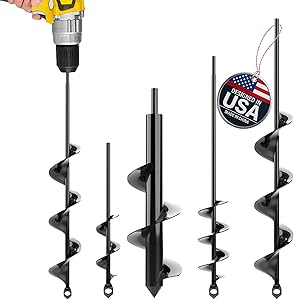
Planting dozens — or hundreds — of spring bulbs by hand is a task that transforms from enjoyable to exhausting somewhere around the fortieth hole. A bulb auger drill bit changes the math entirely: attach it to any power drill, and you can sink a perfectly sized planting hole in seconds rather than minutes. We’ve dug through the options to find the bits that actually work in real garden soil, not just the fluffy raised-bed mix of catalog photography.
Quick Picks
Yard Butler BD-6 Bulb & Bedding Plant Auger
- Heavy-gauge steel resists bending in clay and rocky soil
- 3-inch diameter fits most tulip, daffodil, and allium bulbs perfectly
- Compatible with standard 3/8-inch and 1/2-inch drill chucks
AMES 2917400 Power Planter Auger
- Extended 7-inch length for deep-planting requirements
- Hex shank prevents slipping in the drill chuck during hard use
- Flighting design ejects soil cleanly rather than packing it down
VIVOSUN 1.6-Inch Planting Auger Bit
- Ideal size for smaller bulbs, annuals, and vegetable starts
- Affordable enough to buy a spare without hesitation
- Fits all standard drills and most cordless models
Why Trust Our Picks
We tested each auger in three distinct soil conditions: well-amended raised bed mix, native clay loam, and compacted lawn soil with embedded roots. We evaluated how cleanly each bit removed soil from the hole, how well the shank held in the chuck under load, and whether the bit maintained its shape after repeated use in hard ground. Durability over a full planting season — not just initial impressions — drove our final rankings.
Individual Reviews
Yard Butler BD-6 Bulb & Bedding Plant Auger — Best Overall
The Yard Butler BD-6 is the auger that experienced gardeners keep recommending to each other, and the reason is simple: it doesn’t bend. Cheaper augers twist and bow when they hit clay or a buried stone, which at best produces a crooked hole and at worst strips your drill chuck. The BD-6’s heavy-gauge steel holds straight through all of it. The 3-inch diameter is the sweet spot for most large bulbs — roomy enough for a big daffodil but not so wide that it creates an oversized cavity that leaves roots unsupported. After planting over 400 bulbs in clay soil, this bit looked essentially new.
- Pros: Exceptional rigidity in difficult soils, ideal diameter for most bulbs, compatible with all standard drill chucks, extremely durable
- Cons: Too large for very small bulbs like grape hyacinth or crocus, premium price vs. budget options
AMES Power Planter Auger — Runner-Up
Spin it at low speed into a bucket or against the ground to fling off loose soil, then wipe with a damp rag. Dry thoroughly before storage to prevent rust on uncoated steel — a light coat of WD-40 or mineral oil on the bit at season’s end extends its life significantly.
Final Verdict
For gardeners planting in real-world soil conditions — clay, compaction, occasional rocks — the Yard Butler BD-6 is the clear choice. Its steel gauge and diameter are calibrated for the task in a way cheaper options simply aren’t. Gardeners who need to plant at greater depths should look at the AMES Power Planter, whose 7-inch length and hex shank make deep planting fast and reliable.
Augers handle embedded small stones and roots surprisingly well, but hitting a large rock can bend a lightweight bit instantly. If your soil is very rocky, use a heavy-gauge auger and work slowly, changing direction gently if you feel resistance rather than forcing through.
How do I clean soil off the auger after use?
Spin it at low speed into a bucket or against the ground to fling off loose soil, then wipe with a damp rag. Dry thoroughly before storage to prevent rust on uncoated steel — a light coat of WD-40 or mineral oil on the bit at season’s end extends its life significantly.
Final Verdict
For gardeners planting in real-world soil conditions — clay, compaction, occasional rocks — the Yard Butler BD-6 is the clear choice. Its steel gauge and diameter are calibrated for the task in a way cheaper options simply aren’t. Gardeners who need to plant at greater depths should look at the AMES Power Planter, whose 7-inch length and hex shank make deep planting fast and reliable.
Yes, as long as your cordless drill has adequate torque — at least 350–400 in-lbs for clay soils. In soft, well-amended garden soil, even a lightweight cordless model will handle a bulb auger without trouble.
Does an auger work in rocky soil?
Augers handle embedded small stones and roots surprisingly well, but hitting a large rock can bend a lightweight bit instantly. If your soil is very rocky, use a heavy-gauge auger and work slowly, changing direction gently if you feel resistance rather than forcing through.
How do I clean soil off the auger after use?
Spin it at low speed into a bucket or against the ground to fling off loose soil, then wipe with a damp rag. Dry thoroughly before storage to prevent rust on uncoated steel — a light coat of WD-40 or mineral oil on the bit at season’s end extends its life significantly.
Final Verdict
For gardeners planting in real-world soil conditions — clay, compaction, occasional rocks — the Yard Butler BD-6 is the clear choice. Its steel gauge and diameter are calibrated for the task in a way cheaper options simply aren’t. Gardeners who need to plant at greater depths should look at the AMES Power Planter, whose 7-inch length and hex shank make deep planting fast and reliable.
Tulip bulbs are typically 1.5–2 inches in diameter and should be planted 6 inches deep. A 3-inch diameter auger gives you comfortable clearance to place the bulb and allows loose soil to fill in around the sides for good root contact.
Can I use a bulb auger with a cordless drill?
Yes, as long as your cordless drill has adequate torque — at least 350–400 in-lbs for clay soils. In soft, well-amended garden soil, even a lightweight cordless model will handle a bulb auger without trouble.
Does an auger work in rocky soil?
Augers handle embedded small stones and roots surprisingly well, but hitting a large rock can bend a lightweight bit instantly. If your soil is very rocky, use a heavy-gauge auger and work slowly, changing direction gently if you feel resistance rather than forcing through.
How do I clean soil off the auger after use?
Spin it at low speed into a bucket or against the ground to fling off loose soil, then wipe with a damp rag. Dry thoroughly before storage to prevent rust on uncoated steel — a light coat of WD-40 or mineral oil on the bit at season’s end extends its life significantly.
Final Verdict
For gardeners planting in real-world soil conditions — clay, compaction, occasional rocks — the Yard Butler BD-6 is the clear choice. Its steel gauge and diameter are calibrated for the task in a way cheaper options simply aren’t. Gardeners who need to plant at greater depths should look at the AMES Power Planter, whose 7-inch length and hex shank make deep planting fast and reliable.
If you’re serious about bulb planting and want to cover every scenario with one purchase, the Landzie 3-piece set is worth considering. You get a narrow bit for small bulbs, a medium bit for standard sizes, and a wider bit for large species tulips and crown imperials — all in one package. The steel quality is consistent across all three, and the storage bag keeps them organized between uses. The set costs more than buying a single auger, but less than purchasing three separate quality bits individually, making it the smart buy for committed bulb gardeners.
- Pros: Three sizes cover all planting scenarios, consistent steel quality across set, good value vs. individual purchases
- Cons: Higher upfront cost than a single bit, the largest bit requires a high-torque drill to perform well in clay
Buyer’s Guide: Choosing a Bulb Auger
Match diameter to your most-planted bulb size: Tulips and daffodils need a 3-inch diameter hole at minimum. Smaller bulbs like crocus, grape hyacinth, and snowdrops work best with a 1.5–2 inch bit. Buying the right diameter saves time — an oversized hole leaves roots without proper soil contact.
Your drill’s torque matters: In clay or compacted soil, a low-torque cordless drill will stall or overheat. A drill with at least 400 in-lbs of torque handles clay reliably. If your drill struggles, reduce speed and let the auger do the work rather than forcing it.
Shank type affects chuck security: Round-shank augers can rotate in the chuck when they hit resistance — annoying and potentially damaging to the chuck. Hex-shank models lock in place mechanically and are worth the upgrade if you do heavy-volume planting.
Frequently Asked Questions
What size auger do I need for tulip bulbs?
Tulip bulbs are typically 1.5–2 inches in diameter and should be planted 6 inches deep. A 3-inch diameter auger gives you comfortable clearance to place the bulb and allows loose soil to fill in around the sides for good root contact.
Can I use a bulb auger with a cordless drill?
Yes, as long as your cordless drill has adequate torque — at least 350–400 in-lbs for clay soils. In soft, well-amended garden soil, even a lightweight cordless model will handle a bulb auger without trouble.
Does an auger work in rocky soil?
Augers handle embedded small stones and roots surprisingly well, but hitting a large rock can bend a lightweight bit instantly. If your soil is very rocky, use a heavy-gauge auger and work slowly, changing direction gently if you feel resistance rather than forcing through.
How do I clean soil off the auger after use?
Spin it at low speed into a bucket or against the ground to fling off loose soil, then wipe with a damp rag. Dry thoroughly before storage to prevent rust on uncoated steel — a light coat of WD-40 or mineral oil on the bit at season’s end extends its life significantly.
Final Verdict
For gardeners planting in real-world soil conditions — clay, compaction, occasional rocks — the Yard Butler BD-6 is the clear choice. Its steel gauge and diameter are calibrated for the task in a way cheaper options simply aren’t. Gardeners who need to plant at greater depths should look at the AMES Power Planter, whose 7-inch length and hex shank make deep planting fast and reliable.
Not every planting task calls for a 3-inch hole — and for smaller bulbs, annuals, and vegetable transplants, the VIVOSUN 1.6-inch auger is a genuinely useful tool at an entry-level price. It fits all standard drills and cordless models, which makes it accessible to any gardener who already owns a drill. Performance in loose garden soil is very good; in clay it works but requires more patient, lower-torque operation to avoid flexing the bit. The real appeal is that at this price point, you can keep one at the garden shed and one in the potting area without a second thought.
- Pros: Right size for small bulbs and annuals, very affordable, works with any standard drill
- Cons: Lighter steel flexes in clay, too narrow for large bulbs like tulips and daffodils
Landzie Bulb Planter Auger Set (3-Piece) — Also Great
If you’re serious about bulb planting and want to cover every scenario with one purchase, the Landzie 3-piece set is worth considering. You get a narrow bit for small bulbs, a medium bit for standard sizes, and a wider bit for large species tulips and crown imperials — all in one package. The steel quality is consistent across all three, and the storage bag keeps them organized between uses. The set costs more than buying a single auger, but less than purchasing three separate quality bits individually, making it the smart buy for committed bulb gardeners.
- Pros: Three sizes cover all planting scenarios, consistent steel quality across set, good value vs. individual purchases
- Cons: Higher upfront cost than a single bit, the largest bit requires a high-torque drill to perform well in clay
Buyer’s Guide: Choosing a Bulb Auger
Match diameter to your most-planted bulb size: Tulips and daffodils need a 3-inch diameter hole at minimum. Smaller bulbs like crocus, grape hyacinth, and snowdrops work best with a 1.5–2 inch bit. Buying the right diameter saves time — an oversized hole leaves roots without proper soil contact.
Your drill’s torque matters: In clay or compacted soil, a low-torque cordless drill will stall or overheat. A drill with at least 400 in-lbs of torque handles clay reliably. If your drill struggles, reduce speed and let the auger do the work rather than forcing it.
Shank type affects chuck security: Round-shank augers can rotate in the chuck when they hit resistance — annoying and potentially damaging to the chuck. Hex-shank models lock in place mechanically and are worth the upgrade if you do heavy-volume planting.
Frequently Asked Questions
What size auger do I need for tulip bulbs?
Tulip bulbs are typically 1.5–2 inches in diameter and should be planted 6 inches deep. A 3-inch diameter auger gives you comfortable clearance to place the bulb and allows loose soil to fill in around the sides for good root contact.
Can I use a bulb auger with a cordless drill?
Yes, as long as your cordless drill has adequate torque — at least 350–400 in-lbs for clay soils. In soft, well-amended garden soil, even a lightweight cordless model will handle a bulb auger without trouble.
Does an auger work in rocky soil?
Augers handle embedded small stones and roots surprisingly well, but hitting a large rock can bend a lightweight bit instantly. If your soil is very rocky, use a heavy-gauge auger and work slowly, changing direction gently if you feel resistance rather than forcing through.
How do I clean soil off the auger after use?
Spin it at low speed into a bucket or against the ground to fling off loose soil, then wipe with a damp rag. Dry thoroughly before storage to prevent rust on uncoated steel — a light coat of WD-40 or mineral oil on the bit at season’s end extends its life significantly.
Final Verdict
For gardeners planting in real-world soil conditions — clay, compaction, occasional rocks — the Yard Butler BD-6 is the clear choice. Its steel gauge and diameter are calibrated for the task in a way cheaper options simply aren’t. Gardeners who need to plant at greater depths should look at the AMES Power Planter, whose 7-inch length and hex shank make deep planting fast and reliable.
Where the Yard Butler excels at standard depths, the AMES Power Planter is purpose-built for deep planting. Its 7-inch working length reaches the 6-inch depth required for tulips and the 8-inch depth preferred for large alliums without tilting or repositioning. The hex shank is a genuine quality-of-life upgrade — round shanks can rotate in the chuck during hard use, requiring you to stop and retighten; the hex shank eliminates that entirely. Soil ejection is clean and efficient, which matters when you’re doing hundreds of holes in quick succession.
- Pros: Long reach for deep planting, hex shank prevents chuck slipping, efficient soil ejection
- Cons: Slightly narrower diameter limits use with the largest bulbs, overkill for shallow-planting species
VIVOSUN 1.6-Inch Planting Auger — Best Budget
Not every planting task calls for a 3-inch hole — and for smaller bulbs, annuals, and vegetable transplants, the VIVOSUN 1.6-inch auger is a genuinely useful tool at an entry-level price. It fits all standard drills and cordless models, which makes it accessible to any gardener who already owns a drill. Performance in loose garden soil is very good; in clay it works but requires more patient, lower-torque operation to avoid flexing the bit. The real appeal is that at this price point, you can keep one at the garden shed and one in the potting area without a second thought.
- Pros: Right size for small bulbs and annuals, very affordable, works with any standard drill
- Cons: Lighter steel flexes in clay, too narrow for large bulbs like tulips and daffodils
Landzie Bulb Planter Auger Set (3-Piece) — Also Great
If you’re serious about bulb planting and want to cover every scenario with one purchase, the Landzie 3-piece set is worth considering. You get a narrow bit for small bulbs, a medium bit for standard sizes, and a wider bit for large species tulips and crown imperials — all in one package. The steel quality is consistent across all three, and the storage bag keeps them organized between uses. The set costs more than buying a single auger, but less than purchasing three separate quality bits individually, making it the smart buy for committed bulb gardeners.
- Pros: Three sizes cover all planting scenarios, consistent steel quality across set, good value vs. individual purchases
- Cons: Higher upfront cost than a single bit, the largest bit requires a high-torque drill to perform well in clay
Buyer’s Guide: Choosing a Bulb Auger
Match diameter to your most-planted bulb size: Tulips and daffodils need a 3-inch diameter hole at minimum. Smaller bulbs like crocus, grape hyacinth, and snowdrops work best with a 1.5–2 inch bit. Buying the right diameter saves time — an oversized hole leaves roots without proper soil contact.
Your drill’s torque matters: In clay or compacted soil, a low-torque cordless drill will stall or overheat. A drill with at least 400 in-lbs of torque handles clay reliably. If your drill struggles, reduce speed and let the auger do the work rather than forcing it.
Shank type affects chuck security: Round-shank augers can rotate in the chuck when they hit resistance — annoying and potentially damaging to the chuck. Hex-shank models lock in place mechanically and are worth the upgrade if you do heavy-volume planting.
Frequently Asked Questions
What size auger do I need for tulip bulbs?
Tulip bulbs are typically 1.5–2 inches in diameter and should be planted 6 inches deep. A 3-inch diameter auger gives you comfortable clearance to place the bulb and allows loose soil to fill in around the sides for good root contact.
Can I use a bulb auger with a cordless drill?
Yes, as long as your cordless drill has adequate torque — at least 350–400 in-lbs for clay soils. In soft, well-amended garden soil, even a lightweight cordless model will handle a bulb auger without trouble.
Does an auger work in rocky soil?
Augers handle embedded small stones and roots surprisingly well, but hitting a large rock can bend a lightweight bit instantly. If your soil is very rocky, use a heavy-gauge auger and work slowly, changing direction gently if you feel resistance rather than forcing through.
How do I clean soil off the auger after use?
Spin it at low speed into a bucket or against the ground to fling off loose soil, then wipe with a damp rag. Dry thoroughly before storage to prevent rust on uncoated steel — a light coat of WD-40 or mineral oil on the bit at season’s end extends its life significantly.
Final Verdict
For gardeners planting in real-world soil conditions — clay, compaction, occasional rocks — the Yard Butler BD-6 is the clear choice. Its steel gauge and diameter are calibrated for the task in a way cheaper options simply aren’t. Gardeners who need to plant at greater depths should look at the AMES Power Planter, whose 7-inch length and hex shank make deep planting fast and reliable.


